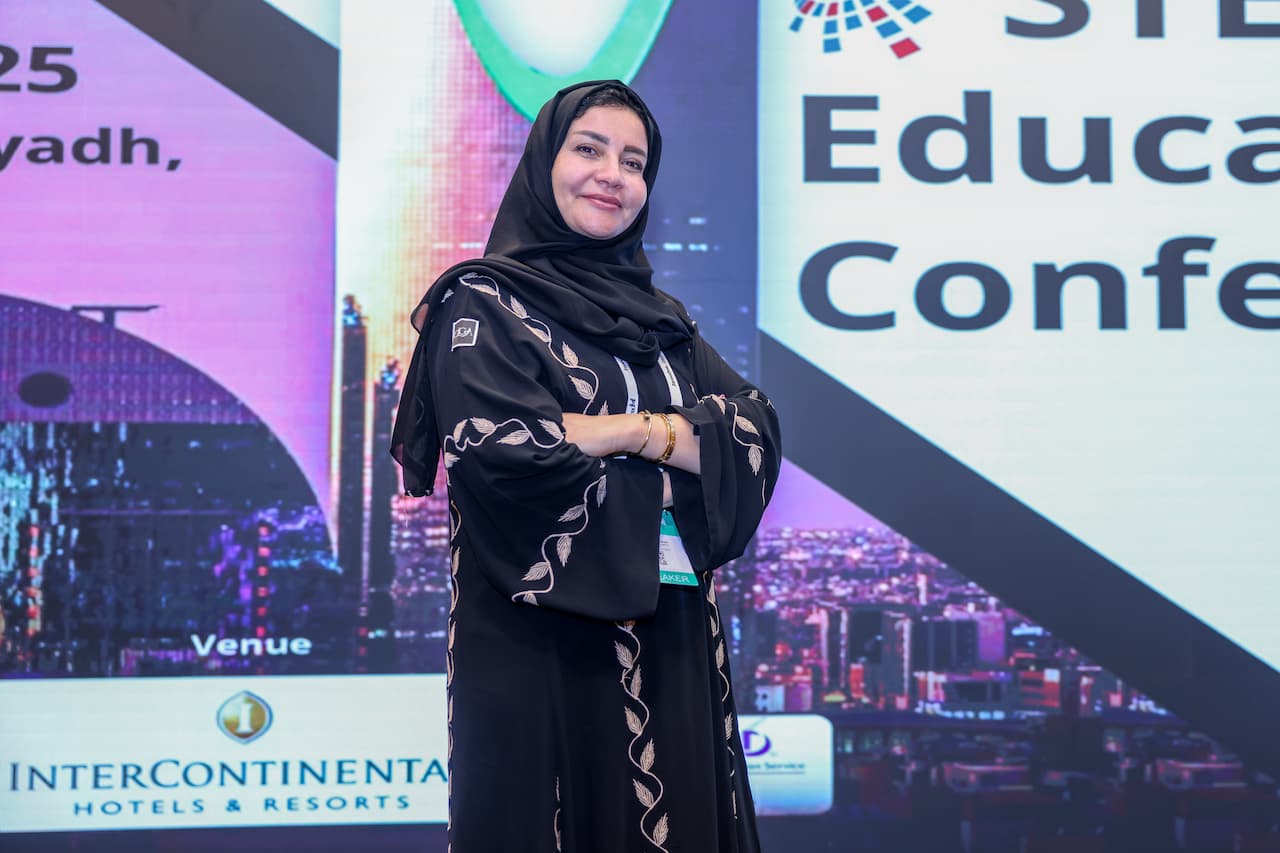
In a world where education systems struggle to keep pace with technological advancement and societal needs, Rania Abdelfattah Obeid stands as a beacon of transformative change. Her journey from a curious educator to a globally recognized STEM advocate represents more than professional growth; it embodies a mission to revolutionize how we prepare students for a future that demands both technical proficiency and purposeful innovation.
“From the earliest stages of my career, I was fascinated by the intersection between science, technology, and human potential,” Rania reflects on her foundational calling. This intersection would become the cornerstone of her life’s work, driving her to bridge the gap between traditional education and the rapidly evolving demands of the 21st century.
What began as an observation about education’s lag behind reality has evolved into a comprehensive philosophy of learning transformation. Rania saw STEM not merely as a collection of subjects but as “a philosophy of inquiry, problem-solving, and innovation.” This realization would shape her approach to educational consulting, where she seeks to scale impact beyond individual classrooms to entire educational ecosystems.
THE TRAINER OF TRAINERS: MODELING CURIOSITY AND RESILIENCE
Rania’s certification as a Trainer of Trainers (TOT) and STEM specialist provided her with profound insights that continue to guide her leadership approach today. The dual revelation that educators themselves require continuous inspiration while educational leadership must fundamentally serve others has shaped her collaborative methodology.
“When I train teachers, I don’t just share techniques I model curiosity, resilience, and adaptability,” she explains. This philosophy transforms the traditional hierarchical model of professional development into something more dynamic and empowering. Rather than dictating methods, Rania guides schools and educators to discover their unique voice while maintaining alignment with global best practices.
Her approach recognizes that sustainable educational change requires educators who see themselves as both perpetual learners and inspiring mentors. This perspective keeps her work fresh and grounded, ensuring that theoretical frameworks translate into practical classroom transformations.
REDEFINING PURPOSE IN MODERN EDUCATION
At the heart of Rania’s educational philosophy lies the concept of purpose-driven learning, which she defines as “connecting knowledge to meaning.” In an era where information is abundant but meaning often remains elusive, this approach addresses a critical gap in contemporary education.
“It is no longer enough for students to ‘know’ something; they need to understand why it matters and how they can use it to make a difference,” Rania emphasizes. This philosophy manifests in practical applications where students engage with sustainability projects, develop coding solutions for real-world problems, and participate in design thinking challenges aligned with the United Nations Sustainable Development Goals.
The psychological impact of purpose-driven learning extends beyond academic achievement. When learners connect with a greater “why,” they develop the resilience necessary to persevere through challenging “how” processes. This connection between purpose and persistence represents a fundamental shift from compliance-based learning to engagement-driven education.
STRUCTURED CREATIVITY: THE ART OF JOYFUL RIGOR
One of Rania’s most innovative contributions to educational design is her concept of “structured creativity,” which elegantly balances academic rigor with joyful learning experiences. This approach acknowledges that standardization ensures alignment with international benchmarks while recognizing that joy serves as a crucial catalyst for deep learning.
Her methodology transforms potentially dry academic concepts into engaging challenges that maintain educational integrity while sparking student enthusiasm. For instance, she might present a standardized mathematics concept through a coding challenge where students design algorithms to optimize water usage in sustainable city models.
“By weaving storytelling, gamification, and hands-on design into structured curricula, I ensure that the experience is both rigorous and engaging,” Rania explains. This integration demonstrates that academic excellence and student enjoyment are not competing priorities but complementary elements of effective education.
BUILDING GLOBALLY COMPETITIVE, FUTURE-READY CURRICULA
Rania’s framework for developing globally competitive curricula reflects her deep understanding of the skills and competencies required for future success. Her approach integrates STEM disciplines with critical thinking, coding, artificial intelligence, and sustainability while building global citizenship through alignment with international frameworks.
The curriculum development process prioritizes digital literacy, collaboration, and entrepreneurial skills while fostering the adaptability necessary for navigating industries that do not yet exist. This forward-thinking approach recognizes that today’s students will enter careers that may be fundamentally different from current professional landscapes.
Her philosophy balances international standards with local cultural values, ensuring that students develop strong identity roots while preparing for global opportunities. This cultural grounding prevents educational globalization from becoming cultural homogenization, preserving diversity while building competency.
TRANSFORMING ACCREDITATION FROM COMPLIANCE TO EXCELLENCE
Rania’s approach to supporting schools through licensing and international accreditation processes exemplifies her commitment to genuine improvement over superficial compliance. Her methodology begins with comprehensive gap analysis of current practices, policies, and outcomes before developing alignment strategies with accreditation frameworks such as AdvancED or CIS.
The transformation process involves teacher training, governance strengthening, quality assurance system implementation, and the integration of STEM-driven innovation into educational programs. “My role is not just administrative but transformative: ensuring that the pursuit of accreditation results in genuine improvement rather than paperwork compliance,” she explains.
This approach transforms accreditation from a bureaucratic exercise into a meaningful development process that creates lasting institutional improvement and cultural change.
ADDRESSING URGENT EDUCATIONAL IMPERATIVES
Rania’s perspective on necessary educational reforms reflects her comprehensive understanding of current system limitations and future requirements. She advocates for fundamental shifts from rote learning to experiential learning while addressing specific skill gaps and systemic inequities.
Her reform agenda includes embedding coding, artificial intelligence, and robotics as core competencies rather than optional enhancements, rethinking assessment methodologies to measure creativity, collaboration, and problem-solving capabilities, closing gender participation gaps in STEM fields, and integrating sustainability across all subjects rather than treating it as an isolated unit.
“Above all, we must make education student-centered, with systems designed around the learner’s growth rather than bureaucratic convenience,” Rania emphasizes. This student-centric approach requires fundamental restructuring of educational priorities and administrative systems.
THE SUSTAINABLE SMART HOMES PROJECT: MEASURING TRANSFORMATIONAL SUCCESS
One of Rania’s most impactful projects involved guiding middle school students through the design of sustainable smart homes using coding and robotics integration. This interdisciplinary challenge combined engineering principles, programming skills, and environmental science knowledge while developing crucial soft skills.
The measurable outcomes extended beyond the regional STEM competition victory to include significant improvements in student confidence and teamwork capabilities. “Parents reported their children began seeing themselves as innovators rather than passive learners. For me, that transformation was the true success,” Rania reflects.
This project exemplifies her holistic approach to education, where academic achievement serves as a foundation for identity transformation and capability development. The students’ shift from passive recipients to active innovators represents the kind of fundamental change that sustainable educational reform requires.
NURTURING GIFTED AND TALENTED MINDS
Rania’s approach to identifying and nurturing gifted students reflects her understanding that intellectual giftedness requires comprehensive support extending beyond academic acceleration. She recognizes that gifted students often demonstrate curiosity, unconventional thinking, or intense focus on specific topics that require specialized attention.
Her differentiated learning strategies include project-based learning opportunities, advanced STEM challenges, and structured mentorship programs designed to provide appropriate intellectual stimulation while supporting emotional and social development. “Importantly, I balance acceleration with emotional support, ensuring gifted students develop resilience and social-emotional intelligence alongside their intellectual abilities,” she explains.
This balanced approach prevents the common pitfall of prioritizing intellectual development while neglecting the social and emotional needs that gifted students require for healthy development and long-term success.
INNOVATIVE EDUCATOR TRAINING THROUGH EXPERIENTIAL LEARNING
Rania’s methodology for training educators in innovative approaches demonstrates her commitment to modeling the teaching methods she advocates. Rather than lecturing about innovation, she immerses teachers in STEM design challenges, coding tasks, and sustainability projects that provide firsthand experience with student-centered, inquiry-driven learning.
“Instead of lecturing teachers about ‘innovation,’ I immerse them in STEM design challenges, coding tasks, and sustainability projects. They experience firsthand what student-centered, inquiry-driven learning feels like,” she explains. This experiential approach builds educator confidence while sparking the creativity necessary for classroom transformation.
The training process includes structured reflection and coaching components that help teachers translate their experiences into practical classroom applications, ensuring that professional development translates into sustained teaching practice changes.
HOLISTIC PREPARATION FOR INTERNATIONAL EXAMINATIONS
Rania’s approach to preparing students for international examinations such as IELTS, TOEFL, GRE, and SAT extends beyond content mastery to include essential skills like time management, test-taking strategies, and stress resilience. Her methodology integrates examination practice with technology through adaptive learning platforms that customize questions based on individual student weaknesses.
“Beyond test drills, I encourage reading, debate, and academic writing, so language and reasoning become part of daily learning rather than cramming,” she explains. This comprehensive approach addresses common challenges including test anxiety, format unfamiliarity, and limited academic English exposure through mindfulness strategies, frequent mock testing under realistic conditions, and targeted skill development.
For mathematics-heavy examinations, she employs coding exercises to teach problem-solving patterns, making quantitative reasoning both engaging and practically applicable to other learning contexts.
MENTORING GRADUATE STUDENTS FOR ACADEMIC AND CAREER SUCCESS
Rania’s approach to academic and career counseling for master’s and doctoral students reflects her role as both mentor and strategic advisor. She guides students through research goal clarification, global academic standard alignment, and strategic program or university selection while integrating career foresight that connects academic journeys with future workforce demands.
“For example, a Ph.D. in environmental engineering might benefit from coding skills for data modeling or AI for climate predictions,” she illustrates. This forward-thinking approach ensures that graduate education prepares students for evolving professional landscapes rather than static career paths.
Her mentorship recognizes that advanced degree pursuit represents both intellectual development and career investment, requiring strategic thinking about skill development and professional positioning.
RESEARCH AS THE FOUNDATION FOR EVIDENCE-BASED PRACTICE
Research serves as the backbone of Rania’s curriculum development work, ensuring that every recommendation relies on evidence-based practices informed by global studies on STEM education, cognitive science, and instructional design. Her commitment to research-informed practice extends to encouraging action research within schools, where teachers systematically study their own classroom practices.
“Every recommendation I make is evidence-based, informed by global studies on STEM education, cognitive science, and instructional design,” she explains. This approach ensures that curriculum design maintains both global relevance and local validation through systematic inquiry and continuous improvement processes.
Her research focus contributes to the broader educational knowledge base while directly informing her consulting practice and professional development activities.
ACHIEVING INTEGRATION ACROSS MULTIPLE PROFESSIONAL ROLES
Rania’s success in balancing responsibilities as a STEM director, researcher, and speaker stems from her philosophy of integration rather than compartmentalization. Her research informs her speaking engagements, consulting projects fuel her research interests, and her leadership role grounds both activities in practical application.
“Balance comes from integration. My research informs my speaking; my consulting projects fuel my research; and my leadership role grounds both in real-world practice,” she explains. This synergistic approach creates coherence across her various professional activities while amplifying their collective impact.
She also emphasizes the importance of intentional rest and reflection, modeling work-life balance for the educators she mentors because sustainable leadership requires personal resilience and renewal.
MAKING EMERGING TECHNOLOGIES ACCESSIBLE AND MEANINGFUL
Rania’s approach to engaging students and educators with emerging technologies like artificial intelligence and robotics emphasizes practical problem-solving over abstract conceptualization. She introduces these technologies as tools for addressing meaningful challenges rather than as ends in themselves.
Students might program robots to plant seeds in school gardens or use artificial intelligence to analyze energy consumption patterns, creating tangible connections between advanced technology and real-world applications. Educators receive training that positions these technologies as extensions of critical thinking and design rather than as separate technical skills.
This approach ensures that technology integration enhances rather than replaces fundamental educational processes while preparing students for a future where such technologies will be commonplace professional tools.
ADVANCING INCLUSIVITY AND EQUITY IN STEM EDUCATION
Rania’s commitment to inclusivity and equity in STEM education recognizes that representation significantly impacts participation and achievement. Her strategies include highlighting female role models, creating structured mentorship programs, and designing challenges that connect to real-life contexts relevant to girls and underrepresented groups.
“Representation matters. I highlight female role models in STEM, create mentorship programs, and design challenges that connect to real-life contexts relevant to girls and underrepresented groups,” she explains. Her approach also includes scholarship opportunities, differentiated pathways, and community engagement initiatives.
Her philosophy maintains that inclusivity means expanding opportunities rather than lowering standards, ensuring that all students receive appropriate support for achieving excellence rather than accepting diminished expectations.
INTEGRATING SUSTAINABLE DEVELOPMENT GOALS INTO EDUCATIONAL PRACTICE
Every STEM project that Rania designs maps to at least one United Nations Sustainable Development Goal, providing students with a global framework for purpose-driven innovation while helping them envision themselves as changemakers. Coding projects for water conservation applications align with Clean Water and Sanitation goals, while robotics projects in renewable energy connect with Affordable and Clean Energy objectives.
“This gives students a global framework for purpose-driven innovation and helps them see themselves as changemakers,” she explains. This integration ensures that educational activities contribute to broader social objectives while providing students with meaningful contexts for learning application.
The SDG framework also helps students understand global interconnections and their potential roles in addressing worldwide challenges through local and regional actions.
PRACTICAL WISDOM FOR EDUCATIONAL TRANSFORMATION
Rania’s advice to educators seeking greater creativity and innovation emphasizes starting with manageable changes that build confidence and competence. She recommends introducing design-thinking activities, simple coding projects, or sustainability-connected lessons while creating safe spaces where failure becomes feedback rather than judgment.
“Start small. Introduce a design-thinking activity, let students code simple projects, or connect a lesson to a sustainability challenge,” she suggests. Her emphasis on educator modeling recognizes that students mirror the mindset and behaviors of their teachers, making personal growth essential for classroom transformation.
Creating cultures where failure serves as learning feedback rather than performance judgment enables both educators and students to take the creative risks necessary for innovation and growth.
STAYING CURRENT IN A RAPIDLY EVOLVING FIELD
Rania maintains currency with evolving global education trends through dedicated weekly professional reading, international conference participation, and networking with global experts. Her information sources include academic journals, educational technology forums, and collaborative relationships with universities worldwide.
“Staying current is not a luxury it’s a professional duty for any educator who wants to prepare students for the future,” she emphasizes. This commitment reflects her understanding that educational leadership requires continuous learning and adaptation to serve student needs effectively.
Her global perspective ensures that local educational initiatives benefit from international best practices while contributing to worldwide conversations about educational improvement and innovation.
DELIVERING A TRANSFORMATIVE MESSAGE TO GLOBAL AUDIENCES
As a public speaker and educational influencer, Rania’s core message emphasizes empowerment over information transfer: “education is not about filling minds, but about empowering lives.” Through STEM integration, sustainability focus, and innovation emphasis, she advocates for transforming classrooms into incubators for solutions to pressing global challenges.
Her speaking engagements consistently reinforce the message that every educator and student possesses the potential to catalyze positive change through purposeful learning and application. This empowerment message resonates across cultural and institutional contexts while providing practical frameworks for implementation.
Her influence extends beyond individual presentations to shape educational policy discussions and institutional strategic planning processes throughout the region and internationally.
A LEGACY OF EMPOWERMENT AND INNOVATION
Rania’s vision for her long-term impact extends beyond individual achievements to systematic and cultural transformation that continues empowering learners long after her direct involvement. Her dream centers on developing educational systems, curricula, and mindsets that sustain positive change across generations.
“My dream legacy is a generation of students especially in the Arab world who are globally competitive, locally grounded, and passionately committed to sustainability and innovation,” she reflects. This vision balances international competitiveness with cultural rootedness while emphasizing values-driven innovation.
Her success metric remains deeply personal and practical: if one student applies coding skills to solve community challenges, or one educator embraces purpose-driven teaching methods, her mission achieves meaningful fulfillment.
THE CONTINUING TRANSFORMATION
Rania Abdelfattah Obeid represents the evolution of educational leadership from content delivery to capability development, from institutional management to societal transformation. Her work demonstrates that sustainable educational change requires leaders who understand both global trends and local contexts, who can balance academic rigor with joyful learning, and who see education as a catalyst for addressing humanity’s greatest challenges.
As educational systems worldwide grapple with preparing students for an uncertain future, leaders like Rania provide essential guidance on maintaining purposeful focus while embracing innovative methods. Her example shows that transformative education emerges when technical expertise combines with moral purpose, when global perspective integrates with cultural sensitivity, and when individual empowerment serves collective advancement.
The future of education will be shaped by those who understand that true transformation requires both visionary thinking and practical implementation, both technological fluency and human wisdom. Rania’s career provides a compelling model for achieving this integration while creating lasting positive impact on learners, educators, and communities worldwide.