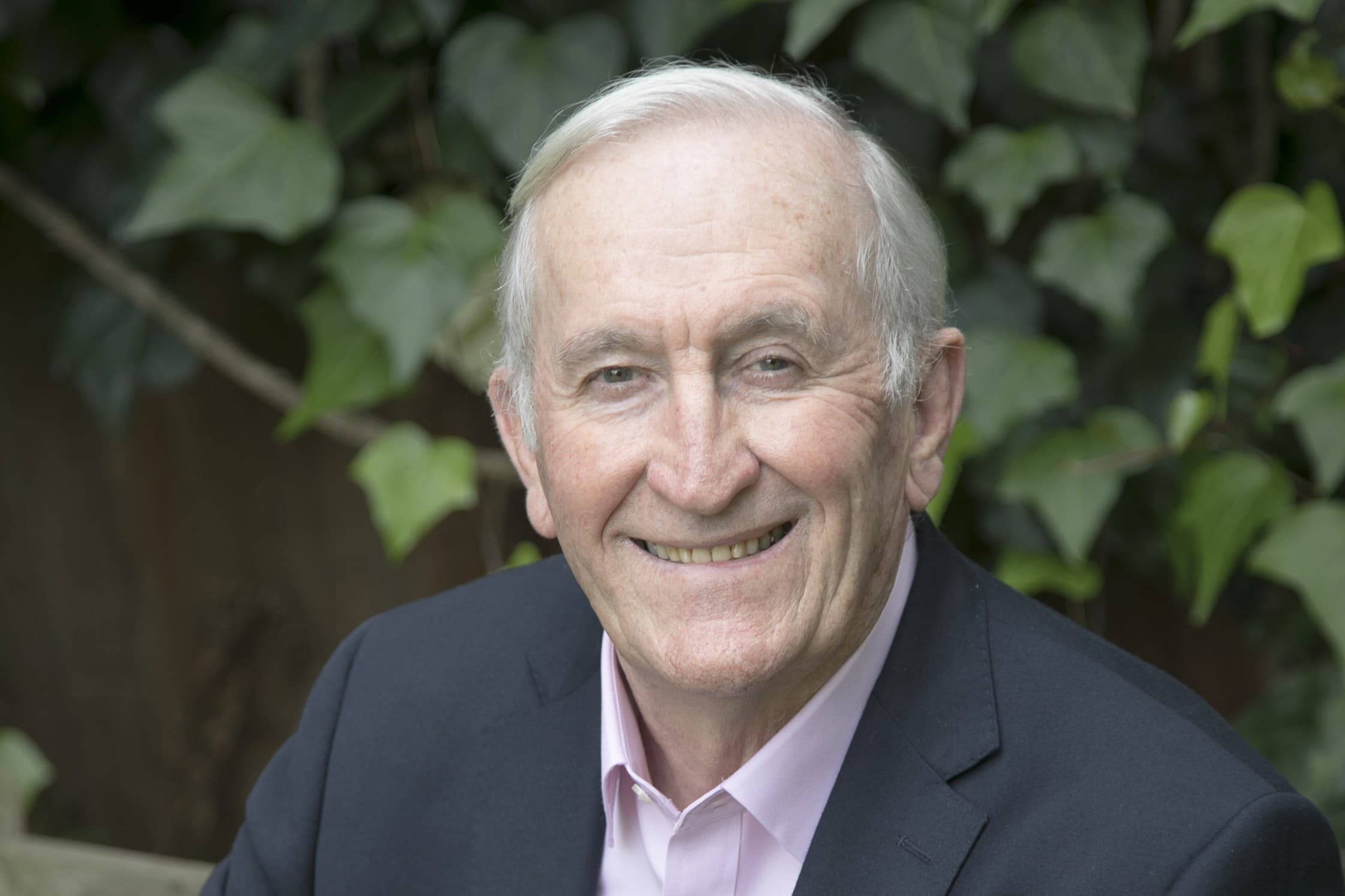
“All of us are brands ourselves and we have to shape and manage that brand as we climb the corporate tree. The personal qualities that matter are vision, integrity and courage to build a meaningful career.”
-Dr. James Espey OBE
In the pantheon of business legends, few can claim to have invented an entirely new category of consumer experience. Dr. James Espey OBE stands among this rare breed. His career reads like a masterclass in brand alchemy, where vision meets courage, and patience produces billion-pound returns.
The story begins in 1977, when a young Espey was brought from South Africa to England to head up global marketing at International Distillers & Vintners, with particular focus on a fledgling product called Baileys Irish Cream. What happened next would reshape the spirits industry forever.
“Baileys was invented in 1974 initially because the Irish government gave tax incentives for exports,” But what started as a tax-driven experiment became something far more significant. Espey transformed the formula in 1978 to ensure liquid stability and positioned it not as a novelty but as a serious liqueur. The strategy was deceptively simple yet profoundly effective: focus all communication on credibility, but above all, get people to taste it.
Today, Baileys sells 8 million cases annually. That number represents more than commercial success. It represents the power of believing in a product when others saw only a curious Irish concoction, and the discipline to build a brand with unwavering focus on quality and storytelling.
THE INNOVATION THAT CHANGED WHISKY LABELING FOREVER
If the Baileys story demonstrated Espey’s ability to build categories, his work at United Distillers proved his capacity to innovate within established traditions. In 1986, he joined the Distillers Company to work with their leading brand, Johnnie Walker amongst others. Reuniting with his innovation partner Tom Jago from IDV, they set out to create something unprecedented.
The result was Johnnie Walker Oldest, a superb blend of 15-year-old whisky enhanced with touches of 60-year-old spirit. Rather than follow convention, they labelled it honestly: Johnnie Walker Oldest 15 to 60 year old. The product took off immediately.
But the story doesn’t end there. After leaving the company, Espey noticed in Taiwan that the distributor was misleadingly marketing it as 60-year-old whisky. His response reveals the integrity that defines his career. He got the law changed. Today, regulations require that only the youngest age of any whisky in a blend can be mentioned. If there’s no age statement, as Espey notes with characteristic directness, “it may be a superb whisky but usually never as old as it pretends to be.”
This wasn’t just about one brand. Espey reshaped industry standards to protect consumers and ensure honesty prevailed over marketing opportunism. Few leaders possess both the influence and the conviction to change laws when principles are at stake.
THE CHIVAS DECISION: WHEN VISION COSTS YOU YOUR JOB
Perhaps no episode in Espey’s career better illustrates his philosophy than his tenure as Chief Executive of Chivas Bros at Seagram in 1992. At 49, he negotiated terms that reflected both ambition and realism: a minimum three-year contract with two years rolling notice, and critically, $100 million in investment.
The allocation told the story of his priorities. Ten million would upgrade distilleries. The remaining ninety million would go into laying down and building stock, with the goal of growing from less than 2 million cases annually to about 5 million over twenty years.
Then in 1997 Espey launched Chivas Regal 18 to compete with Johnnie Walker Blue Label, the ultra-premium product he had created in a previous role. The family owners disagreed with his long-term strategy. Rather than compromise his vision, Espey negotiated retirement on his 55th birthday.
“I have always stuck to my principles but at times it has meant I was faced with difficult decisions,” Espey reflects on this pivotal moment. The decision cost him his position but vindicated his vision spectacularly.
Twenty-seven years later, Pernod Ricard, which now owns Chivas Bros, invited Espey and his wife to Scotland as VIP guests. The Chairman wanted to personally thank him for decisions taken nearly three decades earlier. Chivas Bros now sells well over 5 million cases annually. Chivas Regal 18 is the number one 18-year-old whisky in the world, with sales exceeding 400,000 cases per annum. The company has made billions of pounds as a direct result of Espey’s strategy.
The vindication arrived decades late, but it arrived absolutely. This is what separating visionaries from managers looks like in practice.
BUILDING TEAMS THAT OUTLAST INDIVIDUALS
Throughout his career, Espey has maintained an unwavering focus on the human foundation of business success. “I believe strongly in TEAM – together everyone achieves more. There is no I in team,” he emphasizes, articulating a philosophy that has guided his leadership across multiple organizations and continents.
But Espey’s approach to team building goes beyond motivational slogans. It reflects a sophisticated understanding of organizational dynamics and human psychology. His views on governance cut through corporate bureaucracy with refreshing clarity. “I do not believe much in committees but prefer strong Advisory Boards. A camel is a racehorse designed by a committee,” he observes with characteristic wit.
This preference for decisive leadership over consensus-driven mediocrity extends to his approach to corporate structure. Espey believes in building strong teams with long-term perspectives who understand the importance of delegation. “You cannot keep a pack of dogs and do all the barking yourself,” he notes, capturing the essence of effective leadership in a single memorable phrase.
His opposition to short-term bonuses reveals deeper thinking about organizational health and sustainability. “I am very opposed to short term bonuses, which create unnecessary pressure and burn-out,” Espey explains. When people live on bonuses, they cannot take a long-term view of the company. Instead, Espey advocates for long-term incentives, patience, and tenacity, an approach that not only builds sustainable businesses but also protects the mental wellbeing of teams.
THE TRUTH ABOUT BRAND BUILDING THAT NOBODY WANTS TO HEAR
In an era obsessed with viral success and overnight disruption, Espey brings sobering wisdom born from building multiple billion-pound brands. “Sadly, too many people underestimate how long it takes to build a brand,” he observes. “I usually say it takes twice as much money and twice as long to break even.”
His formula is brutally honest: “Turnover is for vanity, profit for sanity and only cash is reality.” These aren’t pessimistic warnings but rather realistic frameworks from someone who has actually built enduring brands rather than just talked about them.
What makes a great brand? Espey’s answer reflects his decades at the intersection of product excellence and consumer psychology. “Great brands start by being a superb product with a strong story, which resonates with consumer,” he explains. But the product and story alone are insufficient. You also need good global distributors and ambassadors who ensure the brand remains relevant in the countries where it’s sold.
In today’s digital world, Espey notes, there is no place to hide. This reality demands reasonably consistent pricing, quality packaging, quality liquid, and above all, a superb credible story. “The story about the brand is more than ever critical in ensuring long term loyalty,” he emphasizes.
This isn’t marketing theory. This is the distilled wisdom of someone who changed how the world drinks cream liqueur, who innovated within whisky’s most traditional categories, and who built brands that generate billions in value decades after his strategic decisions.
SHAPING PERSONAL BRANDS IN THE CORPORATE WORLD
Espey’s insights extend beyond corporate brands to personal career development. His advice to emerging professionals reflects both pragmatism and ambition. “All of us are brands ourselves and we have to shape and manage that brand as we climb the corporate tree,” he notes.
The personal qualities that matter, in Espey’s view, are vision, integrity, and courage. “Too many people are happy to be bureaucrats in large organisations muddling along,” he observes with characteristic directness. While not everyone has the ability or interest to create their own brand, those seeking significant financial success need the courage to do so.
For those starting their careers today, Espey recommends seeking mentorship and requesting six-monthly honest reviews. The approach should combine professed loyalty to the company with proactive questions about what else you can do to learn and advance your career. If fortunate, the firm may even pay for additional education.
He recalls recommending a very bright executive be sent to Harvard some twenty years ago while sitting on a public board. That executive shortly thereafter became Chief Executive and is now the first non-family Chairman. Strategic investment in talent development creates returns that compound across decades.
RESPECTING CULTURE IN A BORDERLESS WORLD
Having travelled extensively throughout his career, Espey has developed a sophisticated appreciation for cultural intelligence in global business. “Today we all live in a global village and there is nowhere to hide,” he observes. “All leaders need to have respect for different culture, religions and way of life.”
His approach was always hands-on and personal. Wherever he visited a country, Espey insisted on eating local food and respecting local culture. He made it a practice to learn courteous words like please and thank you in the local language, recognizing that English may be a third or fourth language for his business partners.
“As a British citizen, who was born in Zambia, I try and have respect for all cultures, which is sadly lacking in too many despotic, autocratic environments,” Espey reflects. This isn’t performative multiculturalism but practical wisdom. Respect for culture translates directly into business effectiveness and human connection.
CHAMPIONING MENTAL WELLBEING IN BUSINESS
Beyond brand building and strategic leadership, Espey has been a passionate advocate for mental health in the workplace. “The most important asset in the company is the people in the company and if they have mental issues they personally are not effective, which means that both the individuals and the company are losers,” he explains.
His commitment stems from both principle and pragmatism. All companies need to openly address mental wellbeing to ensure the best possible health of their teams. This benefits both society and the companies themselves, creating a virtuous cycle where human flourishing and business success reinforce each other.
This focus on mental health connects directly to his opposition to short-term bonus cultures that create unnecessary pressure and burnout. Espey’s vision of sustainable business recognizes that long-term success requires long-term investment in human capital, not just financial capital.
WITCHMARK: THE FINAL CHAPTER IN A LEGENDARY CAREER
At an age when most accomplished executives rest on their laurels, Espey is building again. As Chairman of a startup English whisky company (www.wiltshiredistilling.com), he is applying five decades of brand-building wisdom to create Witchmark, with the ambitious goal of making it the leading English whisky in the world over the next ten years.
The venture reflects everything Espey has learned about patience, quality, and environmental responsibility. The company currently produces superb gin and vodka while more than 1,000 barrels of whisky sleep, waiting for release in the coming years. Every decision reflects a commitment to environmental responsibility and long-term value creation. www.wiltshiredistilling.com
“Witchmark is the last brand I intend to be actively involved with and I look forward to global success before my 90th birthday,” Espey declares with the confidence of someone who has built billion-pound brands before and knows exactly what success requires.
Additionally, Espey remains actively involved as an investor in about ten startups, acknowledging with characteristic honesty that some will fail. This continued engagement reveals a leader who hasn’t just accumulated wisdom but remains committed to applying it, testing it, and sharing it with the next generation of entrepreneurs.
THE LEGACY OF PRINCIPLED INNOVATION
Dr. James Espey OBE’s career offers a masterclass in how vision, integrity, and patience create enduring value. From transforming Baileys into a global phenomenon to changing whisky labelling laws, from sacrificing position for principle at Chivas to being vindicated spectacularly decades later, his journey demonstrates that doing the right thing and doing profitable things are not opposing forces but complementary strategies.
His influence extends beyond the brands he built to the standards he established, the laws he changed, and the leaders he mentored. In an industry often focused on quarterly results, Espey proved that thinking in decades produces results measured in billions.
As he builds Witchmark and invests in startups, Espey continues demonstrating that true entrepreneurs never really retire. They simply find new challenges worthy of their accumulated wisdom. For emerging leaders seeking a model of how to build brands, lead teams, and maintain integrity across a career spanning continents and decades, Espey’s story provides both inspiration and instruction.
The most important lesson may be the simplest: great brands, like great careers, are built on superb products with strong stories that resonate with people. Everything else is detail. But as Espey has proven repeatedly, getting those details right, and being willing to fight for them even at personal cost, makes all the difference between fleeting success and legendary impact.