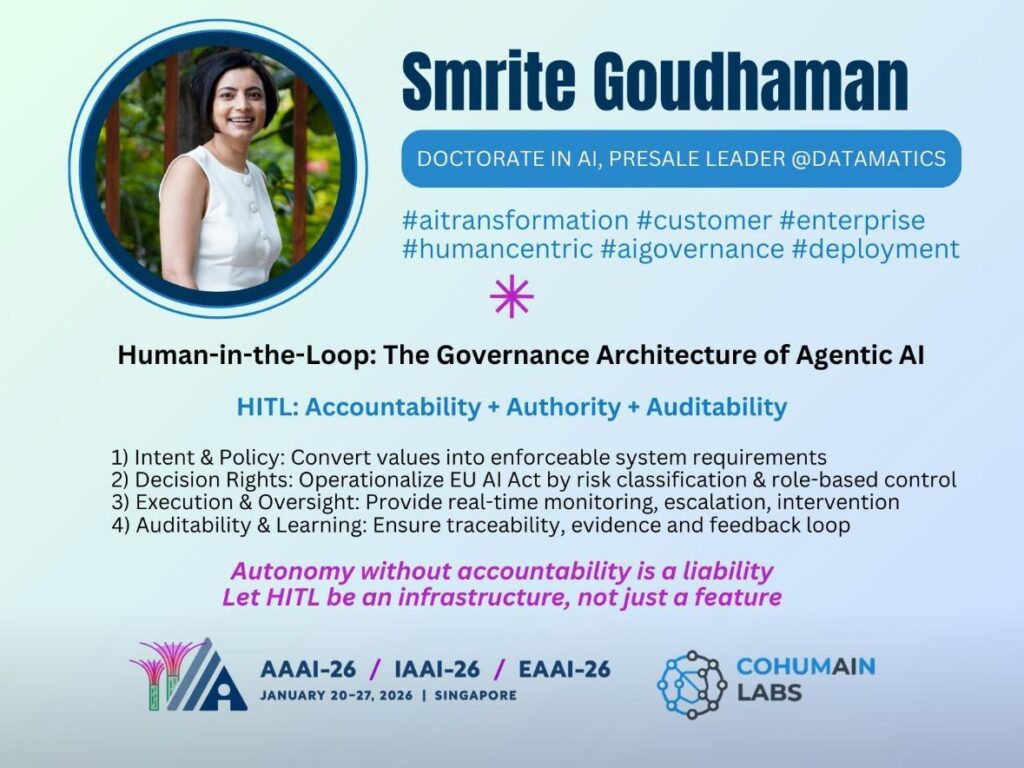
“Artificial intelligence should enhance human capability, not replace human judgment.”
-Dr. Smrite Goudhaman
As artificial intelligence rapidly transforms industries, organizations around the world are grappling with an important question: how can intelligent systems drive innovation without losing sight of the people they are meant to serve?
Few professionals are exploring this balance as thoughtfully as Dr. Smrite Goudhaman, a technology leader who has spent more than fifteen years working at the intersection of artificial intelligence, enterprise transformation, and responsible innovation.
Serving as a Pre-Sales Solutions Leader at Datamatics Global Services and an Adjunct Faculty member at Golden Gate University, Dr. Goudhaman brings a rare perspective that combines real-world industry experience with academic research. Her work focuses on designing human-centered AI systems that help organizations scale their operations while maintaining strong ethical governance and workforce empowerment.
In an era when automation is often viewed as a replacement for human effort, Dr. Goudhaman advocates a different approach, one where intelligent systems enhance human capability rather than diminish it. She believes that artificial intelligence should function as a collaborative partner that strengthens human potential and enables organizations to operate with greater intelligence and responsibility.
This philosophy reflects a broader shift occurring within global enterprises. Companies are increasingly recognizing that successful AI adoption depends not only on technological sophistication but also on the ability to integrate intelligent systems within human environments.
A Career at the Intersection of Technology and People
Throughout her career, Dr. Goudhaman has worked closely with global enterprises navigating complex digital transformations. From automation initiatives to customer experience platforms and AI-driven decision systems, she has witnessed firsthand how organizations adopt and adapt to emerging technologies.
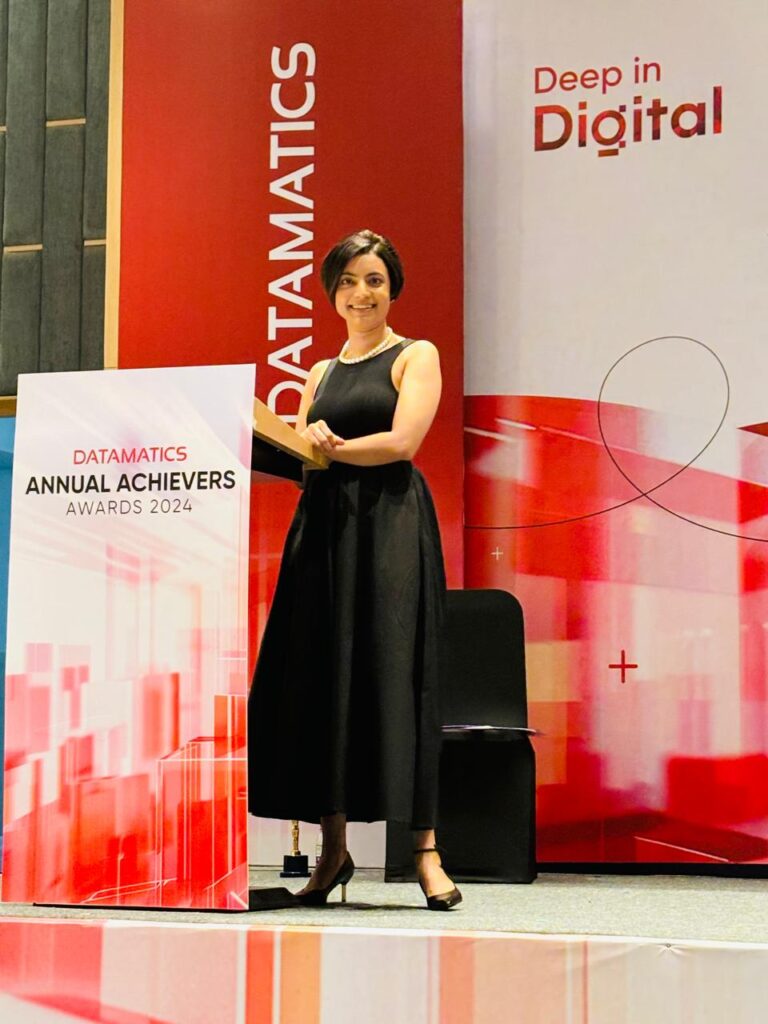
Her experience working with enterprise clients has provided deep insight into the practical challenges of implementing intelligent systems at scale. Organizations often begin their transformation journey with ambitious technological goals, yet many discover that technology alone cannot guarantee meaningful impact.
What Dr. Goudhaman discovered early in her professional journey was that technological sophistication alone does not guarantee success.
Many organizations initially approach automation with a focus on efficiency, expecting technology to streamline operations and reduce costs. While efficiency gains are certainly valuable, true transformation occurs only when systems integrate effectively with human workflows, organizational culture, and employee capabilities.
Through her work in enterprise solution design at Datamatics, Dr. Goudhaman observed that the most successful AI implementations were those that placed people at the center of the transformation process.
Frontline employees adapting to new tools, managers making data-driven decisions, and customers interacting with digital platforms all play critical roles in determining whether technology initiatives succeed.
These experiences reinforced an important lesson. Technology initiatives achieve long-term success only when they empower people rather than disrupt them.
This insight would later shape her broader philosophy that artificial intelligence must work alongside people, not independently of them.
Advancing Human-Centered AI
The concept of human-centered AI sits at the core of Dr. Goudhaman’s work and professional vision.
In enterprise environments, this approach means designing intelligent systems that support decision-making rather than replace it. Artificial intelligence should simplify complex tasks, provide actionable insights, and enable employees to focus on areas that require creativity, empathy, and strategic thinking.
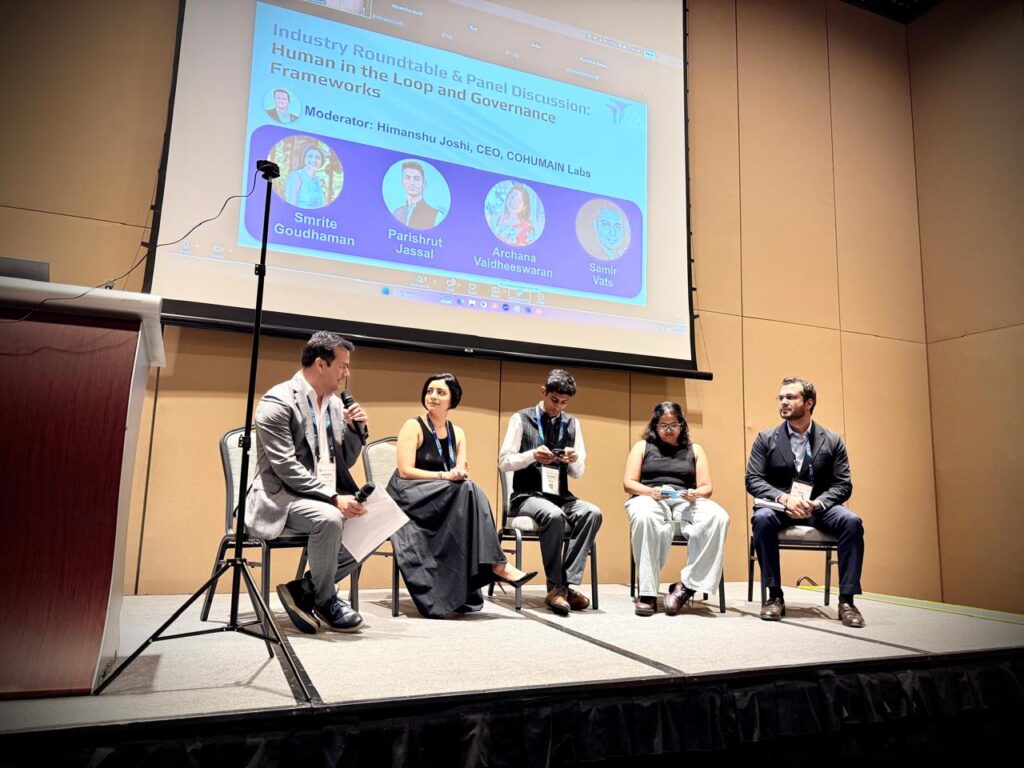
Human-centered AI is not simply about improving efficiency. It is about creating systems that strengthen collaboration between human intelligence and machine intelligence.
For example, in customer service environments, AI can analyze large volumes of interactions, identify patterns, and suggest responses in real time. However, the human professional remains responsible for empathy, contextual understanding, and relationship-building.
Technology provides the intelligence. People provide the judgment.
Dr. Goudhaman believes that transparency and interpretability are essential elements of this model. Employees must be able to understand how AI systems generate recommendations and retain the authority to make final decisions.
When organizations implement AI systems that prioritize transparency, employees feel more confident in using those systems. This trust encourages stronger adoption and more effective collaboration between people and technology.
When designed thoughtfully, these systems create a powerful partnership between human intelligence and machine intelligence, allowing organizations to operate with greater agility, insight, and responsiveness.
The Role of Governance in Responsible AI
As organizations increasingly deploy AI technologies across their operations, governance has become a critical component of responsible innovation.
Dr. Goudhaman emphasizes that responsible AI implementation requires clear frameworks around accountability, transparency, and data integrity.
Without strong governance structures, organizations risk introducing bias into decision-making systems or relying too heavily on automated outputs without sufficient human oversight.
Responsible governance begins with human accountability. Even when AI assists with decision-making, organizations must ensure that individuals remain responsible for reviewing and interpreting outcomes.
Transparency is equally important. When stakeholders understand how AI systems generate recommendations or conclusions, trust in those systems increases significantly.
Another essential aspect of governance is data management. Artificial intelligence models learn from historical datasets, which means organizations must carefully monitor how those datasets are collected, managed, and updated.
Regular audits of data and algorithms help ensure that systems remain fair, accurate, and aligned with ethical standards.
According to Dr. Goudhaman, governance should not be viewed merely as a compliance requirement. Instead, it should become an integral part of organizational culture and leadership strategy.
When governance frameworks are embedded early in the development process, companies are able to innovate with confidence while maintaining ethical responsibility.
Researching the Future of AI-Driven Learning
Beyond her industry leadership role, Dr. Goudhaman has also contributed to the academic exploration of artificial intelligence through her doctoral research.
Her research focused on AI-enabled training systems and their impact on employee learning, performance, and retention within modern organizations.
One of the most significant insights from her work was that adaptive learning technologies can significantly improve how employees acquire and apply new knowledge.
Traditional training programs often rely on standardized formats that do not account for individual learning differences. In contrast, AI-powered learning systems can analyze employee performance data and deliver personalized learning pathways tailored to each individual’s needs.
These systems allow employees to learn at their own pace while receiving targeted guidance and feedback.
AI-based training platforms can provide micro-learning modules, interactive assessments, and real-time progress tracking. These features create a more engaging and effective learning experience for employees.
Employees interacting with AI-supported learning tools often demonstrate stronger engagement and improved learning outcomes over time.
In an era where business environments evolve rapidly, continuous learning has become essential for organizational success.
AI-driven learning platforms provide organizations with scalable solutions that support workforce development while maintaining personalized learning experiences.
Beyond her enterprise work, Dr. Goudhaman’s contributions increasingly extend into global academic and governance conversations on responsible artificial intelligence. Through her doctoral research on AI-enabled workforce training and her role as Adjunct Faculty at Golden Gate University, she examines how intelligent systems can enhance learning, productivity, and organizational resilience. Her commitment to responsible innovation is also reflected in her membership in the International Association of Safe and Ethical AI (IASEAI), a global community focused on advancing frameworks for trustworthy and accountable AI systems. By participating in international dialogues that bring together researchers, policymakers, and industry leaders, she contributes to shaping how organizations approach AI governance and ethical deployment at scale. Combining practical enterprise experience with research and global collaboration, Dr. Goudhaman represents a new generation of technology leaders who bridge industry innovation, academic insight, and international governance frameworks to guide the future of human-centered AI.
Preparing the Workforce for Intelligent Systems
Despite the potential benefits of artificial intelligence, many organizations encounter resistance from employees when introducing automation technologies.
Dr. Goudhaman notes that this resistance often arises from uncertainty rather than opposition to innovation.
Employees may feel unsure about how AI will influence their roles, responsibilities, and long-term career paths.
To address these concerns, organizations must prioritize transparent communication and inclusive transformation strategies.
Employees should be involved early in the technology implementation process. When teams participate in pilot programs, testing phases, and feedback discussions, they develop a stronger sense of ownership in the transformation journey.
Training and reskilling programs also play a crucial role in building confidence among employees.
When organizations invest in helping employees develop digital skills, individuals feel better equipped to collaborate with intelligent systems.
In this model, AI becomes a tool that enhances productivity and professional growth rather than a force that threatens workforce stability.
Mentoring the Next Generation of AI Leaders
In addition to her work in enterprise technology, Dr. Goudhaman also contributes to shaping the future of artificial intelligence through her role as an Adjunct Faculty member at Golden Gate University.
Through her teaching and mentorship, she encourages students to develop both technical expertise and ethical awareness.
AI leadership today requires interdisciplinary thinking. Professionals must understand not only the technical foundations of machine learning but also the broader business, ethical, and societal implications of automated decision-making.
Students are encouraged to cultivate curiosity, adaptability, and a strong sense of responsibility when designing intelligent systems.
Dr. Goudhaman believes the future of AI leadership will belong to individuals who combine analytical thinking with human empathy.
A Vision for Responsible and Scalable AI
Looking ahead to the coming decade, Dr. Goudhaman believes artificial intelligence will reshape how organizations approach workforce development, productivity, and learning.
Traditional training models are already evolving into continuous, technology-enabled learning ecosystems. AI will play a central role in identifying skill gaps and recommending personalized learning pathways in real time.
Decision-support systems powered by artificial intelligence will also become more common across industries. These tools will enable employees to analyze complex data, identify patterns, and make more informed decisions.
However, the organizations that succeed in this evolving environment will be those that treat artificial intelligence not simply as a technological investment but as a strategic enabler of human potential.
Ultimately, Dr. Goudhaman envisions a future where intelligent systems amplify human capabilities while remaining aligned with ethical principles and societal values.
When technology is developed with this mindset, AI becomes more than an efficiency tool. It becomes a force for responsible innovation and sustainable progress.