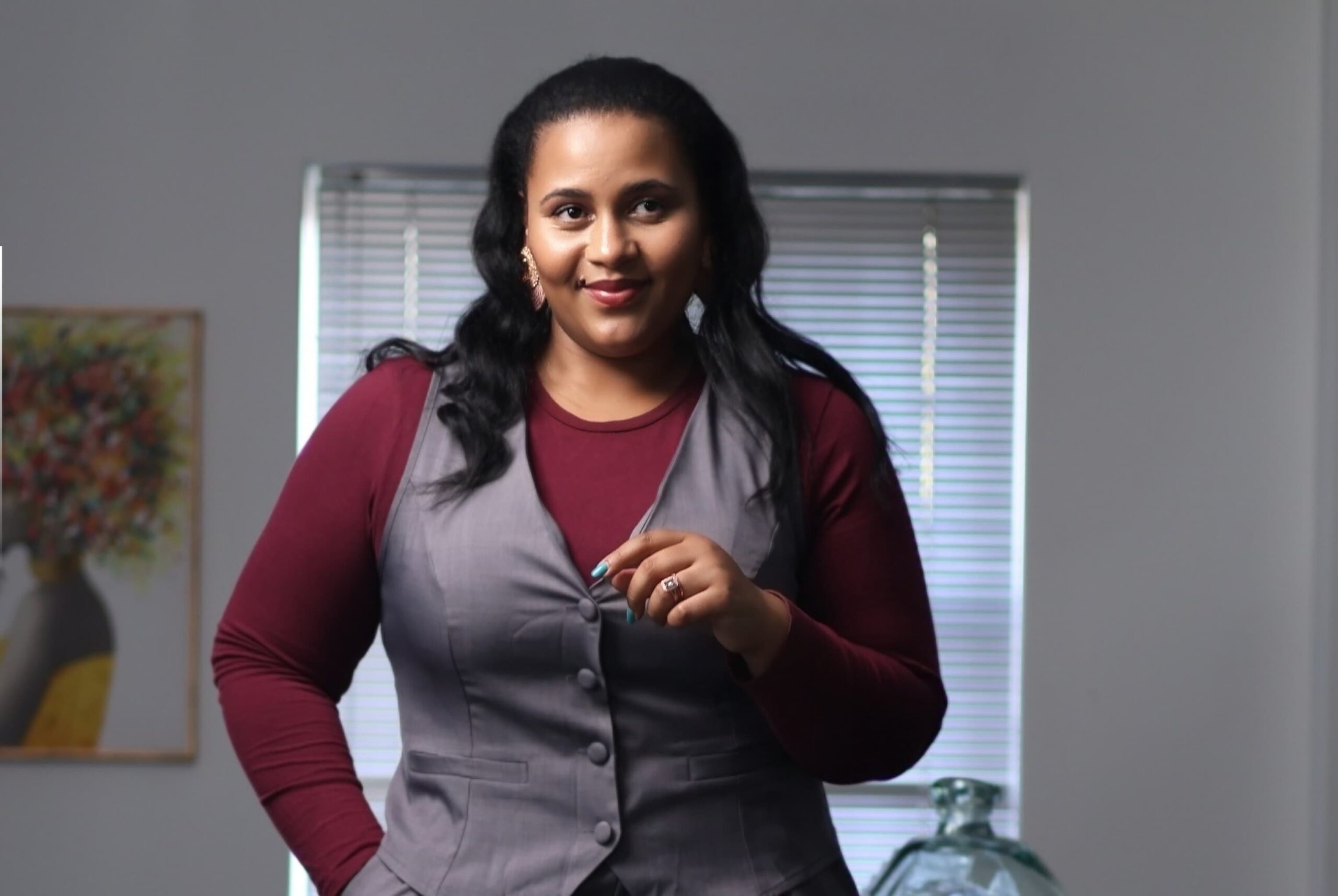
“The inspiration is still those people around me. The mission is to build what they taught me to build.”
-Amanda John-Ncube
IT STARTED WITH PEOPLE, NOT SPREADSHEETS
Amanda John-Ncube will tell you plainly that her journey into financial services did not begin with a career plan. It began with an example.
Growing up, she was surrounded by people who led by showing up fully, who believed in building something larger than themselves, and who treated solving real problems as a basic responsibility rather than an aspiration. Parents, teachers, mentors in early corporate life: the pattern was consistent. “It’s hard not to catch that kind of fire,” she reflects. And she caught it early.
Financial services arrived almost by accident during university, in an era when accounting, law, and medicine were the expected destinations. But the more Amanda explored the sector, the more it held her. Insurance sits at the intersection of risk, trust, and human consequence. It is about designing products that protect dignity and unlock opportunity. That combination of strategic depth and real-world impact pulled her in and never let go.
Over seventeen years, that pull has sharpened into a focused and purposeful mission: transformation, market access beyond inherited models, and financial solutions that genuinely reflect Africa’s diversity rather than simply replicating frameworks designed elsewhere. “The inspiration is still those people around me,” she says. “The mission is to build what they taught me to build.”
BECAUSE THEY CAN
At the heart of Amanda’s work scaling advisory ecosystems across South Africa and beyond sits a phrase she returns to with quiet conviction: because they can.
Working closely with independent financial advisors, many of them black-owned practices built from scratch, she observed something early that has never left her. The motivation is already present. Advisors want to grow, want to scale, want to serve clients better. What is frequently missing is not ambition. It is a second set of eyes. Someone willing to look past the linear playbook and ask what else this business could become.

“Passion is contagious. It makes capability building feel less like a project and more like a shared mission.”
“That’s where I try to play a role,” she explains. “Not to tell them there’s only one way to scale, but to help them see the non-linear options, the gaps, the opportunities they might not be looking at yet.”
For years, access to mentorship, market insight, and strategic support was not equally distributed across the advisory landscape. The vision Amanda has pursued is straightforward in its logic and significant in its implications: take the raw drive these advisors already carry and fuel it with strategy, with tools, with a broader view of what is genuinely possible. When an advisor wins, clients win, communities win. That multiplier effect is what keeps her committed to the work.
THE BELIEF PIECE IS EVERYTHING
As leader of the Black Distributors Trust, Amanda approaches the transition of black-owned advisory firms toward sustainable, growth-oriented businesses with a starting point that might surprise those expecting a conversation about balance sheets: she starts with the people.

Black-owned advisory firms are run by individuals who carry history, culture, and often decades of barriers they did not create. The first transition, she insists, has to be personal. Helping practice owners believe that sustainable growth is not blocked by what came before. That belief shift is not peripheral to the work. It is the work.
“If you don’t see businesses that look like you, feel like you, serve like you, then scaling to the next level feels theoretical,” she says. Part of what BDT does is replace the idea of isolated competition with collective aspiration, pointing toward exemplary firms that are already sustainable and scaling, so the next generation can see the destination clearly enough to chart a course toward it.
BDT is also documenting these journeys, recording interviews so future advisors can hear directly from people who have built what they are trying to build. When you can listen to someone’s actual journey, the transition stops feeling impossible and starts feeling inevitable. That, Amanda says, is the shift they are driving: from “can this work for me?” to “because I can.”
MEET PEOPLE WHERE THEY ARE
On financial inclusion across Africa, Amanda is direct about one thing above all others: the continent is not one market, and any solution that treats it as one will fail.
What inclusion looks like in South Africa is different from Nigeria, Angola, or Malawi. The gaps, the infrastructure, the customer needs are all local. The first practical step is therefore both simple and demanding: be where your feet are. If you are building for a market, understand that market deeply. Funding structures, product terms, distribution models must all be relevant to the actual gap being addressed, not templates copied from elsewhere.
The second step is partnership. There is real opportunity, she argues, in identifying businesses already solving adjacent problems and collaborating rather than duplicating effort. When smaller businesses can plug into what is already working, costs are redirected, reach widens, and impact compounds.
The third is staying current with innovation. AI, mobile-first distribution, data analytics are no longer specialist concerns. They are everyone’s responsibility. “Inclusion in 2026 won’t scale without tech,” she says plainly. “Understand the local need, collaborate where you can, and innovate where you must.”
TECHNOLOGY RESHAPES. LEADERSHIP REMOVES FEAR.
Amanda studied digital transformation at the master’s level, and what she learned has shaped her perspective in ways that differ from the standard conversation about technology disruption. The tech, she will tell you, is rarely the hard part. The hard part is the mindset shift.
Financial advisors in Africa are not being asked to become AI engineers. They are being asked one question: what in my business could work better and faster if technology helped? The reframe she consistently offers moves the conversation from “will AI take my job?” to “what can AI do that my business wasn’t doing at all?” When the question shifts, technology stops being a threat and becomes a tool for developing people rather than replacing them.
Distribution models, she notes, are already hybrid. Solutions move through technology, through relationships, through reimagined branch structures. The common thread holding all of it together is intentional change management. “Technology reshapes advisory by removing friction,” she says. “Leadership’s job is to remove fear.”
LOVE FOR THE WORK
Ask Amanda about the leadership principles that have guided her across large-scale capability-building programs and national advisor networks, and her first answer is not a framework or a methodology. It is love for the work.
“When you love the work, people feel it,” she says. “Passion is contagious. It makes capability building feel less like a project and more like a shared mission.”
The second principle is a willingness to build what does not yet exist when what exists is insufficient. Amanda has consistently sat close to opportunities where new programs, new networks, and new support structures could be formed and made accessible. What she has learned is that advisors do not only need tools and training. They need connection. Business can be lonely. Part of leading at scale is ensuring people feel they are building alongside others rather than in isolation.
GOVERNANCE WITH IMPACT
In financial services, Amanda is unequivocal: ethical leadership is not optional. It is the baseline. Doing business ethically, servicing clients ethically, and maintaining rigorous compliance are non-negotiable foundations, not periodic priorities.
But she pushes the definition of governance further than most. Regulations change constantly, and while the changes are clear on paper, translating them into daily practice is genuinely difficult for small advisory firms whose owners are already carrying enormous operational weight. “Running a business is lonely,” she observes. “Owners might know a regulation exists but not know exactly how it fits into their practice.”
Governance with impact, as she defines it, means not just following the rules but actively ensuring the businesses she supports can actually live by them. That is the responsibility she accepts as a business partner: not just compliance in principle, but sustainability in practice.
DON’T JUST CHASE ACCESS. BUILD IT.
The milestones Amanda values most are not titles or awards. They are the moments when effort visibly aligns with outcome, when she can look at what has been built and recognize the work of everyone who contributed to it. And then there is her family. Her children are both the motivation for her financial literacy work and its most honest test audience. When a goal lands now, she can say her kids contributed to it.
Her message to the next generation is as direct as her leadership style. For emerging entrepreneurs: growth comes through mentorship and collaboration, not just market access. Sit down with businesses that look nothing like yours. You will be surprised what access to market can look like when you partner with people who bring what you do not have. For women leaders: this is our time, and the programs, funding, and sponsorships exist to prove it. Take them, but do not build in isolation. For young professionals: mentorship is not supplementary. It is foundational.
“Don’t just chase access,” Amanda says. “Build it, with others.”
It is advice that doubles as a summary of everything she has spent seventeen years doing.