Most people who train in design learn to make things look good. Monica Visca learned that too and then spent two decades questioning whether that was ever really the point. Her journey from design graduate to global brand strategist was not a straight line. It was a gradual and deliberate shift in what she was actually interested in: not the surface of a brand, but the psychology underneath it. Not the logo, but the trust it either earns or fails to earn.
Over more than twenty years working across branding, strategy, and communication with global brands, established businesses, and purpose-driven founders, a pattern emerged clearly enough that she could no longer ignore it. Many businesses looked professional from the outside while remaining deeply unclear on the inside. The logo existed. The website existed. The content existed. But the message did not always reflect who the business really was, what it genuinely stood for, or why anyone should believe in it. That gap became the territory Monica chose to work in and Brand With Attitude became the vehicle for that work.
THE QUESTION BENEATH THE QUESTION
Monica’s practice is organized around a distinction she returns to consistently: the difference between a strong visual identity and a truly authentic brand. The first makes people notice you. The second makes people trust you. That gap is where most branding fails, and it is where she does her most important work.
A brand can look beautiful and still feel empty, she says, because visual credibility and authentic substance are not the same thing. Authenticity, in her framework, is not about radical transparency or performing vulnerability. It is about alignment: ensuring that what a business says, what it shows, and what people actually experience are in agreement. When those three things diverge and they frequently do the visual identity becomes a promise the brand cannot keep.

“A strong visual identity may attract attention, but an authentic brand builds trust. Authenticity is alignment: what you say, what you show, and what people actually experience need to match.”
The Authentic Brand System™ was built to address exactly this. Monica created it after repeatedly encountering founders who were working hard, investing in content and visuals and marketing strategies, yet still feeling disconnected from their own brand. The problem was rarely effort. It was sequence. They were trying to grow the brand before the foundation was clear. The system provides that foundation examining values, positioning, messaging, emotional connection, client experience, and visual direction as a whole rather than as separate concerns and giving leaders something concrete to measure all their decisions against.
THE EMOTIONAL LOGIC OF BRAND DECISIONS
One of Monica’s most consistent observations is that people significantly underestimate how much of a brand decision is emotional. Logic plays a role, certainly. But trust, confidence, relevance, and the feeling of being genuinely understood are what actually move people from awareness to action. This is especially consequential for consultants, coaches, and service-based founders, where the purchase is not a product but a relationship with someone’s thinking, guidance, and approach.
A human-centred brand, in her model, creates the conditions for that relationship to begin before the sales conversation does. It communicates: this person understands my problem. I trust their approach. I feel safe taking the next step. That sense of psychological safety built through consistent, aligned communication rather than through any single piece of content is what separates brands that convert from brands that simply attract attention.
She is equally clear-eyed about the internal dimension of this work. Many leaders carry fear around visibility, pricing, or being misunderstood, and if that goes unaddressed, it shows up in the brand. The message becomes diluted. The content becomes inconsistent. The sales process feels uncomfortable. Her role, as she describes it, is to help clients connect their expertise with their leadership presence so they can show up with clarity, confidence, and conviction rather than with a carefully managed approximation of themselves.
AI AS MIRROR, NOT STRATEGY
Monica’s position on artificial intelligence is characteristically precise. She sees it as a genuinely useful support tool and a real risk if misunderstood. Used well, AI can help organise ideas, accelerate content creation, and bring more consistency to brand communication. Used badly, it produces content that sounds polished but generic the right words without the real thinking, tone, or point of view behind them.
“AI is a mirror, not the strategy. Authenticity does not come from the tool. It comes from the human intelligence behind the tool. And it only works well when the brand foundation is already clear.”
Her framework is deliberate: human first, strategy second, technology third. Before a business can use AI effectively, it needs to have already done the foundational work understanding its values, voice, audience, positioning, and emotional tone. Once that clarity exists, AI becomes a capable extension of the brand. Without it, AI generates an approximation of a brand that was never fully defined in the first place.
This is not a conservative position on technology. It is a precise one. The opportunity in AI, as she sees it, is using it to express your voice with more clarity and consistency. The danger is using it to replace your voice entirely at the exact moment when audiences are becoming more selective, more skeptical, and more attuned to the difference between a real perspective and a generated one.
THE BRANDS THAT WILL STAND OUT
Looking ahead, Monica’s forecast for branding over the next decade follows from her core convictions rather than from trends alone. As AI makes content easier to produce, attention becomes harder to earn and trust becomes proportionally more valuable. The brands that stand out will be those with demonstrable depth: clear values, real expertise, emotional intelligence, and a client experience that actually matches the promise.
Founder-led and leader-led brands, she believes, will become even more significant in service-based industries precisely because people want to connect with real people rather than polished entities with no visible personality. Reputation and client experience will move from supporting elements of brand strategy to central ones. A brand will be judged not only by what it says but by how people feel at every point in the journey.
Her advice to aspiring founders and business leaders distills everything she has built her practice around: start with clarity. Know who you are, what you stand for, who you serve, and what problem you solve. Build from the inside out. Have a point of view specific enough to mean something and honest enough to sound like yourself. Because trust is built when people experience consistency between what you say, what you show, and what you deliver and that consistency cannot be designed around a foundation that was never properly laid.
Monica Visca has spent two decades learning, refining, and practicing the conviction that branding is not primarily a visual discipline. It is a human one. The clearest expression of that belief is Brand With Attitude itself a practice built on the idea that the bridge between a leader and their audience is not a logo or a colour palette, but something more durable and more difficult: genuine alignment between who they are and how they show up. That is where meaningful growth begins. And that, she would say, is where the real work has always been.
THE FIRST STEP TOWARD BRAND CLARITY
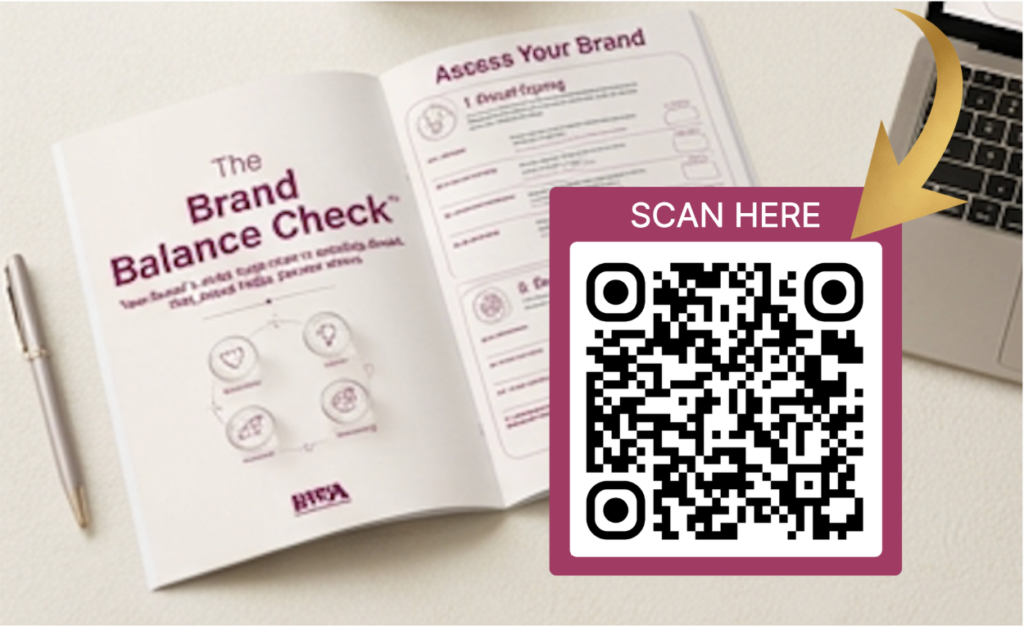
For leaders who want a practical place to begin, Monica has created the Brand Balance Check, a free 5 to 10-minute guide designed to help founders, consultants, and business leaders evaluate how their brand is currently performing.
The guide helps uncover gaps in clarity, positioning, messaging, and client perception while highlighting where focused improvement can create the greatest impact.
At the end of the assessment, readers also receive a thoughtfully designed AI prompt to help reflect on their results and identify areas for self improvement. True to Monica’s philosophy, the tool is designed to support human clarity rather than replace it.
“AI is the mirror, not the strategy, but it gives you a useful starting point,” she says. For anyone ready to strengthen their brand from the inside out, the journey can begin with a simple first step.
<Scan the QR code to access the Brand Balance Check.