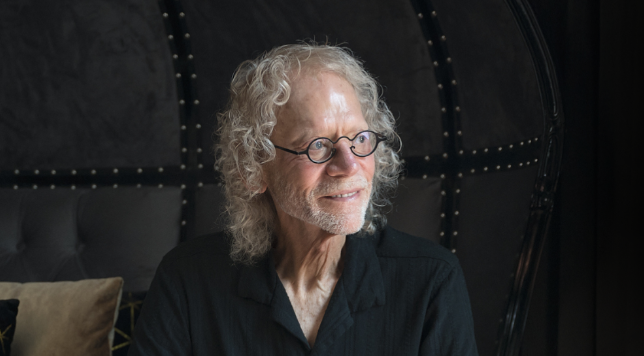
There are people who build careers. And then there are people who build something far more difficult to name: a body of work that reflects every dimension of a life fully lived, including the parts that most professionals spend considerable energy keeping out of sight. Tom LeNoble, CEO and Founder of Opening Pathways Collective, belongs unambiguously to the second category. His career has moved through the highest corridors of Fortune 500 organizations, through operating rooms and medical diagnoses that would have permanently altered most people’s trajectories, through the kind of personal reinvention that requires genuine courage rather than a carefully constructed narrative about it.
What has emerged from all of that is a platform, a philosophy, and a way of working with leaders that the conventional leadership industry has not yet figured out how to replicate. In 2026, the International Association of Top Professionals named him Confidential Leadership Advisor of the Year, recognizing excellence in leadership, coaching, and professional impact. The recognition was significant. But for anyone who has spent time with Tom’s work, the title feels almost beside the point. What he has built goes considerably deeper than any award can capture.
Opening Pathways Collective: A Different Kind of Leadership Space
Tom’s career has taken him through some of the most consequential organizational moments of the digital era. He led customer service operations at MCI during the transformation of the telecommunications industry. He helped shape early customer operations at Walmart.com as the company built its digital presence. He ran global service operations at Palm during the defining years of the Treo era. And he joined Facebook in its earliest days, following an interview with a then nineteen-year-old Mark Zuckerberg, contributing to the foundational operations that helped the company scale into something the world had never seen before.
Across every one of those environments, a pattern kept presenting itself. Organizations believed they were dealing with operational or strategic challenges. The real issues were almost always human: leadership dynamics, identity, cultural misalignment, the invisible weight of responsibility, and the private struggles that high-performing people carry without ever mentioning in a meeting.
Tom became the person leaders turned to when every conventional solution had already been tried. Opening Pathways Collective is the full expression of that role: a confidential advisory practice for founders, executives, nonprofit leaders, business owners, and professionals navigating meaningful moments in leadership and in life. It is not a programme. It is not a curriculum. It does not scale. It works with a limited number of people at any given time, by design, because depth requires space that volume cannot provide.
“The problem you think you have is not the real problem.”
The leaders who find their way to this work are accomplished, aware, and at a turning point. Some lead high-growth startups. Some carry the weight of mission-driven organizations. Some have achieved everything they set out to achieve and find themselves quietly unsettled in ways no performance metric can explain. What they share is a readiness: a recognition that what they need is not more strategy, more information, or more motivation. What they need is perspective, and the rare kind of space in which genuine perspective becomes possible.
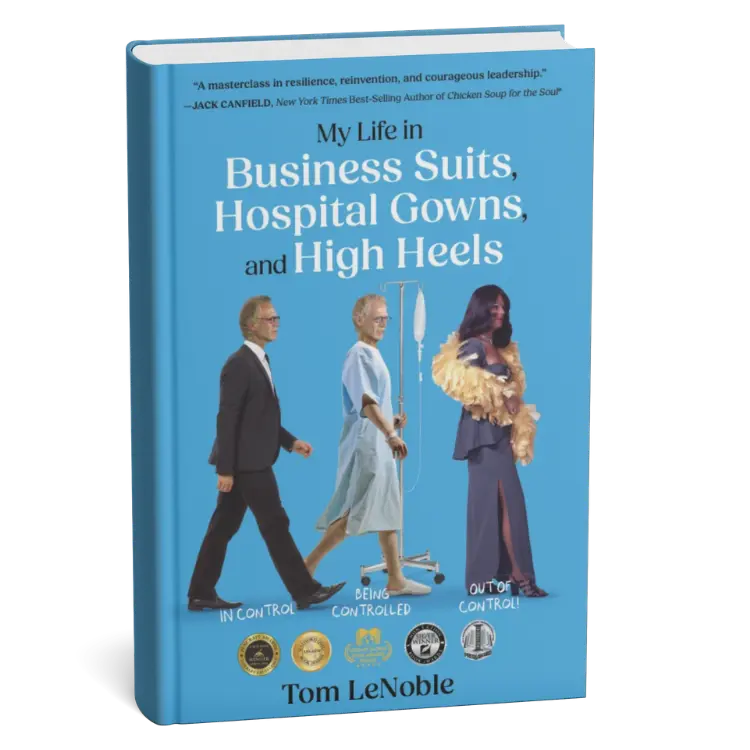
My Life in Business Suits, Hospital Gowns, and High Heels
Long before Opening Pathways Collective had a name, Tom was living the story that would eventually become his most powerful contribution to the leadership conversation. His award-winning memoir, My Life in Business Suits, Hospital Gowns, and High Heels, is one of the most honest books written about what leadership actually costs and what it requires at the level of a whole human life.
The title itself is a map. The Business Suits represent decades inside Fortune 500 boardrooms and Silicon Valley startups. The Hospital Gowns reflect multiple life-threatening diagnoses, including three separate occasions when he was told he had six months or less to live, and a metastatic cancer diagnosis he has now lived with for fourteen years. The High Heels speak to something deeper still: personal identity, the courage of visibility, and the profound work of living authentically in a world that rarely makes space for complexity.
The book traces a journey from a childhood home called the Shack, with no hot water, to the heights of Silicon Valley, through the heartbreak of the AIDS epidemic, through personal loss, organizational pressure, illness, reinvention, and a sustained practice of choosing to remain fully present in life despite every reason to retreat from it. It is funny, searingly honest, and completely unwilling to present resilience as a polished commodity. It approaches resilience as lived reality: messy, imperfect, and irreducibly human.
The memoir received six book awards, including being named a 2026 Independent Press Award Distinguished Favorite in the category of Inspiration. It became a bestseller not because it told people how to succeed, but because it made readers feel seen in their own complexity. That is a far rarer and more lasting achievement.
Morning Ground: The Book That Began Every Day
Where the memoir arrives with full force, Tom’s second book chooses to whisper. And that restraint may be its greatest strength.
Morning Ground grew from something simple: a daily series of short reflections shared each morning on Instagram and Facebook, each less than two minutes long, designed to offer a moment of genuine presence before the noise of the day begins. Coffee. A quiet thought. A breath before the world claims the rest of the hours. The practice resonated immediately, and the community that gathered around it grew steadily into something Tom had not initially anticipated.
The book that followed is equally unassuming in its premise and unexpectedly powerful in its effect. It does not prescribe optimization. It does not fuel the mythology of relentless productivity. It invites readers to inhabit their mornings more consciously, and through that daily practice, to inhabit their lives with greater steadiness and intention. The reflections explore emotional grounding, leadership awareness, resilience, and the quiet discipline of showing up for ordinary moments before the world claims them.
Morning Ground became a bestseller for the same reason the daily videos continue to draw viewers every morning: because in a culture engineered for urgency and stimulation, the invitation to pause carries unusual and necessary weight. Resilience, Tom has long argued, is not only the capacity to survive crises. It is equally the practice of remaining present during the ordinary moments that accumulate, quietly and unnoticed, into a life.
“Our greatest challenges often become the pathways to our greatest growth.”
The Opening Pathways Podcast: 160 Episodes and Counting
The Opening Pathways podcast now stands at more than 160 episodes, a milestone that reflects something more significant than longevity. It reflects a consistent commitment to the kind of conversation that most professional media avoids: honest, reflective, and genuinely interested in the human being behind the leadership title.
Each episode explores the stories behind successful leaders, entrepreneurs, and changemakers, with a particular focus on resilience, reinvention, and the moments that shape who people become. Tom brings to every conversation the same quality he brings to his advisory work: the willingness to go where most interviewers would not, asking the questions that reveal character rather than simply confirming reputation.
The podcast has extended Tom’s reach well beyond the limited number of clients he works with directly, making his philosophy accessible to leaders who may not yet be ready for deeper advisory engagement but who recognize something of their own experience in what they hear. It has become, in its own right, one of the most consistent expressions of what Opening Pathways Collective stands for: creating space for conversations that matter.
Speaking: When the Room Goes Quiet
As an international speaker, Tom occupies rare territory. He does not motivate audiences in the conventional sense. He grounds them. His presentations combine leadership insight with personal storytelling in ways that leave audiences not energized in a temporary and performative sense, but genuinely recalibrated.
His keynote Living Fully While Dying is perhaps the most striking example of this. It explores mortality, resilience, meaning, identity, and the urgency of intentional living through the lens of his own medical experiences, and it does so without a single cliché. He asks audiences a question that cuts straight through professional noise: what would actually change in your life if you truly understood that time is limited? Rather than framing mortality through fear, he presents it as an invitation to stop postponing joy, stop delaying the difficult conversations, and stop waiting for permission to become who we already know ourselves to be.
Audiences consistently describe the experience as grounding and transformative, not because it is dramatic, but because it speaks to something universally human. The keynote has resonated across healthcare systems, nonprofit organizations, LGBTQ+ communities, and major corporate conferences, precisely because its message transcends industry, identity, and role. At its heart, it is not about death at all. It is about awakening.
His other keynote areas, including resilient leadership, the PHILANTHROPIC MINDSET, mental toughness, and living with full intention, reflect the same quality: deeply personal, rigorously honest, and consistently more interested in lasting impact than in temporary inspiration.
Academy for Coaching Excellence: Developing the Next Generation
Alongside Opening Pathways Collective, Tom serves as CEO of the Academy for Coaching Excellence, one of the world’s leading coach training organizations. This role reflects a dimension of his work that extends beyond individual advisory relationships into the development of the broader coaching profession itself.
Through the Academy, he is building the next generation of coaches equipped to do the kind of work that genuinely matters: helping people think clearly, lead intentionally, and navigate uncertainty with steadiness rather than anxiety. He also serves as a Leadership Coach with the Miller Center at Santa Clara University, mentoring social impact leaders, entrepreneurs, and CEOs working to address some of the world’s most pressing challenges.
Together, these platforms reflect a singular purpose that has remained consistent across every dimension of Tom’s work: helping leaders move beyond surface-level solutions toward clarity, alignment, and leadership that is genuinely connected to who they are as human beings.
“Resilience is your greatest currency.”
Still Here. Still Building. Still Opening Pathways.
Having been told three times that he had six months to live, having carried a metastatic cancer diagnosis for fourteen years while continuing to advise, write, speak, lead, and show up fully in life, Tom LeNoble understands something about resilience that cannot be learned from a book or a framework. He understands it as a daily practice. A choice renewed each morning before the world begins its demands. A conviction expressed in three words that have become the quiet backbone of everything he does: I’m Still Here.
That conviction runs through the morning videos, through the podcast conversations, through the advisory relationships, through the memoir and the reflections of Morning Ground, through every keynote that asks an audience to stop performing long enough to feel the weight and the gift of the time they actually have.
Tom LeNoble is not building a personal brand. He is building space. Space for reflection in environments dominated by urgency. Space for authenticity in cultures shaped by performance. Space for the kind of conversation that helps a leader understand not just what they should do next, but who they are becoming in the process of doing it.
In a professional landscape defined by acceleration, optimization, and surface-level visibility, that reminder carries unusual and necessary weight. Because leadership, at its most essential, is not only about building companies or careers or influence. It is about learning to remain fully human while doing so. And that, more than anything else, is the pathway Tom LeNoble continues to open for others.