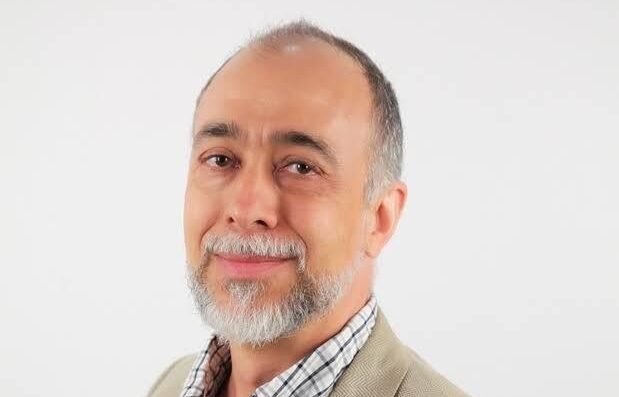
“The goal is not artificial intelligence replacing human intelligence. The goal is artificial intelligence amplifying human intelligence in service of better healthcare outcomes.”
– Ricardo Silva
BEYOND THE EXPERT LADDER: CONNECTING DISCIPLINES TO SOLVE HUMAN PROBLEMS
For Ricardo Silva, the complexity of today’s healthcare and technology challenges cannot be understood through a single professional lens. His career has moved across healthcare, biomedical engineering, artificial intelligence, education, entrepreneurship, innovation, public policy, and international development, creating a perspective that deliberately challenges the increasingly common “expert ladder”—the progression toward deeper knowledge within narrower and narrower specialties. While specialization remains essential, Ricardo believes that excessive specialization can create silos in which professionals become less comfortable engaging with problems beyond their immediate discipline. His own journey has instead been shaped by movement between fields, allowing him to recognize that healthcare is simultaneously medicine, technology, economics, policy, education, logistics, culture, data, and human behavior, while artificial intelligence extends far beyond computer science into ethics, governance, psychology, business strategy, and social impact.
This transdisciplinary perspective has become one of the defining characteristics of his leadership. Ricardo approaches complex problems by asking how different professional perspectives can contribute to a more complete solution rather than attempting to solve everything from within one discipline. Equally important, his movement across fields has reinforced a sense of intellectual humility. Every profession possesses its own language, expertise, assumptions, and ways of understanding the world. The more disciplines he encounters, the more he recognizes the limitations of any single perspective. For Ricardo, leadership is therefore not about possessing every answer; it is about creating the conditions in which diverse people, ideas, and institutions can work together toward an objective greater than any one participant could achieve alone.
RESPONSIBLE DIGITAL TRANSFORMATION: SAFETY, EFFECTIVENESS, AND HUMAN ACCOUNTABILITY
Ricardo’s understanding of responsible digital transformation begins with a deceptively simple question: what does “responsible” actually mean? In healthcare, responsibility cannot be separated from consequences because technological decisions can directly affect human lives. Drawing from fundamental principles in medical device regulation, he emphasizes two essential considerations: safety and effectiveness. Safety does not mean eliminating risk, because every medical intervention carries some degree of risk. Rather, a technology should be evaluated according to whether its risks are acceptable compared with the natural progression of a condition or the available standard of care. Effectiveness, meanwhile, requires evidence that the technology can achieve the outcomes it claims to deliver. This framework is particularly important for AI, where perfection is neither a realistic expectation nor the correct benchmark.
The more meaningful question is whether an AI system performs sufficiently well compared with the alternative available in a particular environment. An AI system supporting an experienced specialist may need to meet a different threshold from one deployed in an underserved region where the alternative is no specialist at all. Ricardo’s work with healthcare organizations and initiatives such as Premier Medical Corporation reflects this principle: technology should be introduced not because it is new or sophisticated, but because it can solve a meaningful problem safely and effectively. Responsible transformation therefore requires organizations to understand tradeoffs, evaluate limitations honestly, maintain appropriate human oversight, and remain accountable for outcomes. The objective is not technology for technology’s sake; it is technology that improves healthcare while preserving trust, safety, and human responsibility.
AI AS AN AMPLIFIER OF HUMAN INTELLIGENCE
Ricardo sees artificial intelligence creating its greatest healthcare value when it allows people to concentrate on the activities humans perform best. Documentation, administrative work, information retrieval, repetitive analysis, pattern recognition, and operational optimization are all areas in which AI can potentially reduce burdens and increase efficiency. Yet healthcare remains fundamentally human. Empathy, communication, contextual judgment, ethical responsibility, and the ability to understand a patient’s individual circumstances cannot simply be transferred to an algorithm. AI can inform a decision, but it should not become the owner of that decision.
His work with Premier Medical Corporation illustrates this philosophy. Affordable rapid diagnostic tests can be particularly valuable in low-resource and low-capacity settings, where simplicity allows healthcare workers with limited training to perform and interpret tests. But the diagnostic test itself is only one component of the larger healthcare system. The greater challenge is ensuring that results are accurately captured, integrated into patient records, incorporated into epidemiological surveillance, connected to inventory management, and translated into timely public health intelligence. A digital platform capable of following the diagnostic journey can help identify anomalies, prevent duplicate reporting, improve traceability, monitor inventory, and identify emerging patterns across populations. AI can then amplify that information into actionable insight without replacing the healthcare worker, laboratory professional, or public health authority. For Ricardo, the sequence matters: first understand the problem, then design the process, determine what information is required, and only then introduce AI as an instrument for augmenting human capability.
THE ETHICAL FOUNDATION OF INTELLIGENT SYSTEMS
Ricardo’s thinking on responsible AI is deeply connected to his work as an educator and author, particularly through The Essence of Intelligent Systems: From Data to Wisdom. He argues that society has invested enormously in STEM education while often giving comparatively less attention to philosophy, ethics, history, law, and the social sciences. This imbalance matters because the people building AI systems also influence the datasets, assumptions, objectives, and definitions embedded within those systems. Every dataset contains limitations. It may be incomplete, outdated, unbalanced, incorrectly documented, or shaped by conscious and unconscious human biases. Those biases do not automatically disappear when data enters an AI model; they can instead be reproduced and amplified at scale.
Ricardo frequently describes modern AI, particularly Large Language Models, as extraordinary probability engines. They calculate highly probable responses based on the information and patterns available to them, but probability should never be confused with certainty. If an intelligent system were trained entirely on the knowledge accepted in another historical period, it could confidently reproduce assumptions that society now recognizes as incorrect. The limitation would not necessarily be the sophistication of the system but the boundaries of the knowledge provided to it. This is why he believes responsible AI requires more than technical safeguards. Researchers must challenge assumptions and generate new knowledge; philosophers and ethicists must examine consequences; policymakers must establish appropriate frameworks; and organizations must maintain accountability and human oversight. The most important safeguard in artificial intelligence is ultimately not the algorithm, but the quality of the humans responsible for designing, governing, and using it.
STRATEGIC FORESIGHT: REHEARSING THE FUTURE BEFORE IT ARRIVES
Ricardo’s interest in strategic foresight is grounded in a recognition that no discipline can independently anticipate the full consequences of transformative technology. Software development itself provides an example: products move through prototypes, alpha testing, beta testing, deployment, and continuous refinement because users inevitably discover unexpected requirements and behaviors. General-purpose AI creates a far more difficult forecasting challenge because it can be applied across virtually every domain, including applications its creators never anticipated. Human creativity, misuse, ingenuity, and unpredictability make it impossible to model every future scenario.
This is where Ricardo sees science fiction as more than entertainment. He considers it a laboratory of imagination, a space in which technological, social, political, economic, and human consequences can be explored before they occur in reality. His decision to become a serious science-fiction author reflects this philosophy. Through the Comet Surfer Universe, he examines plausible futures shaped by technological development while focusing not merely on machines, but on people, institutions, relationships, healthcare, economics, governance, and civilization. His objective is not to predict the future perfectly. It is to broaden awareness of possible futures, challenge assumptions, and encourage society to rehearse the unexpected. In that sense, science fiction becomes an instrument of strategic thinking: not an attempt to predict the future, but an attempt to prepare the imagination for it.
FROM TECHNOLOGY IMPLEMENTATION TO SYSTEMS THINKING
Ricardo believes organizations frequently make a fundamental mistake when introducing emerging technology: they assume the technology itself is the solution. In reality, successful transformation depends on the interaction between people, processes, culture, leadership, governance, and technology. He distinguishes between research and innovation through a deliberately simple formulation: research turns money into knowledge, while innovation turns knowledge into value. The skills required for discovering knowledge are therefore not necessarily the same as those required for commercializing it, implementing it, governing it, or scaling it.
Successful transformation consequently requires a multidisciplinary “tribe” consisting of researchers, engineers, developers, business leaders, operators, regulators, auditors, customers, and end users. Yet even a tribe requires a conductor—not a boss, but a leader capable of understanding the larger system and accepting responsibility for its outcomes. Ricardo describes leadership as the ability to balance resilience with adaptability, remaining flexible when circumstances change while holding firmly to principles when stability is required. This becomes particularly important with AI because technology can amplify existing weaknesses. A poorly designed process supported by powerful AI may simply produce poor decisions faster. His preferred sequence is therefore clear: understand the problem, build the team, improve the system, deploy the technology, and continuously supervise and refine the outcome.
REIMAGINING EDUCATION FOR AN AI-ENABLED GENERATION
As an educator, Ricardo approaches technology not as an enemy of learning but as another instrument through which learning can occur. His teaching philosophy begins with a simple principle: the instructor’s responsibility is not to demonstrate how much they know, but to ensure that students leave with more knowledge, skills, confidence, and capability than they possessed when they entered the classroom. This requires adaptation because every group of students is different. Ricardo therefore favors active learning and believes that people learn best by doing.
His approach to AI in education reflects the same philosophy. Rather than simply banning AI because students may misuse it, he advocates teaching them how to use it responsibly, critically, and ethically. He has developed specialized AI agents that function as tutors and mentors within defined guardrails, extending learning opportunities beyond the classroom while preserving academic integrity. In one graduate course on Artificial Intelligence and Clinical Decision Support Systems at Villanova University, students developed an AI-native patient navigator for the Build with Gemini AI competition. Students who initially had limited exposure to clinical decision support, low-code development, healthcare privacy, software-as-a-medical-device requirements, and AI governance ultimately produced a functional solution while experiencing those concepts through practical work. For Ricardo, that is the essence of education: transforming information into understanding, understanding into judgment, and judgment into action.
FROM SICK CARE TO A CIVILIZATION DESIGNED AROUND HEALTH
Ricardo’s vision extends beyond individual technologies to the structure of healthcare itself. He points to the distinction between health and the absence of disease, noting that much of modern healthcare remains organized around “sick care” intervening after a condition has already developed. As chronic and non-communicable diseases continue to place pressure on healthcare systems, he believes societies must increasingly shift toward prevention, continuous monitoring, wellness, and early intervention. The economic and organizational incentives of healthcare must evolve so that maintaining health becomes as important as treating illness.
Here, the convergence of AI, wearable technologies, distributed communications, Internet of Medical Things systems, edge computing, cloud infrastructure, and digital diagnostics could fundamentally change the patient experience. Healthcare could become less episodic and more continuous, with intelligent systems supporting early risk identification, personalized guidance, remote monitoring, patient navigation, and timely intervention. Many services currently concentrated in hospitals could increasingly move into homes and communities, while hospitals focus on specialized and acute care. Ricardo’s broader concept of civilization design therefore places human wellbeing at the center. Technology is not the destination. Human wellbeing is. The objective is to move from a civilization organized primarily around disease management toward one designed to help people remain healthy, productive, and fulfilled throughout their lives.
INNOVATION ECOSYSTEMS AND THE FUTURE OF HUMAN DEVELOPMENT
Ricardo’s work across universities, research laboratories, ministries of health, global organizations, technology initiatives, and innovation ecosystems has given him a nuanced understanding of how institutions approach change. Research laboratories excel at questioning assumptions and generating knowledge but can sometimes lose sight of commercialization or practical application. Universities balance discovery with education, although they must increasingly rethink how students acquire knowledge in an environment where information is abundant. Government and global health organizations operate under greater constraints because they must balance innovation with public accountability, regulation, budgets, and risk. Companies are closest to customers and market needs but may be constrained by short-term priorities.
He believes the strongest innovation ecosystems do not attempt to make every institution perform the same function. Instead, they create relationships between specialized actors. Universities and research institutions generate knowledge; companies transform that knowledge into scalable products and services; governments and international organizations provide appropriate incentives, standards, funding mechanisms, and regulatory frameworks. When those relationships function effectively, knowledge generates innovation, innovation generates value, and value supports the creation of new knowledge. This virtuous cycle is central to Ricardo’s vision of responsible progress: not a hierarchy of institutions, but a network of mutually reinforcing capabilities working toward outcomes none could achieve independently.
THE FUTURE: PROGRESS WITH HUMILITY
Looking toward 2026 and beyond, Ricardo believes the most important development is not any individual AI model, medical device, or digital platform, but the growing need for AI literacy, systems thinking, change management, data governance, and multidisciplinary leadership. Technologies will continue to evolve, but organizations must develop the human capabilities required to use them responsibly. Leaders should therefore ask not simply how advanced a technology is, but what problem it solves, whether the data supporting it is trustworthy, how it changes workflows, who remains accountable, and whether the people expected to use it are prepared.
His broader vision is one of responsible evolution. Healthcare should move toward prevention and wellness. AI should amplify human capability rather than diminish human agency. Education should develop critical thinking and judgment rather than merely transfer information. Innovation should connect disciplines rather than reinforce silos. And leaders should remain humble enough to recognize that humanity is entering technological territory it has never experienced before.
Ricardo’s career reflects that philosophy. From healthcare and biomedical engineering to artificial intelligence, education, international development, strategic foresight, entrepreneurship, and science fiction, his work has consistently explored one underlying question: how can human beings use knowledge and technology to create better systems for the future? His answer is neither blind optimism nor technological resistance. It is curiosity guided by responsibility, innovation balanced by wisdom, and progress anchored in human wellbeing.
PROFESSIONAL RECOGNITION & INTELLECTUAL CONTRIBUTIONS
Ricardo’s multidisciplinary career encompasses healthcare technology management, digital health, biomedical engineering, education, entrepreneurship, research, and international development. His professional recognition includes the Digital Health Award from the Global Clinical Engineering Alliance in 2023 and inclusion in the 2024 edition of Marquis Who’s Who in America for achievements spanning healthcare technology, digital health, education, innovation, artificial intelligence, entrepreneurship, and international development.
His intellectual contributions include The Essence of Intelligent Systems: From Data to Wisdom, alongside the Comet Surfer Universe, which explores humanity’s technological and civilizational evolution through scientifically grounded speculative fiction. His recent scholarly work addresses topics including organization and structural identity, interoperable semantic architectures for traditional and integrative medicine in electronic health records, neural-network compression, cybersecurity and explainable AI in intelligent hospitals, and responsible digital transformation.
Through leadership roles and initiatives involving Premier Medical Corporation, the Healthcare Technology Foundation, WHO, IEEE, IFMBE, and the Global Clinical Engineering Alliance, Ricardo continues to contribute to the development of healthcare systems and technologies designed not simply to become more intelligent, but to become more accessible, accountable, resilient, and human-centered.