In the bustling corridors of The Browning School, where 400 young minds navigate their educational journey, one educator stands as a beacon of inclusive excellence. Joan Gillman’s path to becoming one of New York City’s most celebrated science educators began not in a laboratory or lecture hall, but on a lower school playground where she discovered her gift for ensuring every child had a place to shine.
“The head of the school was particularly pleased with my work,” Joan recalls of her formative volunteer experience. “She greatly admired how I was able to include all children in the playground games and not just those that showed special athletic abilities.” This early recognition of her inclusive approach would become the cornerstone of a teaching philosophy that has inspired countless students across four decades.
As an educator, I want to make my students so excited about education that when they leave school in the afternoon, they can’t wait to learn more about the topics we have been studying in school
Joan’s childhood curiosity about the natural world provided the perfect foundation for her educational calling. While other children played with conventional toys, she transformed her bathroom into a makeshift laboratory, experimenting with different solutions and powders, convinced she would discover the next breakthrough product. Her fascination with weather patterns led to meticulous documentation of snowfall rates, temperature readings, and barometric pressure measurements, creating detailed records of each storm that swept through her neighborhood.
“I was always interested in science and engineering, even as a young child,” Joan reflects. “I still remember experimenting with different solutions in my bathroom. I was sure I would come up with a new product if I kept mixing different powders and liquids together.”
These early experiences, combined with collaborative projects building robots from shoe boxes with her older brother and constructing elaborate snow tunnels, unknowingly prepared her for a career dedicated to hands-on learning and creative problem-solving.
BRIDGING PROGRESSIVE AND TRADITIONAL PEDAGOGIES
Joan’s professional journey has been shaped by her experiences at two distinctly different educational institutions. Her time at The Calhoun School, known for its progressive approach, provided her with the freedom to develop curriculum that followed student interests and passions. This environment nurtured her belief in inquiry-based learning and student-centered education.
The transition to The Browning School brought new opportunities to implement the Next Generation Science Standards while maintaining her commitment to engaging, hands-on education. “The Browning School is an all-boys independent school that was founded in 1888 in New York City,” Joan explains. “The school’s mission is to create men of intellect and integrity to contribute meaningfully to our world.”
This environment has allowed Joan to tailor her teaching methods to meet the developmental needs of boys while incorporating research-based strategies that foster deep learning. The school’s commitment to evidence-based educational practices aligns perfectly with her own dedication to continuous professional development and educational excellence.
THE ART OF HANDS-ON LEARNING ACROSS AGE GROUPS
Teaching science to second, fourth, and sixth graders requires remarkable adaptability and creativity. Joan has mastered this challenge through innovative project-based learning that makes complex concepts accessible and engaging for each age group.
Her second-grade engineering unit exemplifies this approach. Students design and build their own skyscrapers and bridges while learning about structures from around the world. “It is so heartwarming to hear the students celebrating their own cultures when they spot structures that they are familiar with from their own countries,” Joan observes.
The unit culminates in “the elephant project,” where students must construct a bridge capable of supporting a family of elephants. This challenge integrates science, mathematics, and environmental consciousness while using recycled materials and craft supplies.
For her fourth graders, the Straw Rocket project demonstrates Joan’s ability to combine multiple disciplines seamlessly. Students work with variables including straw length, fin design, clay nose cone size, and launch angles while applying mathematical measurement skills and scientific analysis. “What I love about this project is that the students use their math and measurement skills along with their science knowledge,” she explains.
The iterative nature of the project teaches resilience and improvement through failure. After analyzing initial results, students redesign their rockets and launch again, applying newfound knowledge to achieve better outcomes.
STORYTELLING AS A GATEWAY TO WONDER
Joan’s approach to astronomy education reveals her deep understanding of how narrative can illuminate scientific concepts. During constellation studies, she guides students through traditional Greek mythology before exploring Native American tales and stories from Arabia and Great Britain.
“The students find it fascinating that civilizations had different names and stories for the patterns they viewed in the sky,” Joan notes. This cultural exploration then empowers students to create their own constellations and origin stories, combining creativity with astronomical knowledge.
This storytelling methodology extends throughout her curriculum, including her signature sixth-grade natural disaster “raps” that introduce new topics with humor and engagement. “The students actually look forward to seeing what I will perform!” she laughs.
ENVIRONMENTAL STEWARDSHIP THROUGH THE GREEN TEAM
As the leader of The Browning School’s K-12 club, Joan has created a platform for environmental action that extends far beyond the classroom. The Green Team represents her commitment to empowering students to become active environmental stewards rather than passive observers of climate change.
One of her most memorable achievements involved a sixth-grade student who was deeply moved by a lesson on water shortages. Together, they researched organizations addressing clean water access and selected water.org as their focus. The resulting fundraiser raised over $1,000, demonstrating the power of education to inspire action.
“As a science teacher and the leader of our Green Team, I believe that this is already occurring,” Joan reflects on her students’ positive impact on the world. “I have always made it a point to teach her kids that they’re powerful, and can use their knowledge to make a difference.”
The Green Team’s initiatives include weekly “Green Action of the Week” campaigns, Central Park cleanup projects, and the annual Biodiversity Day that engages the entire school community in environmental awareness activities.
ADDRESSING EQUITY THROUGH SCIENCE EDUCATION
Joan’s commitment to diversity, equity, and inclusion manifests through carefully crafted curricula that address environmental racism and social justice issues. Her climate change unit challenges sixth graders to evaluate whether major relief organizations like FEMA, the American Red Cross, and Habitat for Humanity actually follow their stated mission statements when responding to hurricanes.
“The students were then asked to evaluate whether or not the organizations followed what they claimed to do in their mission statements,” Joan explains. “If the answer was no, the students then had to come up with ways for the organizations to improve their practice.”
This approach empowers students to think critically about systemic inequalities while developing research and presentation skills. Her students create slideshows, videos, and television interview formats to share their findings, making complex social issues accessible and actionable.
In her space program curriculum, Joan addresses the historical lack of diversity in NASA’s astronaut corps, helping fourth graders understand how societal barriers prevented equitable representation in space exploration. “It can come as a surprise to them when they find out that it took many decades before the astronaut program looked more like the population we currently have in the country.”
PROFESSIONAL EXCELLENCE AND NATIONAL RECOGNITION
Joan’s dedication to educational excellence extends far beyond her classroom through extensive professional development and leadership in educational organizations. She maintains active membership in the National Science Teaching Association, the Science Teaching Association of New York State, Science Educators for Equity, Diversity and Social Justice, and the Science Council of New York City. She has been serving as a Subject Area Representative for the elementary level at STANYS for many years.
Her workshop presentations at national conferences have earned widespread recognition for their creative and practical approaches to science education. Topics range from oil spill simulations to natural disaster safety, always emphasizing hands-on learning and real-world application.
The pinnacle of her professional recognition came through her National Geographic Certified Educator certification, where she achieved “Exemplary” grades for her innovative oil spill curriculum. This recognition validated her approach of using environmental simulations to teach both scientific concepts and environmental responsibility.
“I put enormous effort into designing lesson plans that would be age appropriate and would help the students become knowledgeable about oil spills,” Joan reflects. “Due to all of my diligence, the National Geographic Educator program awarded me with ‘Exemplary’ grades. I felt so proud to be recognized in such a positive manner.”
EMBRACING TECHNOLOGICAL EVOLUTION
Joan’s 43-year career spans the complete transformation of educational technology, from blackboards and chalk to SmartBoards and Chromebooks. Her adaptability demonstrates the growth mindset essential for effective education in the digital age.
“When I think back to when I first started teaching in 1982, I was just using a blackboard and chalk,” she recalls. “I can still remember the first time someone put a computer in my classroom. I didn’t even know where to find the switch to turn the machine on.”
Today, she seamlessly integrates multiple online platforms (Seesaw, Google Classroom, and Canvas) to meet the developmental needs of different age groups while maintaining her commitment to hands-on, experiential learning.
Her approach to artificial intelligence reflects her balanced perspective on educational technology. “The use of AI technology is in its infancy, but it is bound to become much more widespread in its use amongst teachers and their students,” she observes. “Our job is to make sure that it enhances the learning experience and does not take away from the students developing their own skills.”
THE INTERSECTION OF MUSIC AND EDUCATION
Joan’s musical talents as both a violinist and pianist provide unexpected insight into her educational philosophy. Playing in orchestras offers creative expression while reinforcing her empathy for struggling students.
“When a particular piece of music needs extra practice due to its specific challenges, it helps remind me of some of the struggles my students might be going through when they need to learn a new topic,” she explains. “This just increases my compassion for my students.”
This artistic dimension adds depth to her teaching approach, demonstrating how diverse interests and skills can enhance educational effectiveness.
MEASURING SUCCESS BEYOND STANDARDIZED METRICS
Joan’s definition of educational success transcends traditional academic measurements. Her focus on developing environmental stewards and critical thinkers reflects a broader vision of education’s purpose in society.
“As I look at a long career, I will consider myself successful if my students leave my classroom with a positive attitude about themselves and believe that they can make a fine difference in the world,” she states. “When I first began teaching, it was really mostly about making sure the students comprehended the lessons and passed their tests. Now it is much more about applying their knowledge to make the world a better place.”
This evolution from content delivery to transformational education represents the maturation of a master teacher who understands that knowledge without application lacks meaning.
MEMORABLE MOMENTS OF CONNECTION
Among Joan’s most treasured memories are those moments when students experience genuine scientific wonder and decide to take action. Her fifth-grade Rube Goldberg machine project exemplifies this connection between learning and joy.
“What I found most rewarding was hearing my students say, ‘This is the best science class ever!’” Joan recalls. “The students were learning all about potential and kinetic energy and other forms of energy while at the same time having a grand time in the classroom.”
These moments of authentic engagement validate her belief that learning should be both rigorous and joyful, challenging students while maintaining their natural curiosity and enthusiasm.
BUILDING COMMUNITIES OF LEARNERS
Joan’s classroom operates as a community of learners where collaboration and mutual support drive success. Her approach recognizes that each student brings unique strengths that can contribute to collective achievement.
“When the students work together on a project, I always like to make sure that everyone is contributing positively to their goals,” she explains. “Some students might be great artists while others might be adept at putting together slideshows and other types of presentations.”
This collaborative model prepares students for real-world teamwork while ensuring that every individual feels valued and capable of meaningful contribution.
PREPARING STUDENTS FOR AN UNCERTAIN FUTURE
Joan’s approach to climate change education demonstrates her commitment to preparing students for the challenges they will inherit. Rather than frightening young learners, she empowers them with knowledge and agency to create positive change.
“One of the biggest challenges facing education today is how to address climate change issues without frightening the students,” she observes. “Children need to understand how the world works so that they can make wise decisions as adults and help bring about positive changes to our world.”
Her Green Team initiatives and environmental curricula provide practical frameworks for student action while building the scientific literacy necessary for informed citizenship.
A LEGACY OF INSPIRATION AND EMPOWERMENT
As Joan looks toward the future of science education, her vision emphasizes interdisciplinary learning that mirrors real-world complexity. Her belief that learning shouldn’t occur in isolation reflects a sophisticated understanding of how knowledge intersects across domains.
“In my science classes, not only do the students learn science skills, but I also incorporate all of the other academic subjects into the lessons,” she explains. “In this way, learning doesn’t take place in isolation and the students see the connection between all of the disciplines. Isn’t that the way the world actually works!”
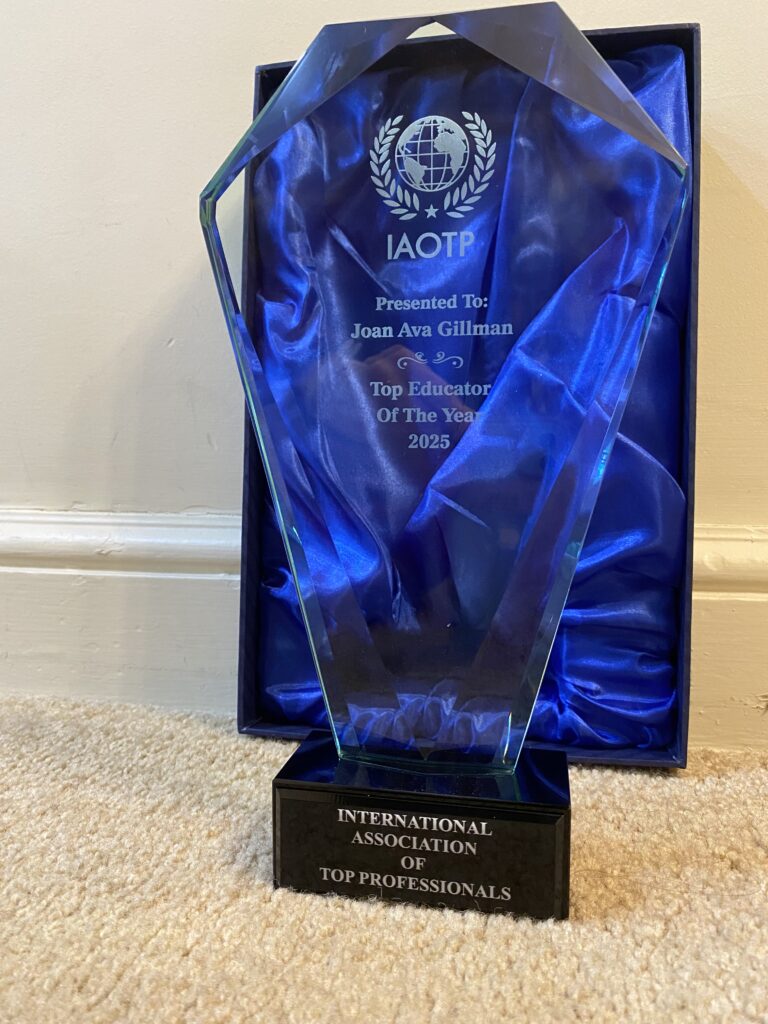
Her recent recognition as “Top Educator of the Year 2025” by the International Association of Top Professionals represents not just personal achievement, but validation of her approach to education as transformation rather than information transfer.
Joan Gillman’s 43-year career stands as testament to the power of inclusive, hands-on education that honors student curiosity while building scientific literacy. Her ability to adapt pedagogical approaches while maintaining core values of compassion, creativity, and environmental stewardship provides a model for educators navigating an uncertain future.
Through her teaching, writing, workshop presentations, and environmental advocacy, Joan continues to influence not just individual students but the broader educational community. Her legacy lives in the countless young scientists, environmental advocates, and thoughtful citizens who carry forward the lessons learned in her classrooms and through The Green Team.
“As an educator, I want to make my students so excited about education that when they leave school in the afternoon, they can’t wait to learn more about the topics we have been studying in school,” Joan reflects. “The learning mustn’t stop at school. My aim is to help them become lifelong learners.”
This vision of education as a catalyst for lifelong curiosity and positive action represents the highest aspirations of the teaching profession. Joan Gillman has not only achieved these aspirations but has created pathways for others to follow, ensuring that her impact will resonate far beyond her own remarkable career.