
In the rapidly evolving world of artificial intelligence, where hype often overshadows substance and tools are mistaken for strategy, one leader stands apart by bringing clarity to chaos. Dr. Kavita Ganesan has spent nearly two decades not just working with AI, but understanding its true potential and its limitations. As the founder and CEO of Opinosis Analytics, she has built her reputation—and that of her company—on a simple yet profound principle: AI is not magic, and success requires more than just adopting the latest technology.
Her journey through the AI landscape has given her a unique vantage point. From the early 2000s when AI was confined to big tech laboratories, through the experimental phases at companies like eBay, 3M, and GitHub, to today’s ChatGPT-driven democratization, Dr. Kavita Ganesan has witnessed and participated in every major shift in the field. Yet what distinguishes her approach—and the methodology she’s built into Opinosis Analytics—is not just technical depth but strategic clarity about what AI can and cannot do.
“Having been in the field applying AI for different problems, I’ve seen countless mistakes being made in getting results from AI leading to failed initiatives,” Dr. Kavita Ganesan reflects. This observation would become the foundation of her work and the core philosophy behind Opinosis Analytics, transforming how organizations think about and implement artificial intelligence.
THE DEMOCRATIZATION MOMENT: WHEN AI BECAME ACCESSIBLE TO EVERYONE
November 2022 marked a watershed moment in AI history. Before ChatGPT’s arrival, artificial intelligence remained largely a concept known within tech circles, particularly in big tech companies. The shift that followed was nothing short of revolutionary.
“The biggest change or shift after ChatGPT was released is that AI is now accessible to anyone and everyone, even the most non tech savvy,” Dr. Kavita Ganesan explains. The evidence of this transformation appeared in unexpected places. She recalls teaching a salon owner how to use ChatGPT for basic tasks. After just one session, the salon owner began using it for everything from marketing copywriting to improving her professional bio.
This democratization brought both opportunity and risk. While AI tools became accessible, the strategic thinking required to use them effectively did not automatically follow. Organizations rushed to adopt AI without understanding the fundamentals, leading to the exact failures Dr. Kavita Ganesan had observed throughout her career. The need for strategic guidance became more urgent than ever—a need that would shape the mission of Opinosis Analytics.
WRITING THE BLUEPRINT: THE BUSINESS CASE FOR AI
The decision to write “The Business Case for AI” emerged from years of observing a consistent pattern. Organizations were failing with AI not because of technical limitations but due to foundational misunderstandings. Mismatched expectations at the leadership level, faulty assumptions about user needs at the implementation stage, and a disconnect between what AI promised and what it could actually deliver created a landscape littered with failed initiatives.
Yet Dr. Kavita Ganesan’s own track record told a different story. The models she built and deployed for clients and employers consistently succeeded. User feedback remained positive. The AI tools she created actually worked. This contrast revealed a crucial insight: she must be doing something fundamentally different.
“I wanted to teach more companies on the best practices that I have established over the years for successful AI implementation and it starts with the foundations of AI,” Dr. Kavita Ganesan explains. The book became more than just a guide. It became a prerequisite for working with Opinosis Analytics, ensuring clients arrived with realistic expectations and fundamental understanding.
The book delivers three core messages that challenge conventional wisdom about AI adoption. First, you need to understand the beast. AI cannot be treated as a black box that magically solves problems. Second, AI may not be the best solution for everything. This runs counter to the industry hype but reflects reality. Third, AI is expensive and must be treated like a game of chess, requiring strategic thinking that extends far beyond writing code or integrating tools.
BUILDING OPINOSIS ANALYTICS: WHERE STRATEGY MEETS EXECUTION
Founded in 2018, Opinosis Analytics emerged from Dr. Kavita Ganesan’s vision to bridge the gap between AI’s technical possibilities and business realities. The company was built on the lessons learned from nearly two decades of implementing AI across diverse industries—lessons about what works, what fails, and why.
Opinosis Analytics operates with a distinctive philosophy that sets it apart in the crowded AI consulting landscape. While competitors sell tools and promise quick wins, the company insists on understanding problems first. This discipline, instilled by Dr. Kavita Ganesan’s leadership, separates organizations that achieve lasting success from those that waste resources on failed experiments.
The company’s approach reflects Dr. Kavita Ganesan’s own evolution from technical expert to strategic advisor. Every engagement combines deep technical expertise with rigorous strategic assessment, ensuring that AI implementations serve real business objectives rather than chasing technological trends. This methodology has proven its value across numerous client engagements, consistently turning AI potential into measurable business outcomes.
THE HOT MESS FIX: TURNING FAILURE INTO SUCCESS
Theory meets practice in dramatic ways, as illustrated by one of Opinosis Analytics’ most revealing engagements. A mid-sized software development firm sought to create a new revenue stream by offering AI products to existing clients. They hired data scientists, took on their first major project building a government-constrained chatbot, and initially showed promising progress.
Two years into development, the project had become what the Opinosis Analytics team calls a “hot mess.” The chatbot models proved increasingly brittle, repeatedly failing functional and edge case tests. Despite having talented data scientists, the team hit insurmountable roadblocks. The firm engaged Opinosis Analytics to diagnose what had gone wrong.
The comprehensive assessment conducted by Dr. Kavita Ganesan and her team revealed problems that had nothing to do with coding ability or AI techniques. The dataset was overly artificial and too small for meaningful training. The initial scope was far too ambitious for a first AI project. Most critically, the team lacked strategic planning in their technical effort. Even their dataset lacked strategy.
“We worked closely with the client to redesign the architecture and reset expectations,” Dr. Kavita Ganesan explains. The Opinosis Analytics team redesigned the scope, revamped the datasets, and aligned evaluation criteria with real-world constraints. Within four months of implementing these changes, the team delivered its first production-ready MVP with high accuracy. The chatbot passed internal testing, providing not just a successful product but a foundation for future AI engagements.
This transformation illustrated a principle central to Opinosis Analytics’ work: technical problems often mask strategic failures. The solution required strategic thinking, not just better code—precisely the kind of integrated approach that Dr. Kavita Ganesan built into her company’s DNA.
THE CLARITY IMPERATIVE: SOLVING THE RIGHT PROBLEMS
The most common pitfall in AI implementation reveals itself consistently across organizations of all sizes. Companies chase tools and AI models without understanding what problems they actually need to solve. Without clarity about problems, without determining where AI truly fits, and without assessing whether it’s even the right tool, organizations achieve only marginal impact from their AI investments.
“Instead of forcing AI onto problems, I would ask, do you truly understand the problems in your business that’s hampering productivity or revenue growth?” Dr. Kavita Ganesan poses this fundamental question to every client. At Opinosis Analytics, clarity forms the foundation of every engagement.
This clarity-first approach manifests in rigorous assessment before any implementation begins. When organizations propose applying AI to a particular problem, Dr. Kavita Ganesan and the Opinosis Analytics team first evaluate whether it’s the right problem to solve and whether the thinking behind it is sound. This extra strategic layer may slow initial progress, but it pays dividends for years to come.
The approach directly challenges the dominant narrative in AI adoption. It’s this commitment to strategic thinking that has made Opinosis Analytics a trusted partner for organizations seeking not just AI implementation, but AI transformation that delivers lasting value.
FRAMEWORKS FOR STRATEGIC THINKING: HI-AI AND JUMPSTART APPROACHES
To operationalize strategic thinking, Dr. Kavita Ganesan developed two frameworks that guide Opinosis Analytics’ work with clients through the complexity of AI adoption. The HI-AI Discovery Framework focuses on avoiding pitfalls in strategic planning by emphasizing collaboration with AI experts throughout the discovery process.
“Although you might think that you have a great AI idea, without expert validation, it’s hard to know,” Dr. Kavita Ganesan explains. The framework requires several sequential steps. First, determine if ideas align with business objectives. Then formalize ideas for better collaboration. Next, use experts to validate ideas and assess feasibility. Finally, continue working with AI experts to shortlist projects for pilots using context-dependent prioritization strategies.
This structured approach prevents organizations from pursuing attractive but ultimately unviable AI initiatives. It ensures that expert knowledge informs decisions from the earliest stages, not just during implementation when course corrections become expensive. These frameworks have become core to how Opinosis Analytics delivers value, providing clients with repeatable methodologies for AI success.
The frameworks reflect a broader philosophy that Dr. Kavita Ganesan has embedded throughout Opinosis Analytics: AI adoption is not a technical challenge that happens to have business implications. It is a business challenge that happens to involve technology. This perspective inversion changes everything about how organizations approach AI.
BEYOND THE HYPE: LLMS AND AI AGENTS AS TOOLS, NOT STRATEGY
The rapid rise of large language models and AI agents has created a new wave of hype and confusion. Organizations rush to adopt these technologies, treating them as strategies rather than tools. Dr. Kavita Ganesan’s perspective, reinforced throughout Opinosis Analytics’ client work, cuts through this confusion with characteristic clarity.
“It’s important to keep in mind that LLM and AI agents are not a strategy. They’re a tool,” she emphasizes. These technologies enable automations far more complex than previously possible, but they also introduce greater risk and implementation challenges, especially when integrated deep within workflows.
The distinction between companies will be stark. Organizations that plan their AI strategy with true expertise and a level-headed, realistic approach—the kind of approach championed by Opinosis Analytics—position themselves for significant competitive advantage. They will realize cost savings, measurable productivity gains, and improved work quality at higher speeds than before.
Meanwhile, companies lacking good strategy will chase tools, shooting from the hip. Eventually they will conclude that AI is purely hype, find it too expensive to implement, or place themselves in a significant losing position. This bifurcation happens with every technology that people don’t fully understand, but the stakes with AI are particularly high.
THE ETHICS IMPERATIVE: RESPONSIBLE INNOVATION THROUGH STRATEGY
When asked about AI ethics and responsible implementation, Dr. Kavita Ganesan reveals something surprising. “Believe it or not, this is the last thing most companies are thinking about, but it’s something I lose sleep over often.” While organizations race to adopt AI, few consider the ethical implications until problems emerge.
Opinosis Analytics addresses this gap through multiple approaches, particularly during leadership training sessions. These sessions hammer in the risks of AI through hands-on components that make abstract concerns concrete. The impact often surprises participants.
“I’ve had leaders tell me that we were thinking of doing this, but after the training session, we are reconsidering how we’ll deploy or use our AI solution,” Dr. Kavita Ganesan shares. The technology doesn’t change, but how organizations plan to use or deploy it shifts fundamentally. This illustrates a crucial point that Opinosis Analytics emphasizes in all its work: responsible innovation emerges from sensible strategy, not from technology constraints.
The ethical challenges of AI extend beyond obvious concerns like bias or privacy. They include questions about data ownership, the opacity of legal agreements around cloud-based AI tools, and the nuanced risks that emerge when AI tools operate within complex workflows. Strategy must account for these risks from the beginning, not as afterthoughts—a principle that Dr. Kavita Ganesan has made central to Opinosis Analytics’ methodology.
MINDSET SHIFTS FOR AI-DRIVEN LEADERSHIP
As an advisor to C-suite leaders, Dr. Kavita Ganesan identifies three critical mindset shifts executives must embrace to lead AI-driven transformation effectively. These insights, refined through Opinosis Analytics’ extensive client work, have become core to the company’s leadership training programs.
First, don’t treat AI as a black box technology. Attempt to understand it, because you can. Leaders need not get into technical weeds, but they must grasp fundamental concepts about how AI works and what it can realistically achieve. This understanding enables better strategic decisions and more realistic expectations.
Second, recognize that AI is fundamentally a tool for automation. It could be a solution to automation problems, but it may not be. Leaders must keep an open mind and keep possibilities wide open rather than forcing AI onto every problem.
Third, understand that your data may no longer be yours once you start using cloud-based AI tools. Privacy enforcement and legal agreements around these tools are opaque and highly nuanced. Strategy must account for such risks from the outset, not discover them after implementation.
These mindset shifts challenge common executive assumptions about AI. They require leaders to engage more deeply with technology while maintaining strategic perspective about its role in the organization—precisely the balance that Opinosis Analytics helps clients achieve.
WHAT DISTINGUISHES LASTING SUCCESS FROM FAILURE
After nearly two decades implementing AI across diverse organizations and industries, Dr. Kavita Ganesan has identified what separates companies achieving lasting success from those that fail. Her answer is deceptively simple: Strategy plus the right expertise and teams.
This formula appears obvious, yet most organizations miss one or both components. Some have expertise without strategy, leading to technically impressive solutions that don’t solve business problems. Others have strategy without expertise, creating plans that cannot be executed effectively. Both are required, working in concert.
The challenge lies in recognizing that AI expertise differs from general software engineering expertise. Building effective AI solutions requires understanding not just how to code models but how to design systems that remain robust in production, how to evaluate results meaningfully, and how to align technical capabilities with business objectives. This integrated approach is exactly what Opinosis Analytics delivers—combining Dr. Kavita Ganesan’s strategic vision with deep technical capabilities to ensure clients achieve lasting success.
LESSONS FROM THE PIONEERS: EBAY, 3M, AND GITHUB
Dr. Kavita Ganesan’s work with leading organizations like eBay, 3M, and GitHub provided invaluable lessons about successful AI adoption—lessons that now inform every engagement at Opinosis Analytics. Each organization approached AI differently, reflecting their unique contexts and needs.
eBay stood out particularly from the early 2000s. “They were highly innovative, constantly experimenting and willing to take risks,” Dr. Kavita Ganesan recalls. The biggest best practice she observed there: give room and time for experimentation. This remains true for any AI project involving custom development.
“There needs to be time for experimentation and starting over if you have to,” Dr. Kavita Ganesan explains. The problem may require AI, but the solution may not be immediate, especially for complex challenges. Organizations that succeed with AI create space for this experimentation rather than demanding immediate results.
This patience runs counter to typical business pressures for quick returns on investment. Yet it reflects the reality of AI development that Dr. Kavita Ganesan emphasizes in all of Opinosis Analytics’ work. The technology is powerful but unpredictable. Solutions emerge through iteration and learning, not through rigid execution of predetermined plans.
LOOKING FORWARD: THE NEXT CHAPTER
Two major initiatives currently occupy Dr. Kavita Ganesan and the Opinosis Analytics team, both aimed at advancing how organizations think about and implement AI. The first is publishing the second edition of “The Business Case for AI.” This update represents more than a refresh. It’s a crucial step moving beyond vague discussions around generative AI and agentic AI toward more concrete, practical guidance.
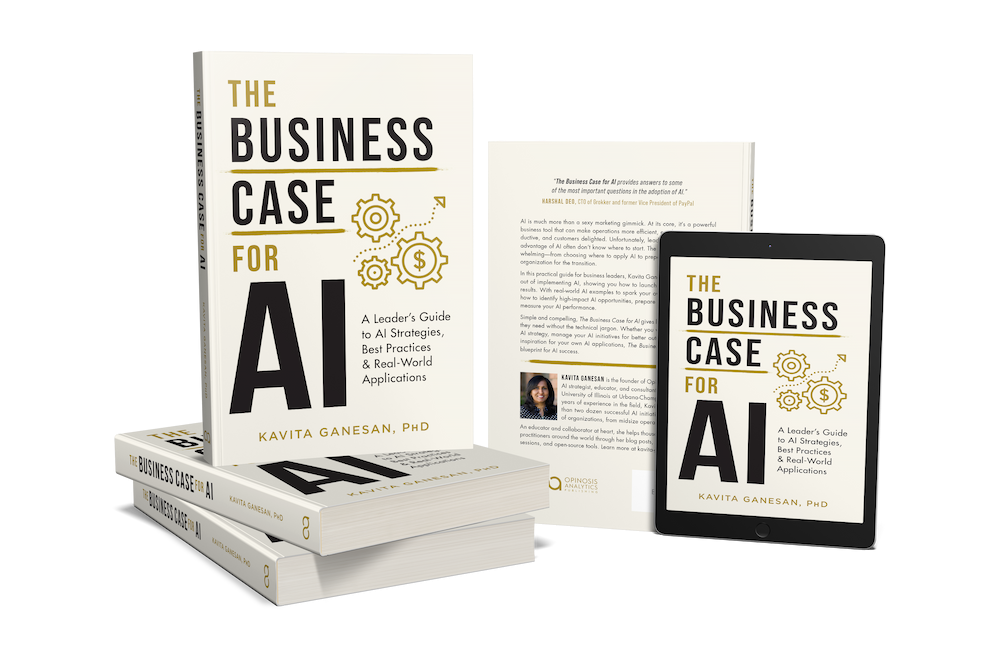
“We’re incorporating lessons learned from recent deployments, highlighting the critical importance of responsible AI thinking and updated strategic approaches,” Dr. Kavita Ganesan explains. The new edition will address the challenges organizations face in today’s rapidly evolving AI landscape while maintaining the foundational principles that made the first edition valuable.
Simultaneously, Opinosis Analytics is developing a suite of tools designed to drastically speed up various workflows within the enterprise. These tools remain in development, with details to be shared as they are released. This work represents a natural evolution, applying the strategic principles Dr. Kavita Ganesan has developed to create practical solutions that demonstrate AI’s potential when properly implemented.
A VISION GROUNDED IN REALITY
Dr. Kavita Ganesan’s career stands as a testament to the power of combining deep technical expertise with strategic thinking and unwavering commitment to realistic expectations. Through Opinosis Analytics, she has built an organization that embodies these principles, helping clients navigate an industry often dominated by hype and unrealistic promises.
The Opinosis Analytics approach challenges conventional wisdom about AI adoption. Rather than selling tools and promising transformation, the company insists on understanding problems first. Rather than treating AI as magical technology, the team demystifies it while respecting its complexity. Rather than chasing every new trend, Opinosis Analytics evaluates technologies based on their actual potential to solve real business problems.
This grounded approach has proven its value across nearly two decades and countless implementations. Organizations that work with Dr. Kavita Ganesan and Opinosis Analytics avoid the pitfalls that doom most AI initiatives. They achieve measurable results rather than accumulating failed experiments. They position themselves for lasting competitive advantage rather than short-term wins followed by disillusionment.
As AI continues evolving at a breathtaking pace, leaders like Dr. Kavita Ganesan provide essential guidance for navigating the hype and identifying genuine opportunities. Through Opinosis Analytics, she ensures that more organizations develop the capabilities needed to succeed. Her legacy—and that of her company—will be measured not in the AI tools developed but in the strategic thinking instilled in leaders across industries.
To learn more about how Opinosis Analytics helps organizations achieve AI success through strategic clarity and technical excellence, visit www.opinosis-analytics.com.