

Redefining regional integration through collaborative leadership and the architecture of sustainable impact ecosystems in Latin America.
From January 27 to 30, 2026, I participated in the International Economic Forum of Latin America and the Caribbean (CAF), held in Panama City an event that brought together more than 6,500 leaders from 70 countries, including seven sitting presidents and one president-elect, as well as ministers, CEOs, and multilateral authorities.
It was an honor to participate as a special guest of the National Confederation of Industry (CNI), with the support of CAF – Development Bank of Latin America and the Caribbean, and in collaboration with the Brazilian Network of International Negotiation Centers and the National Forum of Women Entrepreneurs (FNME). This allowed me to engage in strategic conversations and exchange experiences with regional and global leaders.
At the welcoming meeting for the Brazilian and Mercosur delegation, the CNI Director and Manager of International Trade and Integration emphasized:
“We can contribute by generating synergies and joining forces. Being present in discussions, raising our hands, engaging in articulation work, calling for dialogue let us see this moment as a new beginning, replicating our work and best practices in favor of the economy…”
With this vision, the regional dialogue began, leaving a key lesson: integration is not a political narrative it is a concrete economic practice.
Trade, Logistics, and Integration: Foundations of Competitiveness
Trade was at the center of the agenda, with discussions on regional integration, efficient logistics, and multilateral cooperation. During his remarks, President Lula highlighted Brazil and Mercosur’s recent trade agreements, underscoring that greater regional integration is essential to addressing present and future challenges.
However, Latin America’s intraregional trade remains lower than that of Europe, North America, or Asia. Logistics continues to be one of the main challenges to overcome. CAF and other development banks play a critical role in reducing risk in infrastructure project financing, working in collaboration with private banks and ensuring due diligence.
Logistics costs were also a central topic in the Mercosur Industrial Council consultation led by CNI. It was estimated, for example, that trade costs for Barbados could be reduced by up to 40% if trade with Latin America were more direct, avoiding complex transshipment routes.
For the Global South, the lesson is clear: investing in modern infrastructure and productive integration strengthens economic sovereignty and expands negotiating capacity within the international system. It is not only about trading more it is about trading better and with greater strategic autonomy.
Women in Trade: From Evidence to Public Policy
During the forum, CNI, CAF, and the OECD launched a research initiative on Women in Trade, aimed at strengthening knowledge about women-led businesses.
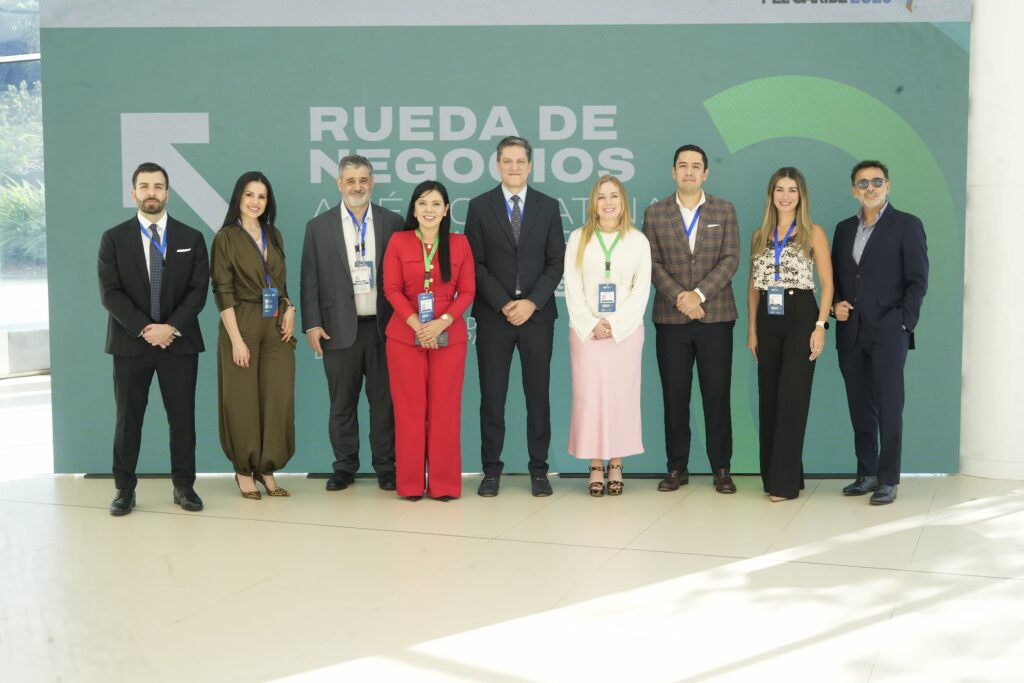
I observed that effective policymaking depends on clearly understanding existing challenges: access to financing, building international networks, and knowledge of global regulations.
From the global perspective that WEFEcuador contributes through its research, I emphasize the importance of having country-disaggregated data to generate real change. Women are already exporting; the issue is not talent, but systems. What is not measured is not managed; and what is not managed does not scale.
Main Obstacles to the Internationalization of Women-Led Businesses
1️⃣ Limited Access to Financing
Many women entrepreneurs face difficulties accessing credit, working capital, or financing for international expansion due to shorter credit histories, limited collateral, and structural discrimination.
Impact: Limits their ability to produce at scale and meet export requirements.
2️⃣ Lack of International Networks and Connections
Exporting requires contacts with distributors, agents, trade fairs, and strategic partners. Women often have more localized networks and less access to international circles.
Impact: Reduces opportunities for partnerships and contracts.
3️⃣ Information and Knowledge Gaps
Understanding regulations, tariffs, sanitary standards, logistics, customs documentation, and trade agreements is essential.
Impact: Lack of information or specialized training limits confidence and market access.
By seeking resources, weaving connections, and sharing knowledge, we discover our collective strength to open new opportunities and transform challenges into achievements.
Strategic Axis: Trade with a Gender Perspective and Productive Integration
In response to these challenges, it is imperative to incorporate gender-related provisions into trade agreements; support the internationalization of women-led businesses; and guarantee real, competitive, and sustainable market access.
This strategic axis requires alignment between trade, labor, and financial policies, articulating measures that reduce informality and eliminate regulatory and structural barriers.
A more inclusive trade agenda is not merely a social priority it is a structural strategy for competitiveness and resilience in emerging economies.
The Panama Canal: Logistics with a Human Face
I had the opportunity to visit the Panama Canal, an engineering feat where logistics reveals itself as a human and technological system that mobilizes global trade, economies, and lives.
In the last fiscal year, the Canal recorded more than 13,400 transits and moved 489 million tons, generating revenues exceeding 5.7 billion dollars. Feeling each vessel pass was a reminder that behind every shipment there are stories, economies, and families that depend on that movement.
Logistics is not only infrastructure it is economic architecture in action.
For Southern economies, strengthening strategic corridors, port digitalization, and infrastructure financing is part of building a more balanced and multipolar economic architecture.
Strategic Lessons with South–South Projection
The main lessons from the CAF Forum can also be read through a South–South lens:
1️⃣ Strategic cohesion: joining forces beyond national differences.
2️⃣ Internal growth: building strong regional ecosystems before competing globally.
3️⃣ Innovation and energy transition: drivers of productivity and economic transformation.
4️⃣ Structural inclusion: expanding the productive base by fully incorporating women into international trade.
In a transforming global order, cooperation among emerging economies is consolidating not as an alternative, but as a necessary complement for a more balanced and resilient trade system.
Participating in this forum reinforced my professional conviction: international trade is a living system that integrates infrastructure, human talent, and clear rules. Cooperation, innovation, and regional integration are strategic actions that determine the competitiveness and leadership of the Global South in a multipolar landscape.
The forum concluded with a shared conviction:
Integrate to grow: strengthening ourselves from within to transform our regions and interpret the global environment with strategic intelligence.
In an increasingly interconnected world, I remain committed to building global bridges, advancing regional leadership, and fostering innovation with purpose.
The leadership of the Global South is more than an aspiration: it is a strategic construction that integrates and includes, articulates collective will, builds trust, and acts with a long-term vision.