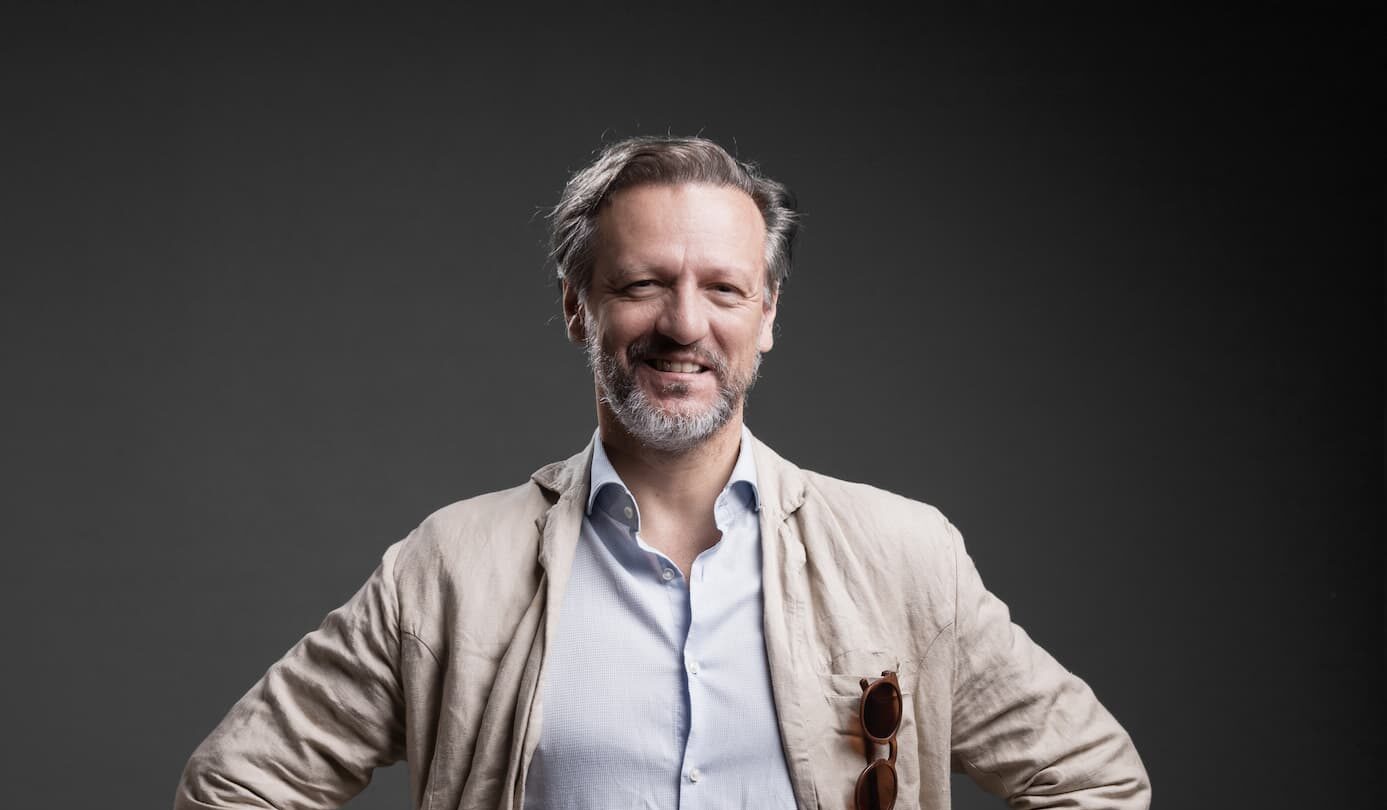
In a world obsessed with speed, performance metrics, and immediate results, one man has spent four decades teaching global leaders something counterintuitive: transformation begins not with action, but with awareness. Prof. Jürgen Paulus stands at the intersection of music, philosophy, neuroscience, information technology and business transformation, representing a rare breed of leadership architect whose methods defy conventional wisdom yet deliver extraordinary results across five continents.
His journey from jazz saxophonist performing under contract with Hyatt Hotels Corporation in the mid-1980s to becoming the trusted advisor to C-suite executives worldwide tells a story about the power of deep listening, conscious presence, and intergenerational thinking. With over 350 global transformation and CEO recruiting assignments spanning 35+ countries, Jürgen has developed what he calls “Human-AI Conscious Leadership,” a framework preparing organizations not just for tomorrow, but for 2050 and beyond.
“Legacy today is not about personal success or visibility,” Jürgen reflects. “It is about impact that remains coherent when you are no longer present.”
THE SINGLE TONE THAT CHANGED EVERYTHING
At the beginning of his jazz education, Jürgen’s teacher gave him an exercise that seemed almost trivial. Play one single tone every day, and be with this tone as ONE. Play it soft, then loud. Let it diminish, let it expand. Imitate the traffic in your head, modulate the frequencies, and sync with your environment and feelings.
“Only much later did I understand what I was really learning,” Jürgen recalls. “Jazz taught me awareness before complexity. Before speed, before virtuosity, before performance, there must be presence.”
This foundational lesson became the cornerstone of his leadership philosophy. Just as jazz musicians must listen deeply before improvising, leaders must sense their organizations, people, systems, timing, and energy before taking action. Without this listening capacity, freedom becomes noise. With it, transformation flows naturally.
His musical training in the mid-1980s as a jazz saxophonist and clarinetist sharpened his ability to listen and adapt in real time. These skills proved decisive when, between 1988 and 1991, he led the design of a decentralized European P&L system for Benckiser across Germany, Switzerland, and Austria, at a time when enterprise finance was still largely centralized on IBM mainframes.”Transformation does not start with action,” Jürgen emphasizes. “It starts with sensing. Just like in jazz, leadership is improvisation inside structure.”
FROM SCHOPENHAUER TO THE SUBCONSCIOUS: PHILOSOPHY, NEUROSCIENCE , AND JAZZ
While many consultants focus exclusively on strategy and process, Jürgen brings a radically different perspective shaped by philosophy, neuroscience, and lived experience with jazz. His study of Schopenhauer revealed a truth that explained countless leadership failures: most human decisions are not rational. They are driven by will, unconscious motivation, fear, and desire.
In jazz, this reality is never theoretical. A musician may intend to play a phrase precisely, yet tension, hesitation, or overcontrol immediately alters the sound. The body reveals what the mind attempts to hide. Paulus recognized the same pattern in leadership.
“Executives believe they are acting logically,” he observes, “while in reality they are reacting emotionally.” This insight transformed how he works with leaders. Rather than focusing exclusively on external systems and processes, he helps them recognize the inner drivers shaping their decisions, often long before conscious reasoning enters the picture.
His integration of Neuro-Linguistic Programming (NLP) provided practical tools to work with internal structures such as language patterns, belief systems, and internal representations. Hypnotherapeutic work allowed him to go deeper, into emotional memory and identity patterns that surface under pressure. In this sense, leadership work resembles jazz practice: listening closely to what is actually happening, not what one believes should be happening.
“Blending philosophy with subconscious work allows leaders to recognize their own inner drivers,” he explains. “When those drivers become conscious, behavior changes naturally, without force.” Like a jazz ensemble finding coherence not through control but through awareness, leaders regain clarity when internal dissonance is acknowledged rather than suppressed.
This integration of business expertise, philosophical depth, neuroscience, and musical discipline did not emerge in abstraction. It was shaped by diverse experiences spanning jazz performance, cybernetics, system dynamics, and logic programming. His early work co-developing one of the first circular economy models for the computer industry in Switzerland during the early 1990s further grounded this approach in systemic thinking, where feedback, timing, and coherence determine whether systems sustain or collapse.
REDEFINING LEGACY FOR AN INTERGENERATIONAL WORLD
Jürgen’s understanding of legacy has evolved significantly over decades of global work. What began as a focus on building systems that did not destroy their own foundations has expanded into something more profound and far-reaching.
“Today, legacy is intergenerational,” he states. “It is about whether today’s decisions still make sense in 2050 and beyond, socially, technologically, and ethically.”
This evolution led to the creation of Legacy X 2050, an initiative designed to help leaders think and act beyond immediate cycles. The concept emerged from decades of observing how short-term thinking undermines long-term systems, creating organizations optimized for quarterly results but unprepared for generational challenges.
“Jazz Your Legacy means acting with freedom, but never without responsibility toward future generations,” Jürgen explains. This philosophy encapsulates his approach: combining the improvisational freedom of jazz with the disciplined accountability required for sustainable transformation.
THE BLIND SPOTS HIDING IN THE C-SUITE
As someone who has worked intimately with global CEOs across multiple continents, Jürgen has identified patterns that distinguish truly effective leaders from those who merely appear successful. The most common blind spot, he notes, is not lack of intelligence. It is lack of inner coherence.
“Many leaders believe they are rational while being driven by unconscious fear, ego, or control patterns,” he observes. “These blind spots are amplified under pressure and even more so in AI-accelerated environments. Without self-awareness, power becomes fragile.”
The most powerful breakthroughs he has witnessed occur when leaders recognize the unconscious forces shaping their decisions. When fear, self-doubt, or control patterns become visible, leaders gain calm, clarity, and presence. At that point, transformation no longer requires pressure. It happens naturally.
He later developed the CEO Legacy Sandbox, a Jazz Your Legacy methodology that helps global-acting CEOs align personal purpose with corporate performance. “Leaders must understand their own value and inner drivers genealogy before they can lead organizations sustainably,” he explains. “Like jazz musicians, they must stay attuned to their inner rhythm while contributing to a collective structure. When personal purpose and corporate mission align, performance follows naturally.”
MENTORSHIP ACROSS GENERATIONS: FROM HIERARCHY TO RESONANCE
Jürgen views mentorship as essential for ensuring the continuity of wisdom across generations. Drawing on his jazz background, he observes that in music, mastery is not transmitted through instruction alone. Elder musicians do not control younger ones; they listen, respond, and set a tone that others gradually learn to inhabit.
In a jazz ensemble, experience is shared through presence. The younger musician learns timing, restraint, and courage not from hierarchy, but from resonance. Paulus recognized early that leadership development follows the same logic.
“Today, mentorship must be cross-generational,” he emphasizes. “Gen Z and Gen Alpha are not future leaders; they are present co-creators. Sustainable leadership emerges through dialogue, not hierarchy.” In an environment shaped by accelerating technology and compressed learning cycles, authority no longer flows top-down. It circulates.
His scholarship initiatives reflect this understanding of legacy in action. “Education is legacy in action,” he states. “Scholarships are investments not in careers, but in consciousness.” They are designed to create continuity beyond privilege, allowing insight, responsibility, and orientation to move forward even as contexts change.
This intergenerational perspective shapes his entire approach to leadership development. Just as jazz survives by being reinterpreted without losing its core, organizations preparing for 2050 must enable leadership consciousness that transcends age, role, and title, anchored not in hierarchy, but in shared rhythm and mutual listening.
HUMAN–AI CONSCIOUS LEADERSHIP: NAVIGATING THE ALGORITHM AGE
As artificial intelligence reshapes decision-making across industries, Jürgen has developed what he describes as Human–AI Conscious Leadership,, not as a theory, but as a way of remaining oriented in environments where intelligence is no longer external to work, but embedded within it.
AI is no longer a separate tool executives consult. It has become the software and application layer itself, the systems through which problems are framed, options are ranked, risks are weighted, and actions are triggered. Strategy, finance, supply chains, pricing, and risk management increasingly operate inside AI-mediated architectures long before human judgment formally enters the process. “AI generates insights at a scale humans cannot process alone,” he explains. “The bottleneck today is not information; it is orientation.”
In today’s world, geo-economic and geo-security logic is no longer defined primarily by armies or alliances. It has evolved into a systemic operating model, where tariffs, chips, cloud infrastructures, software platforms, payment systems, data access, and legal frameworks function as levers of strategic power. The United States moves swiftly and unilaterally, while Europe continues to rely on consensus and rule-based coordination. But in geopolitics, as in jazz, speed is power. You either move with the tempo, or you risk becoming noise.
This acceleration exposes a deeper vulnerability. AI systems may evolve, fragment, or even vanish in their current forms as platforms shift and architectures collapse. What remains constant is the leader’s responsibility to read the moment, to sense dissonance early, and to act with clarity under pressure. That is why Jazz Your Legacy is not a metaphor for creativity, but a conscious survival code for leadership in volatile systems.
Paulus’ vision for Human–AI conscious leadership therefore treats AI as amplification, not substitution. Intelligence can be automated; responsibility cannot. While AI-driven software will be indispensable for managing complexity, simulation, forecasting, and optimization, judgment, purpose, and accountability remain human.
“Purpose and ethics remain human tasks,” he insists. “AI can optimize decisions, but no algorithm can carry responsibility. No algorithm can carry legacy.” This distinction separates sustainable innovation from technological hype. “Sustainable innovation integrates technology, human behavior, and long-term impact,” he notes. “If one dimension is missing, innovation becomes short-lived.”
Jazz Your Legacy exists precisely to address this gap. Through what Paulus calls a responsibility architecture, it anchors intelligent systems in human awareness, cultural context, and intergenerational consequence, ensuring that innovation does not merely solve immediate problems, but contributes to continuity beyond the current cycle of technology, power, or growth.
LESSONS FROM 350 TRANSFORMATIONS ACROSS 35 COUNTRIES
Some of Jürgen’s earliest and most formative leadership alliances were built with Chinese CEOs during their market-entry phase in Brazil. His role was not advisory at a distance, but hands-on: supporting leadership teams as they entered the Brazilian market and translating strategy into local execution. What mattered most was preparing them to understand Brazil’s rhythm , how trust is built, how dealer networks function, how relationships precede contracts. “Getting ready to samba,” as he describes it, was not cultural symbolism but commercial reality. This was central in his work he initiated with CEOs such as ZTE and SANY, where long-term success depended less on formal structure and more on cultural fluency, local presence, and execution tempo.
On several long-haul flights between Europe and Brazil, Jürgen spent hours in conversation with Pelé and Ronaldo, not as icons, but as fellow travelers. They spoke sparsely. About pressure. Cities. Movement. What stays when performance ends. They didn’t explain legacy, they embodied it. Presence. Humility. Carrying oneself the same with or without an audience. Those hours felt like a lifetime, time spent with two extraordinary role models of performance and humility. In those conversations, hierarchy vanished. Different paths. Same frequency.
Jazz has always been inclusive. It does not demand sameness; it thrives on difference. Multiple voices, histories, and expressions coexist, not by forcing agreement, but by learning how to listen, respond, and stay in rhythm. This principle quietly underpins Jürgen Paulus’ global work across more than 35 countries.
Decades of transformation projects across Latin America, Asia, Europe, and beyond have given him a clear sense of what transcends cultural boundaries, and what requires deep cultural intelligence. Technology evolves rapidly, structures shift, and markets rise and fall. Human patterns, however, repeat.
“Technology changes. Human patterns repeat,” he observes. “The leaders who succeed are those who listen, align, and act with awareness under pressure. That lesson has remained constant across decades and continents.”
His work in Latin America and Asia proved especially formative. In both regions, Paulus encountered environments where formal structures mattered less than resilience, adaptability, historical awareness, and relational intelligence. Progress depended not on imposing models, but on understanding context, how trust is built, how decisions are influenced by memory, and how collaboration unfolds over time.
Jazz offered a familiar logic. In an ensemble, no single instrument dominates. Each carries its own voice, shaped by origin and tradition. Coherence emerges not through control, but through attentive interaction. Paulus recognized the same dynamic in cross-cultural transformation: sustainable outcomes depend on the ability to hold difference without fragmentation.
“Cultural intelligence begins with humility,” he states. “Leaders must understand that their own worldview is one option, not the standard. Listening across cultures is a leadership discipline.”
He views cross-border collaboration between emerging and developed markets as one of the greatest opportunities of the coming decades. Complementary strengths, innovation speed, resource depth, scale, and experience, can generate long-term value. Yet these collaborations are often strained by power asymmetries and short-term agendas.
As in jazz, sustainable collaboration requires more than technical excellence. It requires mutual respect, shared rhythm, and a long-term vision that allows different voices to remain distinct while contributing to a common direction. Where this balance is achieved, transformation endures. Where it is ignored, even the most sophisticated strategies lose their resonance.
THE NEXT-GEN X LEADER: CONSCIOUSNESS OVER CHRONOLOGY
When asked what kind of leader will thrive in 2050, Jürgen Paulus does not point to an age group. He introduces a different distinction altogether.
“The leaders of 2050 will be Next-Gen X Leaders,” he explains, “defined not by birth year, but by consciousness.”
In jazz, generations do not replace one another; they play together. Experience, youth, experimentation, and tradition coexist in the same ensemble. What matters is not chronology, but the ability to listen, respond, and stay in rhythm while the music evolves. Paulus sees the same pattern emerging in leadership.
Next-Gen X Leaders operate simultaneously across human, AI, geopolitical, and ecological realities. They are fluent in technology without being dominated by it, globally connected without losing local sensitivity, and fast without becoming reactive. What differentiates them is not competence alone, but inner orientation.
This is where his HAIC framework, Human-AI Integrated Consciousness, comes into play. It is not a management system, but a way of staying grounded when intelligence is distributed across software, data, machines, cultures, and power structures. Like jazz, it provides structure without rigidity and freedom without chaos.
His guidance to Gen Z and Gen Alpha leaders stepping into global influence reflects this logic. “Stay human. Stay curious. Don’t outsource your conscience to technology. Learn to listen deeply before you act.”
The advice is deliberately simple. As technological capability expands exponentially, Paulus observes that the scarcest leadership qualities remain unchanged: presence, listening, timing, and ethical judgment. These cannot be automated, accelerated, or delegated.
In Jazz Your Legacy, Next-Gen leadership is therefore not about replacing older generations, nor about waiting one’s turn. It is about cross-generational play, where different ages, cultures, and perspectives contribute distinct frequencies to a shared direction.
The leaders who will endure are those who can hold this complexity without fragmenting. Those who understand that legacy is not handed over at a certain age, but played forward, together.
A MESSAGE FOR 2050: THE LEGACY OF PRESENCE
When asked what message he would leave for future CEOs reading this article in 2050, Jürgen’s response distills the essence of his life’s work into three simple directives:
“Reduce noise. Find your tone. Stay present.”
He adds:
“Legacy is not an outcome. It is a state of being practiced over time. Like jazz.”
This perspective marks the culmination of a long journey, from jazz clubs to boardrooms, from single tones to global transformation initiatives, from individual performance to intergenerational impact. Across all of it, one thread remains constant: disciplined awareness, the courage to look inward, and a commitment to creating impact that extends far beyond any individual tenure.
Prof. Jürgen Paulus represents a new archetype of leadership architect, one who understands that the most enduring transformations occur not through force, but through consciousness; not through control, but through listening; not through short-term optimization, but through long-term responsibility.
As organizations worldwide grapple with accelerating technological change, geopolitical tension, and mounting societal challenges, his work offers a grounded point of orientation. The integration of music, philosophy, neuroscience, and business forms a leadership approach suited for an era that demands both technological sophistication and human wisdom.
“Jazz Your Legacy” is more than a tagline.
It is an invitation to lead with the freedom of improvisation and the discipline of responsibility, playing not just for today’s audience, but for generations yet to come.