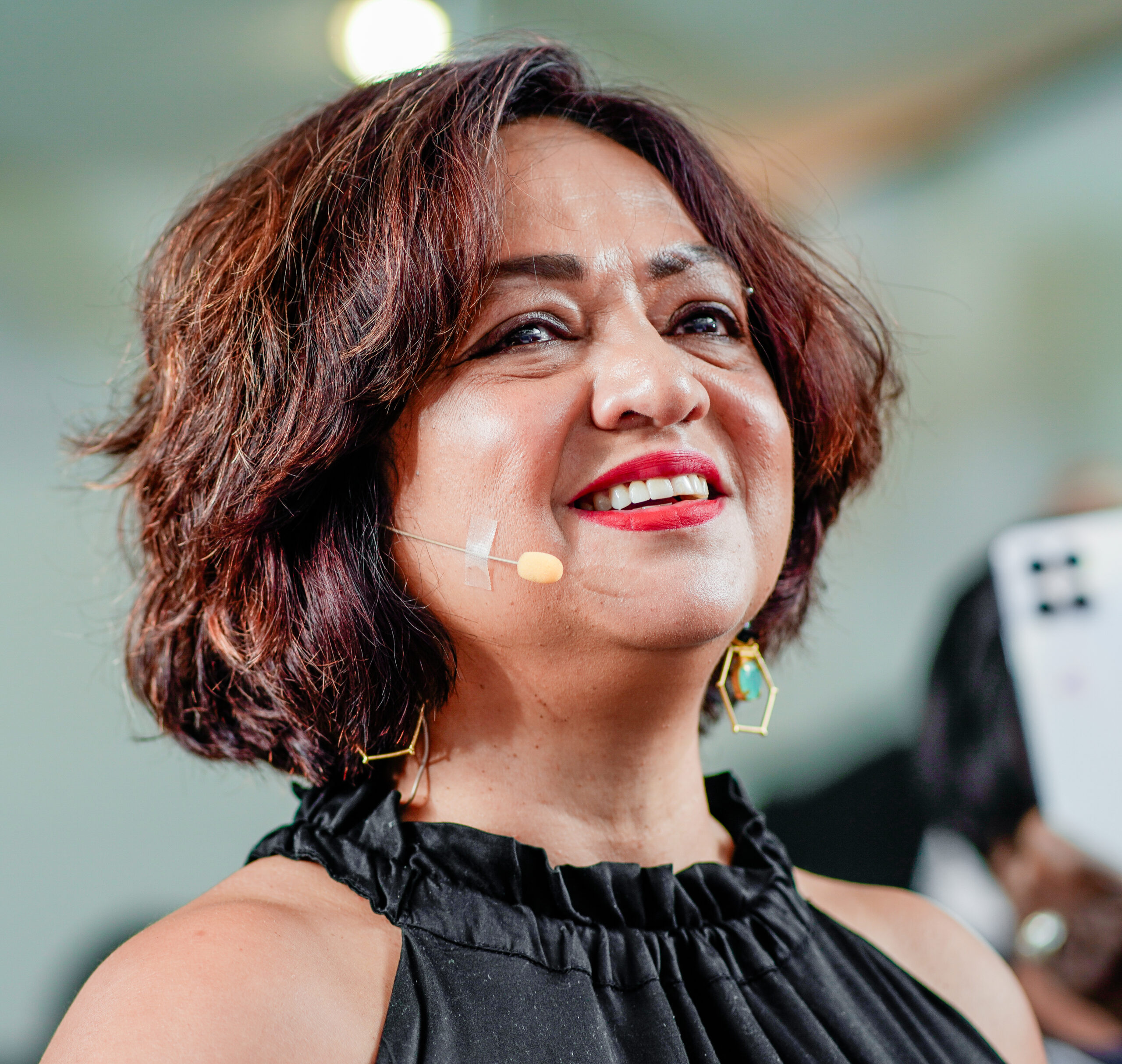
In the unequal landscape of apartheid-era South Africa, a young Fatima Collins absorbed lessons that would take decades to crystallize into purpose. Growing up in a system designed to limit choices and access, she witnessed firsthand how inequality doesn’t just constrain individual lives but fractures entire communities. These early experiences planted seeds that would eventually bloom into a career dedicated to dismantling barriers and building pathways for those denied opportunity.
“Having been a victim of an unjust social system, I understand what access and empowerment can do for the youth,” Fatima reflects, her words carrying the weight of lived experience transformed into actionable commitment.
Her journey to becoming one of Africa’s leading voices in sustainable development and women’s empowerment was anything but linear. It began in the sterile precision of diagnostic laboratories, where she worked as a microbiologist after completing her BSc at the University of Witwatersrand in Johannesburg. The microscope revealed truths about cellular structures, but it couldn’t answer the questions forming in her mind about social structures and human potential.
From South African labs to UK facilities and then to an international development agency in Toronto, Fatima found herself following a thread she couldn’t yet name. “On my return to South Africa, I continued to work in the sciences which I found quite uninspiring,” she admits. The work paid bills but left her soul untended.
The search for meaning led her back to academia and into the world of corporate banking in India. The financial rewards were substantial, the work intellectually engaging, yet something essential remained missing. “I felt that I was making no contribution to the lives of disadvantaged communities in the world,” she explains. This realization became the turning point that would redirect everything.
Her MBA, focused specifically on development and entrepreneurship, became the bridge between her diverse experiences and her emerging purpose. What had seemed like a rudderless journey suddenly revealed its pattern. The microbiologist understood systems. The banker understood capital flows. The development specialist understood community needs. Together, these perspectives would form a unique lens through which Fatima would approach Africa’s most pressing challenges.
CONSCIOUS CAPITALISM: WHERE PROFIT MEETS PURPOSE
Fatima’s transition into development advisory and impact consulting through corporate social responsibility marked more than a career shift. It represented a philosophical stance on how business should operate in the 21st century. Her conviction is clear and uncompromising: “Nothing grows successfully in isolation and that holds true for economies. We need to grow the local communities in which we operate to be sustainable in the long term.”
This principle of conscious capitalism challenges the traditional extractive model that has long defined industries like mining across Africa. The colonial legacy left a continent rich in resources but often destitute in wealth distribution. Fatima’s perspective, forged in both personal experience and professional expertise, recognizes this paradox with unflinching clarity.
“The African continent, which is my home, is also home to rich minerals and wealth sources that have been plundered and exploited by the colonial system. Our people are left destitute and betrayed by a world that benefits from our resources,” she states. The facts reinforce her point: while six of the world’s fastest-growing economies are in Africa, six of the ten most unequal economies are also found here. Africa holds the dubious distinction of being the most unequal continent when measured by Gini coefficients.
Yet within these stark realities, Fatima sees extraordinary potential. With 75% of Africa’s population under 25, the demographic opportunity is immense. However, the infrastructure gaps are equally staggering. Only 38% of Africans have access to electricity. Just a quarter of the continent’s roads are paved. These aren’t mere statistics to Fatima but tangible barriers to the empowerment she envisions.
Her work at organizations including the Development Bank of Southern Africa and the World Bank equipped her with both the technical skills and the systemic perspective needed to address these challenges. More importantly, it reinforced her belief that sustainable development requires moving beyond charity models to strategic, ethical business practices that create shared value.
BUILDING MORE THAN ROADS: INFRASTRUCTURE AS SOCIAL TRANSFORMATION
When Fatima established a development advisory unit within a civil engineering business, she brought a revolutionary perspective to an industry traditionally focused on concrete and steel. Her vision extended far beyond physical structures to encompass the human ecosystems those structures serve.
“Beyond the building and roads, how do we create economic hubs, social assets and human-centric infrastructure that considers the needs of marginalised communities,” she poses as both question and mission statement.
The challenge was significant. “The greatest challenge I faced was adjusting the mindsets of technical engineers to that of social engineers,” Fatima recalls. Engineers are trained to solve problems with precision and measurable outcomes. Fatima needed them to expand their definition of what constitutes a successful project outcome.
Her framework for infrastructure development recognizes that in order to grow economies, linkages and networks are required. But sustainable impact demands more than connectivity. It requires deliberate integration of community development into every project phase. This means conducting skills assessments to identify local unemployed youth who can be directly sourced onto projects. It means ensuring skills transfer so communities can maintain infrastructure long after contractors leave. It means developing transferable capabilities that enable employment beyond any single project’s lifespan.
The economic imperative supports this approach. Studies demonstrate that poor road, rail, and port facilities add 30% to 40% to the costs of goods traded among African countries, adversely affecting private sector development and foreign direct investment flows. But Fatima’s vision pushes further still, advocating for the development of local industries and small businesses that can participate in projects and the establishment of parallel industries that create lasting economic ecosystems.
This perspective transforms infrastructure from a one-time intervention into a catalyst for long-term social and economic transformation. Roads become opportunity corridors. Bridges connect not just places but possibilities. Power grids illuminate futures.
REWRITING THE MINING NARRATIVE: FROM EXTRACTION TO PARTNERSHIP
As Regional Head for Women in Mining at Sibanye Stillwater, Fatima operates at the intersection of multiple transformations: gender equity in a male-dominated sector, sustainable community development in mining regions, and the reimagining of how extractive industries engage with the communities from which they extract value.
Her objectives are clear and measurable: increase female representation through attraction, retention, and development of women, and ensure a safe and conducive environment for women to thrive in. These goals might sound straightforward, but the barriers are deeply entrenched.
Mining remains one of the most stubbornly male-dominated industries globally. The barriers women face include unconscious bias across both genders, physically challenging work environments, limited numbers of women pursuing required technical career paths, and the persistent threat of gender-based violence and harassment in the workplace.
Rather than accepting these barriers as immutable, Fatima has built a comprehensive Women in Mining office that runs initiatives across every dimension of the business. The approach is systematic and strategic, addressing human resources through identification of high-potential females for succession and development of attraction and retention strategies. Infrastructure and technology teams monitor and upgrade facilities to ensure women are safe and supported, conduct incident-based risk assessments specifically for women in mining, and innovate technology to support women working underground.
Employee change management programs include Women Voice Workshops and Leading Inclusively sessions that shift organizational culture at its foundations. Communications platforms amplify women’s experiences and contributions. Perhaps most critically, established Gender-Based Violence support centers operate in both geographical locations, backed by robust reporting frameworks and training programs that make zero tolerance more than a slogan.
The learning and development dimension includes collaborations with business schools for higher education programs targeting high-performing women, creating pathways for advancement that were previously blocked or invisible.
The results speak to the effectiveness of this holistic approach. In just four years, despite challenging business conditions, female representation increased from 12% to 19%. Women now hold 30% of management positions. Gender-based violence is being successfully addressed through the combination of awareness campaigns, reporting mechanisms, and remedial action.
These aren’t merely corporate diversity metrics. They represent lives transformed, families supported, and an industry beginning to reflect the full spectrum of human talent and perspective.
THE COMMUNITY COMPACT: STAKEHOLDER ENGAGEMENT AS STRATEGIC IMPERATIVE
Fatima’s approach to stakeholder engagement and community collaboration reflects her deep understanding that sustainable project outcomes require more than technical excellence. They demand meaningful, respectful dialogue that honors local customs, traditions, and culture.
At Sibanye Stillwater’s South African operations, this philosophy materializes through tools like stakeholder perception indices that track community priorities and perceptions. This data-driven approach to understanding enables tailored responses to issues ranging from employment and transparency to local procurement.
Community collaborations are implemented largely through Social and Labour Plans, regulatory instruments tied to mining rights that ensure corporate commitments translate into concrete actions. But Fatima’s vision extends beyond regulatory compliance. “We seek to create shared value that extends the benefits of our operations to the community,” she explains. Active partnerships with government and other stakeholders amplify reach and enhance sustainability of outcomes.
Feedback loops and ongoing assessment processes ensure engagement improves over time, adapting to changing community needs and evolving circumstances. This iterative approach recognizes that community development is not a project with an end date but an ongoing relationship requiring continuous attention and adjustment.
Enterprise and socio-economic development within mining regions plays a central role in this vision. In a country with South Africa’s history of mining-led inequality and dependence on single-industry economies, targeted interventions can create diversified, resilient local economies. They build skills, businesses, and leadership capacity. They enable inclusive participation in economic value chains and support long-term development that extends beyond mining’s finite lifespan.
The measurement and evaluation frameworks Fatima employs are based on input, output, outcome, and impact indicators decided at project inception. She distinguishes between outputs achieved in the short term and impact realized over medium and long-term horizons. Social and economic projects are evaluated on their sustainability and contribution to specified social and economic indicators. For Women in Mining specifically, impact is measured through retention, succession, progression, and safety outcomes.
ENVISIONING AFRICA’S FUTURE: SMART VILLAGES AND SOCIAL COHESION
When Fatima looks toward the emerging trends that will redefine Africa’s sustainable development landscape in the coming decade, her vision is both technologically informed and deeply humanistic. She sees technology and fintech enabling access to education, finance, and markets. She advocates for development focused on inclusion across water, energy, and agriculture sectors.
But her most provocative insight challenges conventional development thinking: “The creation of smart villages across Africa instead of smart cities.” This reframing recognizes that urbanization strategies copied from other contexts may not serve Africa’s unique demographic and geographic realities. Smart villages could distribute opportunity more equitably while preserving community structures and cultural continuity.
Central to this vision is “maintaining the spirit of ubuntu as opposed to creating individualist ideologies.” Ubuntu, the African philosophy emphasizing our interconnectedness and collective humanity, offers an alternative to Western individualism that may prove more sustainable and more aligned with African values.
“While we address trends, we need to consider that Africa has a history of AIDS orphans, child-headed households, and severe trauma,” Fatima reminds us. “While innovating we must also rebuild social cohesion.” This acknowledgment of historical and ongoing trauma as a development consideration demonstrates the depth of Fatima’s systems thinking. Technology and infrastructure matter, but healing and connection form the foundations upon which everything else must be built.
For mining specifically, Fatima believes African countries can enhance collaboration by learning from South Africa’s regulatory framework. “South Africa has a very well-governed mining industry through the Department of Minerals Resources and Energy. For a licence to operate, mining operations need to commit to responsible mining practices in communities,” she notes. This governance model, which she has helped shape and implement, could provide a template for responsible resource extraction across the continent.
LEADERSHIP FROM THE INSIDE OUT: VALUES THAT ENDURE
Twenty-eight years into a career that has spanned continents, sectors, and countless transformations, Fatima’s leadership remains anchored in core values: respect, integrity, and inclusion. These aren’t abstract principles but lived commitments that shape her inclusive leadership style, which she describes as people-centered and equitable.
The principles of psychological safety, transformation, and empowerment define how she leads. Creating environments where people feel safe to speak, to fail, to grow, and to challenge becomes the precondition for meaningful change. Transformation without psychological safety often becomes performative rather than substantive.
Maintaining balance between high-impact professional work and personal wellbeing requires intentional practice. As a certified yoga practitioner, Fatima has found that her practice supports her lifestyle and allows her to maintain balance. “My dedicated routine allows me to stay physically fit while quietening my mind,” she explains. Regular meditation maintains clarity of mind, essential for someone navigating the complex stakeholder landscapes and strategic challenges that define her work.
This integration of contemplative practice with strategic leadership offers a model particularly relevant for those addressing intractable social challenges. The inner work supports and sustains the outer work.
ADVICE FOR THE NEXT GENERATION: AUTHENTICITY AS COMPETITIVE ADVANTAGE
When Fatima addresses young African women aspiring to lead in development, sustainability, or mining sectors, her message is both simple and profound: “Authenticity is key for diversity, and we need young women that understand the African context, who can bring diverse thought to these sectors and transform male-dominated sectors.”
This emphasis on authenticity challenges the assimilation model that has often characterized diversity efforts. Rather than asking women to adapt to existing cultures and norms, Fatima envisions them bringing their full selves, their contextual knowledge, and their distinct perspectives to transform industries from within.
Her vision for the future of women’s leadership and participation in Africa’s mining and infrastructure sectors encompasses several dimensions. She sees evolution from mere representation to real influence in decision-making and strategic direction. As more females engage in STEM careers through targeted interventions, the pipeline of future women leaders expands. Her vision includes increased representation, inclusive management control, growth rooted in skills and safety, and meaningful accountability.
These elements combine to create conditions where women’s participation reshapes industries rather than simply filling quotas within existing structures.
THE TURNING POINTS THAT SHAPE US
Looking back across her career, Fatima identifies defining moments not in linear promotions or accolades but “in experiences that came from diverse working environments, people that showed compassion and courage, and leadership that prioritizes service over status, people over position, and joint accountability in teams.”
This reflection reveals what truly forms leaders capable of driving systemic change. Technical expertise matters. Strategic thinking counts. But the transformative capacity emerges from exposure to diverse contexts, encounters with people embodying values in action, and experiences of leadership models that prioritize collective success over individual advancement.
The microbiologist in diagnostic labs, the banker in India, the development specialist at multilateral institutions, each contributed essential perspectives. The coherence emerged not despite the diversity of experience but because of it.
A VISION FOR CONSCIOUS BUSINESS IN AFRICA’S TRANSFORMATION
Fatima’s long-term vision synthesizes her decades of experience into a comprehensive framework for how business can drive African transformation: “An Africa where conscious business accelerates human potential, strengthens institutions, and builds resilient local economies, not as charity, but as a strategic, ethical way of doing business.”
This vision fundamentally reframes the relationship between business and development. It represents “shifting from extraction to partnership, and from dependency to dignity.” Conscious businesses align profit with purpose and long-term value creation by embedding environmental, social, and governance considerations, ethics, and inclusion into core strategy rather than treating them as peripheral initiatives.
In this model, business becomes a force multiplier for development, not merely a source of capital. The key drivers shaping Africa’s journey toward inclusive growth and economic resilience include people-centered development, diversified and integrated economies, strong institutions and ethical leadership, private sector innovation and entrepreneurship, and technology, infrastructure, and climate resilience.
The most successful Corporate Social Investment strategies, in Fatima’s experience, share common characteristics. They are focused, context-driven, and oriented toward long-term impact rather than short-term visibility. They are partner-led and well-governed, recognizing that sustainable solutions require local ownership and expertise. They are measured, adaptive, and focused on capacity-building rather than creating dependencies.
“When executed well, CSI moves from being a cost center to a strategic investment that delivers lasting social impact and strengthens the organisation’s social licence to operate,” Fatima explains. The strategic dimension is crucial: effective CSI aligns with the core business rather than existing separately from it.
THE LEGACY BEING BUILT
Fatima Collins represents a generation of African leaders who refuse to accept false choices between economic growth and social justice, between business success and community empowerment, between global competitiveness and local dignity. Her career demonstrates that these apparent tensions can be resolved through strategic thinking, ethical commitment, and sustained effort.
From the laboratories of her early career to the boardrooms and mine sites where she now shapes policy and practice, from the yoga mat where she finds balance to the lecture halls where she shares wisdom, Fatima embodies an integrated approach to leadership and life.
Her work in increasing women’s representation in mining from 12% to 19% in four years matters not just as a metric but as a multiplier. Each woman brought into the sector brings different perspectives, asks different questions, and opens pathways for others. The 30% women in management positions represent not just gender equity but cognitive diversity in strategic decision-making.
The infrastructure projects approached through a development lens don’t just connect places but create economic ecosystems. The stakeholder engagement processes don’t just manage community relations but build genuine partnerships based on mutual respect and shared value creation.
As Africa navigates the complex terrain of the 21st century, balancing resource development with environmental stewardship, economic growth with social cohesion, technological advancement with cultural preservation, leaders like Fatima provide essential guidance. Her journey from the constraints of apartheid to the expansive vision of conscious capitalism across a continent demonstrates that transformation is possible when purpose, persistence, and principle align.
“My long-term vision is for an Africa where conscious business accelerates human potential, strengthens institutions, and builds resilient local economies,” Fatima states. This isn’t aspiration detached from action but a framework being implemented one project, one policy, one person at a time.
The road from injustice to empowerment runs through the choices we make about how business serves society, how industries include or exclude, how resources extract or contribute. Fatima Collins has spent 28 years mapping that road, removing barriers along it, and lighting the way for those who follow.
Her legacy won’t be measured in tonnage extracted or profits generated but in potential unlocked, dignity restored, and futures made possible for communities and individuals across Africa. In an era demanding leaders who can integrate profit with purpose, growth with equity, and innovation with tradition, Fatima’s career provides both inspiration and instruction.
The journey continues. The demographic dividend awaits development. The resources remain abundant. The question isn’t whether Africa can transform but whether business will embrace its role as partner in that transformation. Fatima Collins has answered that question through decades of committed action. Her work invites others to do the same.