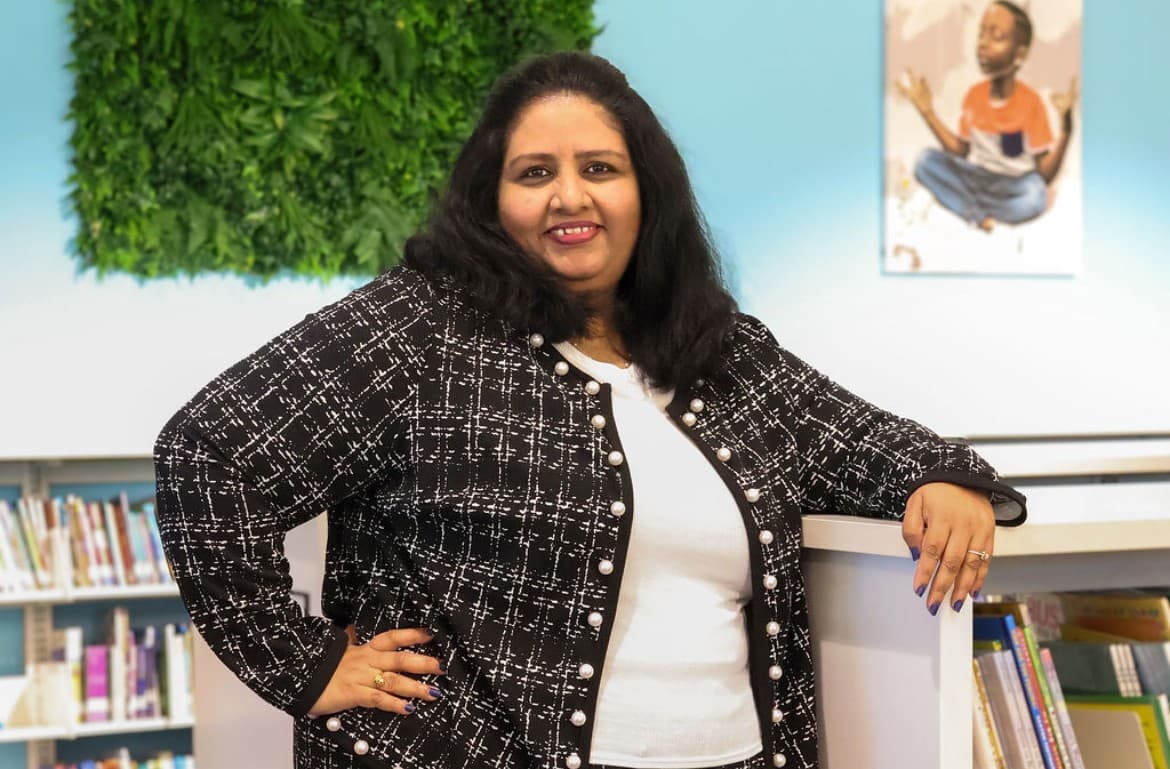
In the landscape of education, some of the most transformative teachers never planned to enter a classroom. Dr. Kavitha Rathinam’s story begins not with childhood dreams of teaching, but with a complete redirection of life’s compass. Like many Indian families, hers envisioned a future in medicine. Yet in 2014, what began as simply securing employment evolved into something far more profound.
“Little did I know that I was meant to be a teacher, or say it ‘a calling,’” Dr. Rathinam reflects on that pivotal moment. What started as necessity transformed into purpose through the relationships she built with students and the deep connections that revealed education’s transformative power, especially in mathematics, a subject too many students fear before they ever attempt it.
Today, twenty-one years later, her journey spans two continents, multiple cultures, diverse grade levels, and evolving leadership roles. Teaching across India and the United States has reinforced her conviction that education remains the strongest tool for changing life trajectories. What continues to fuel her passion is witnessing students discover their own potential, mentoring new educators, and contributing to systems that uplift both teachers and learners.
“Every year brings new challenges, new insights, and new students whose growth reminds me why I began this journey,” she shares, her voice reflecting the energy that has sustained her through two decades of educational transformation.
BEYOND ONE SIZE FITS ALL: DISCOVERING EDUCATION’S TRUE PURPOSE
Dr. Rathinam’s teaching portfolio reads like a comprehensive study in educational diversity. She has worked with gifted students pushing boundaries of advanced learning, supported struggling learners finding their mathematical footing, and mentored educators navigating culturally different environments. Each population has contributed unique insights into what education truly means.
Moments like this make me remember the quote ‘Try to be a rainbow in someone’s cloud.’ Every year brings new challenges, new insights, and new students whose growth reminds me why I began this journey.
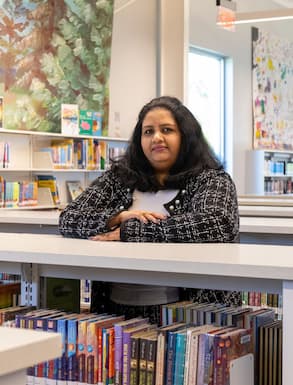
These diverse experiences have taught her the fundamental ineffectiveness of uniform approaches. The true purpose of education, she has discovered, extends far beyond mastering standards. It centers on empowerment. Gifted students remind her that even high achievers need challenge, depth, and emotional support. Students with academic struggles teach the value of patience, differentiation, and celebrating small victories. Mentorship reveals that educators themselves need guidance, encouragement, and belief, especially when working across cultural boundaries.
“True purpose of education is not simply mastering standards but empowerment,” Dr. Rathinam emphasizes. This philosophy has become the foundation of her teaching practice, informing how she structures classrooms, designs assessments, and builds relationships with every student who enters her sphere of influence.
BRIDGING TWO WORLDS: THE FUSION OF EASTERN AND WESTERN PEDAGOGIES
Having studied and taught in both India and the United States, Dr. Rathinam brings a unique bicultural perspective to mathematics education. Rather than viewing these systems as competing philosophies, she has synthesized their strengths into a comprehensive approach that honors both traditions.
Her Indian educational foundation provided structure, strong expectations, and academic rigor. The American system introduced flexibility, inquiry-based exploration, and emphasis on the whole child. From this fusion, she has developed an approach that balances high standards with personalized pathways, combines content mastery with social-emotional learning, and encourages student voice while maintaining clear learning objectives.
“While two learning systems vary, the core needs of a student are universal: belonging, relevance, and challenge,” Dr. Rathinam observes. This understanding has proven invaluable as she works with increasingly diverse student populations, each bringing unique backgrounds, learning styles, and mathematical anxieties into her classroom.
Her bicultural lens extends beyond pedagogical technique to fundamental questions about education’s purpose. She integrates India’s focus on foundational knowledge with America’s emphasis on critical thinking and creativity, creating learning experiences that prepare students not just for tests but for thinking mathematically in complex, real-world contexts.
REWRITING THE MATHEMATICS NARRATIVE: CULTIVATING GROWTH MINDSETS
Central to Dr. Rathinam’s work as a mathematics educator is her recognition that students’ beliefs about their abilities often influence performance more than the content itself. She has witnessed countless students arrive in her classroom already convinced they are “bad at math,” carrying years of mathematical trauma and fixed mindset thinking.
Transforming these beliefs requires intentional design of both classroom environment and instructional practices. Dr. Rathinam helps students see mathematics as a subject they can grow in rather than something predetermined by innate ability or talent.
She begins by modeling growth mindset through her own language and actions, sharing transparently about her learning process as an educator. She discusses moments when she has revised her thinking, sought feedback, or learned from mistakes. This normalizes struggle and positions learning as an ongoing journey rather than a destination.
“I intentionally build a space where mistakes are viewed as experience and not deficits,” Dr. Rathinam explains. In her classroom, errors become learning opportunities. She deliberately makes mistakes while solving problems, demonstrating that even experienced mathematicians encounter confusion and must work through challenges.
Her approach includes error analysis activities where students examine misconceptions, building metacognitive awareness about common pitfalls. Students engage in data chats where they set short-term and long-term goals, tracking their progress and reflecting on growth. Through this process, students begin shifting their internal narrative from “I can’t do this” to “I can’t do this yet,” a powerful transformation in a subject many find intimidating.
The results speak for themselves. Nothing resonates more than seeing students smile and say, “Oh, I get it now,” then step up to help their classmates. These moments of breakthrough, where fear transforms into confidence, represent the core purpose driving Dr. Rathinam’s teaching practice.
NAVIGATING THE MIDDLE SCHOOL MAZE: BUILDING MATHEMATICAL CONFIDENCE
With twelve years of middle school teaching experience in the United States and nine additional years in India, Dr. Rathinam brings deep understanding to one of education’s most challenging developmental stages. Middle school represents a transformative period involving simultaneous physical, emotional, academic, and social change. Students oscillate between motivation and shutdown, sometimes within the same class period.
Her strategies for building confidence begin with accessibility. She launches units with tasks allowing every student to inquire and discuss, typically starting at basic cognitive levels before increasing complexity. This ensures every learner can enter the mathematical conversation regardless of prior preparation.
Problem sequences are carefully constructed to scaffold learning while maintaining appropriate challenge. As complexity increases, she intentionally incorporates error analysis and misconception exploration, helping students understand that mistakes are part of the learning process rather than indicators of failure.
“Some days they’re highly motivated and eager to learn, while on other days they simply shut down,” Dr. Rathinam acknowledges. Her response involves creating multiple pathways to engagement through hands-on activities, real-world problems that make mathematics meaningful, collaborative learning structures, small group sessions, choice boards, and consistent encouragement.
These strategies recognize middle schoolers’ developmental needs for autonomy, belonging, and purpose. Rather than viewing their energy as a barrier to learning, Dr. Rathinam harnesses it through purposeful tasks that allow students to create, problem-solve, and reason. When given these opportunities in supportive environments, students flourish.
CHALLENGING THE GIFTED: NURTURING EXCELLENCE WITHOUT LOSING JOY
Teaching advanced learners presents unique challenges that require different instructional approaches. Dr. Rathinam’s honors and gifted students need both depth and freedom, requiring environments that sharpen abilities while fostering healthy, productive struggle.
Her approach emphasizes critical thinking, creativity, and problem-solving through open-ended tasks that increase reasoning ability and deepen conceptual understanding. Rather than simply accelerating through content, she provides opportunities for students to define problems and develop innovative solutions, building the thinking habits that will serve them throughout their educational journeys and professional lives.
Advanced learners benefit from unconditional environments where challenge is balanced with support. Dr. Rathinam ensures these students don’t simply race through procedures but engage with mathematics at conceptual levels that build genuine understanding. She cultivates curiosity and joy by providing intellectual challenge without creating anxiety or perfectionism that can undermine long-term mathematical identity.
RESEARCH-INFORMED PRACTICE: THE DOCTORAL DIFFERENCE
Dr. Rathinam’s Ed.D. in Curriculum and Instruction has profoundly strengthened her ability to design research-based instruction and grow as a reflective practitioner. Her doctoral journey deepened understanding of learning theory, differentiation, assessment design, and cultural responsiveness, all of which inform her approach to lesson planning and instructional decision-making.
This academic training supported her progression toward accomplished teaching, earning National Board Certification and now advancing toward becoming a National Board Ambassador. The research skills developed during doctoral study enable her to critically evaluate educational trends, separate evidence-based practices from passing fads, and make informed decisions about instructional strategies.
“My academic training has made me not only a stronger teacher, but also a more confident mentor to my colleagues,” Dr. Rathinam notes. This confidence translates into leadership roles where she guides fellow educators in implementing effective, student-centered instruction grounded in research rather than intuition alone.
Her dissertation, exploring international teachers’ perceptions in implementing US curriculum, emerged directly from her lived experience navigating two educational systems. This research has equipped her to support other international educators facing similar challenges, providing both empathy and practical strategies for cultural and pedagogical transitions.
TEACHING THE WHOLE CHILD: INTEGRATING MENTORSHIP INTO MATHEMATICS
Dr. Rathinam recognizes that many students need more than instruction. They require guidance, affirmation, and emotional support to fully engage in learning. Her approach seamlessly integrates mentorship into her role as mathematics educator, viewing these dimensions as inseparable rather than competing priorities.
“Teaching and mentorship go hand in hand,” she explains. Building relationships comes first because genuine connection allows her to understand students’ needs, challenges, and strengths. Not every student openly communicates their struggles, but creating a classroom climate where they feel safe and seen develops the trust necessary for meaningful learning.
Her mentorship practices include regular check-ins, expressing that she missed students when they’re absent, and incorporating humor that builds rapport. These seemingly small gestures create powerful impacts. Students frequently tell her, “You’re my favorite teacher,” reflecting the relational foundation she establishes in her classroom.
This relational approach doesn’t diminish academic rigor. Rather, it creates conditions where students feel secure taking intellectual risks, asking questions without fear of judgment, and persisting through challenging material. The emotional safety she provides becomes the foundation upon which mathematical confidence is built.
ENVISIONING MODERN TEACHING: NECESSARY SHIFTS FOR TOMORROW’S CLASSROOMS
Education today faces rapid evolution driven by technology integration, changing standards, and increasingly diverse student needs. Dr. Rathinam views education as a holistic system where learners, teachers, parents, and other stakeholders play equally important roles in fostering growth and driving change.
She strongly supports technology integration in classrooms, provided it enhances learning without compromising human connections. Technology should be tool rather than replacement for relationship-based teaching. Culturally responsive teaching and inclusive frameworks such as Universal Design for Learning help address diverse learning needs through varied instructional strategies.
“Presenting information and content in multiple ways accommodates different learning styles,” Dr. Rathinam explains, while emphasizing problem-solving and reasoning that create flexible pathways for learners. She advocates embedding vocational courses within curriculum to prepare students for real-world applications beyond traditional academic pathways.
Crucially, she recognizes that supporting teacher wellness and professional growth remains essential, especially during current teacher shortages. Access to ready-to-use resources can alleviate workload, allowing teachers to focus more effectively on student learning rather than being consumed by administrative tasks and resource creation.
Her vision extends beyond classroom walls to systemic structures supporting both educators and students. Sustainable educational improvement requires attending to all stakeholders’ needs, particularly teachers who remain the primary drivers of student learning.
DISPELLING MYTHS: THE TRUTH ABOUT TEACHING MIDDLE SCHOOLERS
A common misconception about middle school students suggests they are too distracted or emotional to engage deeply with academic content. Dr. Rathinam’s twenty-one years of experience proves otherwise. With appropriate structure, genuine respect, and purposeful tasks, their energy becomes an asset rather than a barrier to learning.
“When given opportunities to create, problem-solve, and reason, students thrive,” she notes. Middle schoolers flourish when their needs for belonging, autonomy, and purpose are recognized and supported. The key lies not in controlling their developmental energy but in channeling it toward meaningful learning experiences.
Her classroom practice demonstrates that adolescents are capable of sophisticated mathematical thinking when provided appropriate scaffolding and intellectual challenge. Their questions often reveal deep curiosity about how mathematics connects to real-world phenomena. Their social nature, sometimes seen as distraction, can be leveraged through collaborative learning structures where peer teaching reinforces understanding.
Rather than viewing middle school students through a deficit lens, Dr. Rathinam sees their tremendous potential. She meets them where they are developmentally while maintaining high expectations for what they can achieve with appropriate support and challenge.
LEADING FROM THE CLASSROOM: SUPPORTING FELLOW EDUCATORS
As an instructional leader, Dr. Rathinam extends her impact beyond her own students to support fellow educators in building effective, student-centered classrooms. Her dissertation focus on international teachers’ perceptions in implementing US curriculum sparked passionate commitment to mentoring educators new to the American educational system, supporting them throughout their acculturation period.
She also mentors novice teachers through South Carolina’s induction and mentoring initiative, providing guidance as they navigate early career challenges. Her support includes modeling student-centered strategies, leading professional development sessions, and engaging in collaborative planning that builds collective instructional capacity.
“It’s a great experience to share resources, encourage, and have reflective dialogue with peers,” Dr. Rathinam shares. These mentoring relationships create reciprocal learning where she continues growing as an educator while supporting others’ development. The collaborative culture she fosters extends beyond individual classrooms to build stronger instructional communities.
Her leadership approach recognizes that improving student outcomes requires strengthening teaching practice across entire schools and districts. By investing in fellow educators’ growth, she multiplies her impact far beyond the students directly in her classroom.
THE DUAL LENS: BRIDGING TEACHER AND ADMINISTRATOR PERSPECTIVES
Dr. Rathinam’s experience includes both classroom teaching and administrative roles, with teacher leadership positions in the United States and administrative experience in India. This dual perspective has profoundly influenced her approach to instruction and educational leadership.
Understanding both sides helps her bridge gaps between classroom realities and administrative imperatives. She appreciates the daily pressures teachers face while understanding the broader systems administrators must navigate. This dual understanding enables her to advocate effectively for colleagues while making sense of administrative initiatives that might otherwise seem disconnected from classroom needs.
Her administrative experience provides insight into resource allocation decisions, policy implementation challenges, and systemic constraints that shape educational practice. Simultaneously, her continued classroom teaching keeps her grounded in instructional realities, ensuring her leadership remains connected to the actual work of teaching and learning.
This integrated perspective makes her particularly effective in leadership roles where she must translate between different stakeholder groups, building bridges that strengthen educational communities and improve student outcomes.
THE MOMENT THAT DEFINES A CAREER: BECOMING A RAINBOW IN SOMEONE’S CLOUD
When asked about the moment that reaffirmed her calling as an educator, Dr. Rathinam reflects on students who return after years to share how her belief in them changed their entire academic path. These encounters, happening repeatedly throughout her twenty-one year journey, represent teaching’s most profound impact.
“Moments like this make me remember the quote ‘Try to be a rainbow in someone’s cloud,’” she shares. These words, borrowed from Maya Angelou, capture the essence of her teaching philosophy. Mathematics education, in her hands, becomes more than content delivery. It becomes an act of hope, encouragement, and possibility.
The students who return to express gratitude represent countless others whose lives were touched by her classroom presence. They remind her that teaching’s influence extends far beyond individual lessons or school years. The confidence she builds, the growth mindsets she cultivates, and the belief she demonstrates in students’ potential ripple outward in ways she may never fully know.
These moments sustain her through challenging days, remind her of teaching’s profound purpose, and reinforce that the work she does matters deeply. They validate that her unexpected calling, the path that diverted from medicine toward education, has created meaningful impact in students’ lives.
FINDING BALANCE: THE FOUNDATION OF FAMILY AND FUR BABIES
Outside the classroom, Dr. Rathinam’s strength, balance, and resilience as an educator are nurtured by her family and her four fur babies who share her home in the United States. Her parents, brothers, and their families in Mangalore, Karnataka continue grounding her emotionally, reminding her of the importance of joy, rest, and connection.
The distance from her extended family creates challenges, but these relationships remain central to her identity and wellbeing. Regular communication keeps her connected to her roots while building her life and career in a different country. This bicultural existence mirrors her professional life, where she bridges Indian and American educational traditions.
Her fur babies play meaningful roles in supporting her wellbeing, contributing to the stability and resilience she brings to her work as an educator. They provide unconditional affection, demand present-moment attention, and create routines that balance the intellectual and emotional demands of teaching.
This personal foundation enables her to bring her full self to the classroom. Teachers who maintain healthy work-life balance, who cultivate sources of joy and restoration outside school walls, are better equipped to meet students’ needs with energy, creativity, and emotional presence. Dr. Rathinam models this balance for colleagues and students alike.
A VISION FOR TOMORROW: TRANSFORMING THE FUTURE OF LEARNING
Looking ahead, Dr. Rathinam envisions a future where classrooms are inclusive, inquiry-based, culturally responsive, and centered on student voice. Her dream extends beyond her individual classroom to systemic transformation that benefits all learners and educators.
She imagines learning environments where diversity is celebrated as strength rather than challenge, where inquiry drives instruction rather than compliance with rigid curricula, where cultural backgrounds are honored as assets in learning processes, and where student voice shapes educational experiences in meaningful ways.
Equally important is her vision for teachers themselves. “I also dream of classrooms where teachers feel empowered to invest their time, creativity, and passion into meaningful learning experiences for the generations to come,” she shares. Sustainable educational improvement requires supporting educators’ professional growth, honoring their expertise, and providing conditions where they can thrive.
The impact she hopes to leave encompasses both immediate and long-term dimensions. For students, she wants to instill mathematical confidence, growth mindsets, and belief in their potential to achieve whatever they pursue. For educators, she aims to model student-centered practice, demonstrate the power of relationship-based teaching, and advocate for systemic changes supporting both teachers and learners.
Her legacy will be measured not just in test scores or college acceptances, but in the number of students who discover they can excel in mathematics, the educators she mentors who become transformative teachers themselves, and the communities of learning she helps build where everyone belongs and everyone can grow.
THE UNPLANNED JOURNEY THAT CHANGED EVERYTHING
Dr. Rathinam’s story reminds us that life’s unexpected redirections often lead to our most meaningful work. What began as simply securing employment evolved into a calling that has touched thousands of students across two continents and two decades. Her journey from reluctant teacher to passionate educator, from mathematics instructor to educational leader, demonstrates the transformative power of remaining open to where life leads.
Her integration of Eastern and Western pedagogies, her commitment to growth mindset cultivation, her skill in navigating middle school’s developmental complexities, and her dedication to mentoring both students and fellow educators create a comprehensive model of educational excellence.
As education continues evolving, voices like Dr. Rathinam’s provide essential guidance on maintaining human connection while embracing technological innovation, building inclusive classrooms that honor diversity, and supporting educators as they navigate increasing demands and expectations.
The future she envisions, where every student feels empowered to learn mathematics and every teacher feels supported to teach with creativity and passion, reflects her core belief in education’s transformative power. Through her classroom teaching, instructional leadership, and mentorship of colleagues, she continues working toward this vision, one student and one teacher at a time.
Her career proves that the most powerful educators don’t just teach content. They transform beliefs, build confidence, and become rainbows in students’ clouds, illuminating possibilities that students themselves couldn’t previously imagine. This is the mark of true educational leadership, the kind that shapes not just individual lives but the future of learning itself.