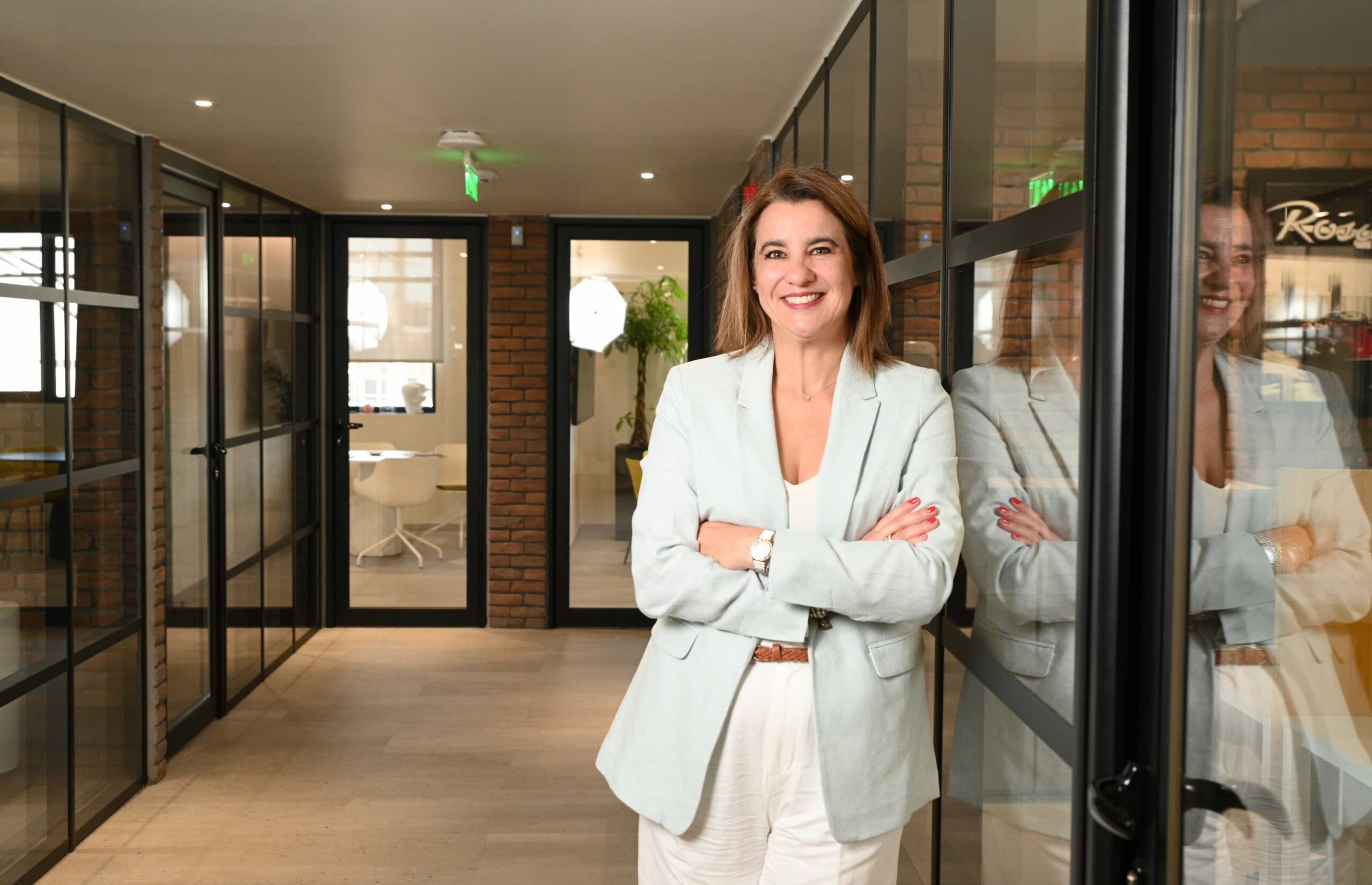
In a world where organizations chase the next trend while struggling to grasp the one after, Elena Kyrnassiou-Athanassoula stands as a rare breed of executive who doesn’t just predict the future but architects it. Her journey from mathematician to one of the most influential voices in strategic transformation reveals a fundamental truth: the spaces we inhabit, the systems we build, and the behaviors we cultivate are not separate elements but one living, breathing ecosystem.
“My journey began with my degree in Mathematics, a discipline which trained me to think about strategy, systems, patterns, and long-term consequences,” Elena reflects. Yet it was her equal draw to architecture and the human stories carried by space that would ultimately define her unique perspective. Early in her career, a crucial insight emerged that would shape everything to follow: when design links to strategy, brand meaning, customer experience, and operational reality, it reshapes behavior and performance beyond mere appearance.
This revelation became the foundation of her three-decade leadership at STIRIXIS Group, where she has pioneered an approach that treats space, process, and culture as inseparable forces. As global volatility intensified, Elena moved deeper into strategic foresight, developing methodologies to translate emerging signals into resilient board-level choices and future-ready design. Today, she leads at the intersection where foresight, high-end design, and organizational transformation through human behavior converge.
AESTHETICS CREATE ETHICS: A PHILOSOPHY FORGED ACROSS CONTINENTS
Elena’s core philosophy, “Aesthetics Create Ethics,” emerged not from abstract theory but from observing how environments quietly guide human behavior across diverse cultures and contexts. Through projects spanning continents, she witnessed a repeating truth: every spatial, operational, or relational choice creates a mood, rhythm, and code of conduct.
“When design carries purpose and consistency, it brings order, dignity, and ease into everyday life over time,” Elena explains. “People collaborate with more respect, clients feel trust, and communities sense care.” Her mathematical background sharpened her awareness that structure shapes outcomes, while strategic design showed her that aesthetics is meaning made visible. This synthesis produced a profound insight: the beauty of intention forms the ethics of behavior, and thoughtful design elevates how we live and work.
Living and working through STIRIXIS Group’s hubs across Athens, London, Bucharest, and Dubai, while participating in projects worldwide, shaped Elena’s leadership into something both rooted and adaptable. Athens gave her identity, cultural depth, and the conviction that meaning comes first. London broadened her standards and discipline, demonstrating how bold vision becomes structured, scalable execution. Bucharest taught resilience and creative agility in fast-paced evolving realities. Dubai strengthened her future orientation through its pace, multicultural intensity, and constant reinvention.
“Across all four, I learned to lead through context: listen deeply, read cultural signals, align diverse viewpoints, and design ecosystems where people feel respected and energized,” Elena shares. These experiences reinforced a core truth: performance rises when strategy, space, and culture support real human behavior.
THREE MOMENTS THAT DEFINED AN EXECUTIVE
Across three decades at STIRIXIS Group, three defining moments crystallized Elena’s executive approach and transformed the organization itself. The first came with the evolution from a construction-focused practice into a strategy-through-execution model. This transition taught her that design creates value only when it serves clear strategic intent and measurable outcomes. The shift required reimagining the entire value proposition, moving from delivering beautiful spaces to designing business ecosystems.
The second defining moment arrived during the Greek financial crisis, a period that could have devastated the organization. Instead of retreating, STIRIXIS Group chose increased international expansion and innovation over downsizing. “That decision strengthened our resilience, courage, and long-term thinking,” Elena recalls. What might have been an existential threat became a catalyst for reinvention, proving that adversity reveals character and creates opportunity for those willing to see beyond immediate pressures.
The third moment came with the development of their systemic methodology, confirming that transformation succeeds only when every element aligns: purpose, people, operations, space, and culture. Global projects and international recognition validated this path, but more importantly, client outcomes demonstrated that integrated thinking produces sustainable results where fragmented approaches fail.
METALLAXIS: TURNING UNCERTAINTY INTO STRATEGIC INTELLIGENCE
The creation of METALLAXIS emerged from a simple but urgent insight that leaders are making long-term bets in a world that no longer moves linearly. Classic strategy cycles prove too slow, and design without foresight becomes obsolete quickly. Elena recognized a strategic gap that was costing organizations their competitive edge and, in some cases, their survival.
“We created METALLAXIS as a strategic foresight engine within STIRIXIS Group, tracking signals, market shifts, and cultural and behavioral change, then translating them into scenarios and actionable direction,” Elena explains. METALLAXIS turns uncertainty into strategic intelligence, guiding decisions on experience, space, operations, and investments so organizations don’t just adapt to the future but actively shape it.
The strategic approach follows a provocative mindset: designing from the future instead of designing for the future. This subtle shift in preposition represents a fundamental reframing. Rather than projecting current assumptions forward, METALLAXIS helps organizations stand in potential futures and work backward, identifying what must change today to enable tomorrow’s prosperity.
The methodology integrates foresight and systems thinking into real, board-level decision-making through ongoing horizon scanning that captures weak signals across society, technology, markets, geopolitics, and culture. These signals are synthesized into a small set of robust future scenarios. For each scenario, systems thinking maps ripple effects through the client ecosystem, revealing second and third-order consequences that conventional planning misses.
“Leaders see what others overlook,” Elena notes. “Together, we translate this into strategic bets, no-regret moves, and clear priorities, then connect them to design and transformation roadmaps with measurable KPIs.” This ensures foresight doesn’t remain trapped in reports but becomes a governance tool for resilient investment and execution.
THE CONVERGING FORCES RESHAPING THE NEXT DECADE
When asked about the emerging forces organizations must prepare for, Elena’s response reveals the comprehensive scanning that defines her approach. The next decade will be shaped by converging pressures that no organization can ignore, each amplifying the others in unpredictable ways.
First, AI and automation are becoming structural, reshaping value creation, work, and even leadership layers. Companies must redesign skills, governance, and ethics in parallel with technology implementation, or risk creating systems that optimize efficiency while destroying trust and meaning.
Second, geopolitical fragmentation and tariff-driven trade rewiring will continue disrupting supply chains and market access. “Resilience will require scenario-based strategy, not single-track planning,” Elena emphasizes. Organizations built on assumptions of stable globalization face fundamental reconfiguration.
Third, climate volatility and energy transition will accelerate regulatory pressure and physical risk, pushing organizations toward circular models and adaptive infrastructure. The question is no longer whether to adapt but how quickly and comprehensively.
Finally, demographic change and shifting expectations around meaning, wellbeing, and trust will redefine customer and employee behavior. “Those who prepare systemically will not just survive change but shape it,” Elena observes. The winners will be organizations that see these forces as interconnected rather than treating each as a separate challenge.
ORGANIZATIONAL RESILIENCE AS A LEADERSHIP CHOICE
Elena defines organizational resilience as the ability of a system to stay meaningful and perform under changing conditions. It operates simultaneously at cultural, strategic, and operational levels. Resilient organizations read signals early, reframe disruption as input, and redesign their ecosystems before pressure becomes crisis.
Leaders cultivate resilience by building three foundational elements. First, foresight means scanning beyond the obvious and preparing multiple scenarios rather than betting everything on a single predicted future. Second, coherence means aligning purpose, strategy, space, processes, and behaviors so the organization moves as one system rather than a collection of competing agendas. Third, trust means empowering people with clarity, autonomy, and psychological safety, because adaptability lives in humans first, not in systems or technologies.
“In uncertainty, resilience is a leadership choice,” Elena states plainly. It requires investing in capabilities that may not show immediate ROI, prioritizing long-term viability over short-term optimization, and accepting that preparation sometimes means building capacity for scenarios that never materialize. The alternative, however, is brittleness that shatters under unexpected pressure.
REDEFINING HIGH-END: WHEN EXCELLENCE BECOMES SYSTEMIC
In Elena’s view, a project elevates into the truly high-end category when excellence is not only visible but systemic. Beyond aesthetics, it is the depth of intention, the precision of strategy, and the human outcome that distinguish exceptional work. High-end means every choice serves a purpose: business goals, brand meaning, cultural alignment, and behavioral impact.
It also requires mastery of invisible layers including how the space performs operationally, how it supports wellbeing, how it guides customer journeys, and how it remains relevant over time. “In that sense, high-end is measured by longevity and transformation, not by luxury signals,” Elena explains. “When design creates clarity, trust, and a better way of working or living, it moves from beautiful to valuable. That is really high-end.”
This definition challenges the conventional association of high-end with expense or ornamentation. Instead, it reframes excellence as the alignment of multiple dimensions in service of lasting value. A space may use modest materials yet qualify as high-end if its strategic insight and human impact prove exceptional. Conversely, expensive finishes without strategic coherence remain superficial regardless of cost.
CULTURAL RESPECT AS PROCESS, NOT STYLE
Ensuring cultural respect and authenticity when designing across diverse regions requires a methodology that begins long before design. Elena’s approach starts with listening through ethnographic research, stakeholder interviews, and time on site to understand daily rituals, power distances, and what concepts like comfort, prestige, or community actually mean locally.
“Then we co-create with partners, engineers, operators, and client teams, so the solution is not imported but authored together,” Elena describes. The process avoids cultural clichés by translating values rather than copying motifs. Systems thinking helps recognize culture as a living ecosystem that includes regulations, climate, technology, and social behavior.
Finally, the design is tested through user journeys and prototypes, adjusting until it feels inevitable to the people who will inhabit it. “Authenticity is a process, not a style,” Elena emphasizes. This commitment to co-creation and iterative refinement ensures solutions resonate deeply rather than impose external aesthetics on local contexts.
DESIGN AS SILENT LEADERSHIP INFRASTRUCTURE
Elena views design as one of the most powerful, silent leadership tools available. It shapes trust and behavior by setting the conditions in which people interact. A well-designed environment or process communicates respect, clarity, and purpose while reducing friction, supporting collaboration, and making desired behaviors easier and more natural.
When people feel the system is coherent and fair, trust grows between teams, toward leadership, and with customers. Long-term value emerges when design is strategic rather than cosmetic, aligning space, experience, operations, and culture with the organization’s future vision.
“Then design doesn’t just express brands but strengthens performance, resilience, and wellbeing over time,” Elena notes. “In that sense, design becomes an infrastructure for prosperity.” This reframing elevates design from aesthetic choice to strategic investment, from cost center to value driver, from nice-to-have to essential foundation.
A compelling example appears in STIRIXIS Group’s transformation of Coca-Cola HBC’s headquarters in Zug, Switzerland. The new offices embodied a successful trajectory for the company, marking their headquarters’ relocation to a new country. The client sought not just a new office but a workplace that would actively support a more connected, future-ready culture across 29 countries.
The environment balanced focus zones with cross-collaboration areas, integrated branding and biophilic elements tied to the building’s natural 360-degree context, and used technology to make hybrid work effortless. What changed was not only flow but mindset. Teams reported stronger interaction across functions, faster decision loops, and a noticeable lift in wellbeing and ownership. The project became living proof that when space is designed as strategy, culture follows.
STRATEGY-THROUGH-EXECUTION: REMOVING THE MOST COMMON FAILURE POINT
STIRIXIS Group’s Strategy-through-Execution™ approach proves uniquely effective because it removes the most common failure point in transformation: fragmentation. Rather than treating strategy, design, and implementation as separate phases handled by different teams, the methodology builds one continuous system from future vision and business strategy through concept, detailed design, execution, and evolution, ensuring every decision stays aligned.
Elena identifies why the gap between strategy and execution persists in most organizations. Strategy is often created in abstraction while execution happens inside messy realities including people, legacy systems, competing priorities, and culture. Many organizations also separate thinkers from doers, so ownership disperses and original intent gets diluted through handovers. Short-term pressures compound these issues, causing even good strategies to lose momentum.
Leaders close this gap by treating execution as part of strategy rather than an afterthought. “That means defining success in behavioral and operational terms, resourcing it early, and building cross-functional accountability from day one,” Elena explains. It also requires a systemic view, aligning purpose, processes, spaces, incentives, and communication so the organization moves as one. Strategy succeeds when the system is designed to sustain it.
ALIGNING STAKEHOLDERS THROUGH SHARED NARRATIVE
Aligning CEOs, boards, and investors when navigating complex transformation journeys starts with establishing a shared view of the why and the future being designed. Elena brings these stakeholders into the same strategic narrative early, grounded in evidence, foresight, and a clear definition of value. Transformation is framed as an investment architecture detailing what will change, what it unlocks, what risks it mitigates, and how success will be measured.
Vision is then translated into a few concrete, board-level choices including strategic bets, no-regret moves, and phased priorities so governance becomes simple and decisive. Regular, transparent checkpoints keep everyone connected to progress and necessary trade-offs.
“Most importantly, I make human and cultural implications visible, because that’s where execution wins or fails,” Elena emphasizes. “When intent, metrics, and culture align, stakeholders move together.” This approach recognizes that financial and strategic alignment proves insufficient without cultural coherence. The human dimension determines whether transformation takes root or withers despite perfect planning.
MEASURING TRANSFORMATION ACROSS THREE INTERCONNECTED LAYERS
Elena evaluates transformation success through three interconnected layers: performance, behavior, and meaning. Performance indicators include measurable outcomes such as ROI, productivity, revenue per square meter, speed of decision-making, customer satisfaction, talent retention, and operational efficiency. Numbers alone, however, prove insufficient.
Behavioral indicators carry equal weight. Are people collaborating more naturally, taking ownership, innovating, and using the new system as intended? Culture manifests in everyday micro-behaviors, so adoption patterns, empathy across functions, and leadership visibility are tracked systematically.
Finally, meaning. Does the transformation feel coherent to stakeholders? Do employees and customers sense purpose, trust, and pride? “When ROI is strong, behaviors evolve, and identity strengthens sustainably, transformation has truly succeeded,” Elena concludes. This three-layer framework prevents organizations from declaring victory based on metrics alone while culture remains unchanged or declaring success based on sentiment while performance stagnates.
HUMAN-CENTERED LEADERSHIP ACROSS CULTURES
Working across Europe and the Middle East taught Elena that human-centered leadership is universal in principle yet local in practice. Everywhere, people need dignity, clarity, and a sense that their contribution matters. What changes is how these needs are expressed and fulfilled.
In Europe, Elena often encounters expectations for participation, transparency, and balance. In the Middle East, she experiences deep respect for hierarchy, hospitality, and collective pride paired with extraordinary ambition and speed. “This range trained me to lead with cultural sensitivity: to listen first, read context carefully, and adapt the how without compromising the why,” Elena reflects.
The experience reinforced a fundamental belief: sustainable performance comes when systems are designed around real human behavior rather than idealized assumptions. Cultural intelligence becomes not just a nice capability but an essential competency for leaders operating in interconnected global markets.
CULTIVATING TOMORROW’S EXECUTIVES
Elena identifies five core qualities that future executives must cultivate to thrive amid rapid global change. First, foresight represents the discipline to scan weak signals, imagine multiple futures, and act before disruption becomes crisis. Second, systems thinking means understanding interdependence so decisions don’t optimize parts while damaging the whole.
Third, ethical courage involves choosing long-term responsibility over short-term applause, especially regarding AI, climate, and social volatility. Fourth, cultural intelligence enables leading across diverse values with respect and adaptability. Fifth, human centeredness creates conditions where people can perform, learn, and belong.
“In rapid change, authority won’t come from certainty,” Elena observes. “It will come from learning speed, clarity of purpose, and the ability to design resilient ecosystems that keep evolving with their stakeholders.” This shift from authority-through-knowledge to authority-through-adaptability represents a fundamental recalibration of executive identity.
BALANCING AMBITION WITH RESPONSIBILITY
Organizations balance ambition, growth, responsibility, and long-term societal impact when they stop treating these as trade-offs and start designing them as one integrated system. Growth without responsibility erodes trust while responsibility without ambition becomes ineffective. The bridge connecting them is purpose translated into strategy and strategy translated into measurable behaviors.
Leaders must define prosperity broadly to include financial performance certainly but also wellbeing, resilience, and contribution to the communities and environments they touch. “When ambition is anchored in meaning and executed through coherent ecosystems, organizations scale sustainably, creating ROI, loyalty, and social legitimacy at the same time,” Elena explains.
This integrated approach requires redefining success metrics, governance structures, and incentive systems. It means measuring what matters rather than what is easy to measure, holding leaders accountable for multidimensional outcomes rather than quarterly earnings alone, and building cultures where responsibility and performance reinforce rather than compete with each other.
THE PSYCHOLOGY RESHAPING DESIGN AND STRATEGY
Human behavior and psychology are fundamentally reshaping design because people no longer accept spaces that only look good or function mechanically. They demand environments that support identity, wellbeing, and purpose. This pushes modern strategy to start from real behavioral truth about how people decide, collaborate, recover, and experience belonging.
“We now design for emotions and rituals as much as for efficiency, creating cues that reduce stress, build trust, and encourage the right interactions,” Elena describes. Neuroscience, habit formation, and cultural patterns help predict what will actually be adopted rather than merely admired.
In parallel, organizations realize space is a strategic asset capable of accelerating change, reinforcing culture, and shaping customer loyalty. Meaningful design becomes a measurable performance driver rather than an aesthetic indulgence. This evolution from space-as-expense to space-as-strategy represents a maturation in how organizations understand the relationship between environment and outcomes.
SHAPING GLOBAL TRANSFORMATION: THE FUTURE OF STIRIXIS GROUP AND METALLAXIS
What excites Elena most about the future is that STIRIXIS Group and METALLAXIS are evolving exactly where the world is heading: toward integrated, future-ready transformation. STIRIXIS Group is no longer just designing spaces but designing whole business ecosystems that unite foresight, strategy, design, execution, and continuous evolution under one system of True Prosperity™.
METALLAXIS strengthens this by keeping the organization permanently connected to emerging signals and scenarios, ensuring clients don’t build for now but for what comes next. “I’m excited by our growing global impact, the caliber of leaders we collaborate with, and the chance to prove, project after project, that aesthetics, ethics, and performance can be designed together,” Elena shares.
In an era of uncertainty, helping organizations prosper responsibly and lastingly feels more relevant than ever. The convergence of mounting global challenges and expanding technical capabilities creates both urgency and opportunity for those willing to think systemically and act courageously.
A LEGACY DESIGNED IN DAILY CHOICES
When asked what message she would leave today’s leaders about foresight, ethics, and legacy, Elena’s response crystallizes her life’s work into essential wisdom: “Lead with the future already in the room with you. Foresight is responsibility: the habit of seeing consequences early and acting with care. Ethics live in daily design, through the spaces, systems, and choices you normalize. Legacy grows from what your organization enables for people, communities, and the planet over time.”
This perspective reframes legacy from something accumulated at career’s end to something cultivated through daily decisions. It transforms foresight from optional luxury to moral obligation. It elevates ethics from abstract principle to concrete practice embedded in organizational systems and physical environments.
Elena Kyrnassiou-Athanassoula represents a new generation of executive leadership where technical mastery, strategic foresight, cultural intelligence, and ethical commitment converge. Her work demonstrates that organizations can achieve exceptional performance while honoring human dignity, that beautiful design can drive measurable results, and that prosperity becomes sustainable only when it serves all stakeholders.
As businesses navigate accelerating change and mounting complexity, leaders like Elena provide essential guidance for maintaining meaning amid transformation. Her example proves that the future belongs not to those who predict it but to those who design it with intention, execute it with discipline, and evolve it with wisdom.