“I see myself not confined to a single role, but as a bridge between science and society, data and emotion, precision and perspective. That is where true influence begins.”
– Dr. Priyadarshini Roy
There are professionals who build expertise, and there are those who build bridges. Dr. Priyadarshini Roy has spent more than twenty-five years doing both, and the result is a career that defies the neat categorisation that institutions and industry typically prefer. She is a clinician who has worked in government hospitals, public sector undertakings, and corporate healthcare. She is a pharmaceutical leader who has held senior roles at Novartis and Dr. Reddy’s. She is a scientific communications expert who translates complex clinical data into meaningful insights for decision-making. She continues to coach and mentor in the above fields. And she is a published author, poet, and literary critic whose creative work began in 1992 and whose honours now include an Honorary D.Litt., the Maharashtra Excellence Award 2026, and recognition by the Asia Book of Records. These are not parallel lives. They are a single, coherent vision of what it means to lead at the intersection of science and humanity.
A multidisciplinary advantage: how medicine, pharma, and literature converge
Dr. Roy describes her deliberately multidisciplinary career not as a series of pivots but as a progressive deepening of a single purpose. Medicine gave her the foundation: evidence, accountability, and an understanding of human impact that cannot be abstracted from professional decisions. The pharmaceutical industry taught her the art of navigating complexity, building business value through strategy, and scaling solutions across diverse and demanding environments. Scientific communications sharpened her ability to extract clarity from bulk data and competing functional perspectives. And literature gave her the depth and expressive capacity to make that clarity resonate.

Innovation is no longer enough. It must be responsible, accessible, and clearly communicated.
The leadership identity this combination has produced is both analytical and intuitive, capable of precision and empathy required to understand what is at stake in every clinical trial, every dataset, and every patient outcome. She describes her role not as confined to any single professional category but as that of a bridge between science and society, between data and emotion, between precision and perspective. True influence, she argues, begins exactly there, built on credibility, clarity, and consistency maintained across every domain she occupies.
Witnessing a transformed landscape: twenty years of pharmaceutical evolution
Across her career in clinical research and pharmaceutical leadership, Dr. Roy has witnessed a transformation of the industry that goes far beyond technological advancement. Drug development has become deeply collaborative and cross-functional, with global networks that optimise resources and make treatment more accessible and affordable. The shift from volume-driven to value-driven healthcare has fundamentally reoriented the industry’s definition of success. Precision medicine, real-world evidence, digital integration, and faster innovation cycles have collectively moved the field from reactive to increasingly predictive approaches to patient care.
What strikes her most about this evolution is the accompanying shift in accountability. Regulatory frameworks and payors have kept pace with urgent medical needs without compromising safety, but industry expectations have risen in parallel. Transparency, ethical responsibility, and scientific credibility are under constant scrutiny. Innovation, she observes, is no longer sufficient on its own. It must be responsible, accessible, and clearly communicated. That formulation encapsulates not just the state of the industry but the standards to which she holds her own work.
Communication as a leadership discipline: structure, audience, integrity
Scientific communication, in Dr. Roy’s practice, is not a matter of simplification. It is a matter of intelligibility without compromise. Her framework rests on three elements she consistently returns to: structure, audience, and integrity. Structuring information logically creates clarity. Understanding the target audience, whether clinicians, scientists, regulators, payors, or patients, determines both what is communicated and how. And integrity ensures that the scientific message remains credible regardless of the format or level of detail required for any given stakeholder.
Different audiences require different levels of depth, but the core message must never be diluted by the adaptation. Trust, she argues, is the ultimate objective of healthcare communication, and trust is built through transparency and accuracy maintained over time. Effective scientific communication enables informed decision-making. That is where its real impact lies, not in the document itself but in the quality of the decision it enables.
Literature as professional depth: the writer who leads with perspective
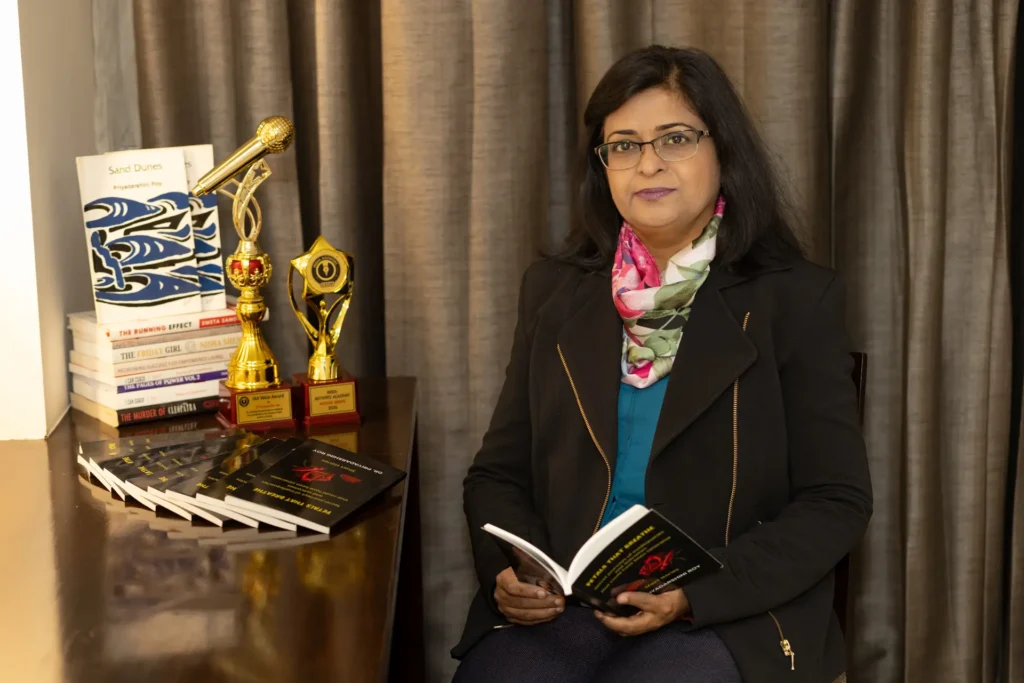
Dr. Roy began publishing poetry and literary criticism in 1992, a career in letters that has run in parallel with her clinical and corporate work for more than three decades and that she describes as not separate from her professional identity but integral to it. Literature gives her depth and insight that the scientific disciplines alone cannot provide. Behind every clinical trial, every dataset, every patient, and their caregiver lie lived experiences, fears, hopes, and silent struggles. The capacity to recognise and respond to those human dimensions is precisely what effective clinical and pharmaceutical leadership requires, and literature is where she has cultivated that capacity most deliberately.
The common thread she identifies across medicine, pharmaceutical innovation, and creative writing is problem-solving with responsibility, delivered through effective communication and storytelling. Each field requires critical thinking, discipline, and accountability. Each carries the potential to shape decisions, perspectives, and outcomes. The logical flow of evidence, supported by a story the target audience connects with, transforms information into meaning. Even data requires a narrative. Her creative writing, centred on societal issues, nature, and human emotion, is the fullest expression of that belief.
Leading through perception: the woman who lets performance speak
Dr. Roy speaks about the barriers she has navigated as a woman leader with a clarity that reflects years of processing rather than residual bitterness. The primary obstacle she identifies has not been capability but perception: predefined expectations about women’s leadership styles that required a deliberate response. Her chosen approach has been to focus on delivery and consistency rather than reacting to every bias. Over time, performance and demeanor establish their own authority, and she has found that authority more durable than any argument made in its defense.
The personal barriers she has faced were equally formative. Encountering regressive expectations in spaces where she had every right to be recognised as exceptional led her not to retreat but to design her life differently and live her own ambitions on her own terms. These experiences sharpened her resolve, reinforced her resilience as sustained focus rather than resistance, and made her more deliberate about creating inclusive environments in which merit is recognised objectively.
A legacy built on resonance, not recognition
The legacy Dr. Priyadarshini Roy is building is one she defines with careful precision: not recognition, but resonance. Impact that continues quietly after one is no longer in the room. Through her pharmaceutical work, she hopes to contribute to systems that are more ethical, patient-centric, and thoughtful in their approach to human need. Through leadership, she aims to nurture professionals who lead with competence, values, self-awareness, and compassion. Through literature, she hopes to leave perspectives that encourage reflection and strengthen what she calls the “cohesive social fabric”.
If there is a single thread she would like her legacy to carry, it is about touching lives with a difference. That ambition, stated simply and pursued with extraordinary range and rigour across more than twenty-five years, is what makes Dr. Roy not merely a distinguished professional in multiple fields but a genuine architect of influence. The bridge she has spent her career building, between science and society, between precision and perspective, between data and the human experience behind it, is one that her students, colleagues, readers, and patients are still crossing.