A GENERATION THAT WATCHED THE FUTURE ARRIVE
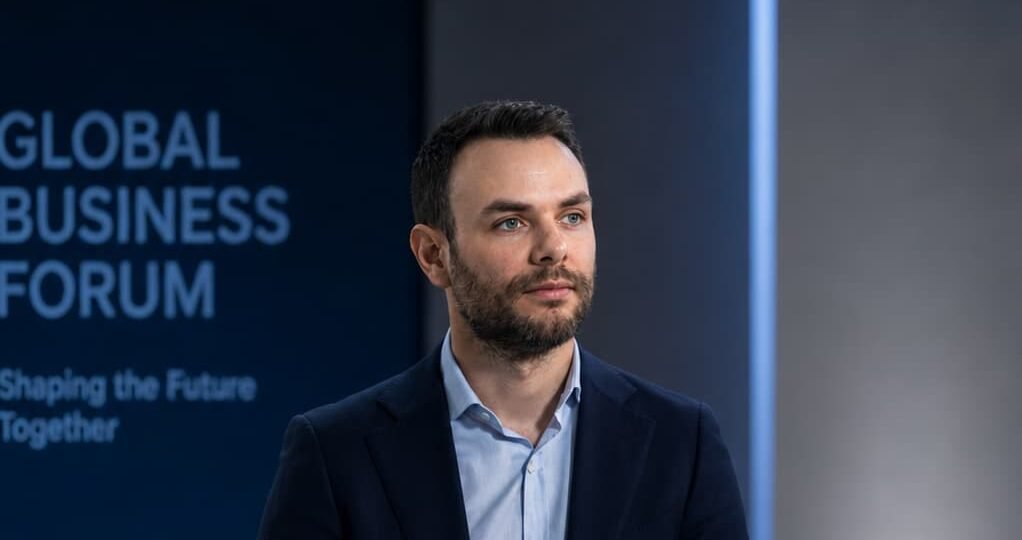
Paolo Pellegrini belongs to a particular generation, and he is precise about what makes it distinctive. It is the generation that still remembers black-and-white televisions and rotary phones. That spent hours watching games load on the first home computers. That, as children, touched the earliest personal computers with the kind of reverence that later generations reserve for entirely different devices.
This is not nostalgia. It is context. Because what that experience gave Paolo was something that would shape every professional decision that followed: the ability to watch a technology arrive from a distance, understand its trajectory before the consensus caught up, and position himself at the frontier before the frontier had a name.
As a teenager, he witnessed the internet emerge and discovered that the digital world offered a way to approach almost any problem differently. During his final years of school and the beginning of university in Italy, he watched mobile, cloud computing, as-a-service models, social media, and big data unfold in real time, not as an observer but as a researcher at one of Italy’s most prestigious universities. His ambition was to enter the great names in strategy consulting. His fascination was the intellectual challenge of taking a business and fundamentally changing its trajectory.
What he found, when he arrived in that world, was a gap. The digital themes he understood intuitively were still being treated as abstract concepts, included in client presentations but not always fully grasped. That gap became his opportunity.
THE BLANK SHEET PHILOSOPHY
The defining metaphor of Paolo’s career is not a breakthrough moment or a single bold decision. It is a blank sheet of paper, requested, again and again, at each inflection point where the next wave of change was becoming visible.
The first came when professors he was working with asked him to help design the proposition for a new consulting firm. That blank sheet, as he puts it, quite literally changed his life. It allowed him to approach his profession without preconceptions, bringing together creativity, research depth, and emerging market signals in a way that a conventional career path would never have permitted.
The second came when data began approaching from the horizon. He asked for another blank sheet and redesigned his entire methodology to be fully data-driven. The third came in 2019, when he chose to change companies entirely in order to have a blank sheet in the world of AI.
That decision proved to be among the best of his career. In record time, he developed a working generative AI solution that was later patented, before OpenAI had released a functioning product and before the technology had acquired the name the world now uses for it. He was not predicting the future. He was building it, quietly, from a position of deep technical understanding and strategic foresight.
THE METYIS MODEL: CONSULTING THAT TRANSFERS CAPABILITY
When Paolo joined Metyis alongside his partner and friend Sasha, the decision was driven by two principles that had become non-negotiable in how he wanted to operate.
The first was entrepreneurship: the opportunity to build a country presence from scratch in a market where Metyis had no footprint. The second was a fundamentally different model of consulting, one that does not stop at strategic design and does not generate volume by managing operations in outsourcing. Instead, the Metyis model is built around creating deep client relationships, launching joint ventures, and building together the capabilities and structures needed to address transformative forces like digital and AI, before transferring those capabilities back to the client so they can continue independently and sustainably.
It was the first time, Paolo notes, that he did not reach for a blank sheet of paper. Because what he saw in front of him already represented the evolution the market needed at that precise moment.
THREE LEVELS, ONE GAME
Paolo’s framework for understanding how AI is reshaping organizational strategy is one of the clearest distillations of a genuinely complex landscape available from any practitioner working at the frontier.
He identifies three levels at which the AI game is currently being played. The first is broad, basic adoption in day-to-day operations, essentially a new layer of office automation. The second is the development of proprietary AI solutions capable of generating real competitive advantage. The third, and the one attracting the most attention on CEO agendas, is the invisible game orchestrated by financial markets, which are using AI as a lens through which to redefine which businesses are now structurally challenged and what new benchmarks in productivity, headcount, and margins each industry should be expected to achieve.
And yet, he is careful to add the caveat that most enthusiasm about AI elides. The best practices for adopting and monetizing AI are still emerging. The real competitive advantage that AI can generate has yet to fully materialize in a concrete and measurable way. The transformation is real and the direction is clear, but anyone claiming certainty about its pace or shape is getting ahead of the evidence.
THE HUMAN STORY INSIDE EVERY TECHNOLOGY STORY
On the question of why so many organizations struggle to realize meaningful results from AI adoption, Paolo reaches not for technical explanations but for historical ones, and the comparison he draws is both unexpected and immediately clarifying.
When personal computers arrived in organizations, companies spent billions doing on a computer exactly what they had previously done on paper, while many managers refused to use them and continued dictating texts to their secretaries as they always had. Email followed a similar path, with CEOs describing it as something that distracted people from real work, while entire workforces pushed for adoption. Hierarchical communication structures were suddenly threatened by the possibility of writing directly to the CEO. The anxiety was organizational, not technical.
Over time, things worked. And for the long tail of late adopters, organizations often resorted to drastic measures: removing typewriters, shutting down internal mail services, and forcing adoption by eliminating the alternatives.
“The story of AI, like every technological story, is ultimately a human story,” Paolo says. “A story of people, habits, and our difficulty in adapting to change.”
The real question, therefore, is not only what AI can add to an organization, but what must be taken away from people so that they adopt AI consciously, responsibly, and in a way that creates genuine value.
BEYOND THE POC TRAP
Paolo’s advice to organizations attempting to translate AI investment into real impact is direct and deliberately contrarian to the dominant consulting playbook.
He has consistently counseled companies to move beyond the logic of proof of concepts. In the corporate environments he operates in, the value of a technology rarely needs to be proven. What needs to be tested, if anything, is the company’s ability to absorb that technology, adapt to it, and reorganize itself around it.
His approach is built on a different principle entirely: identify real areas of business value, apply the technology in a focused way, and ensure it delivers impact in the short term while remaining resilient to future choices and technological shifts. No experimentation for its own sake. No isolated pilots designed to impress a steering committee and then disappear. What organizations need are practical exercises that generate immediate results, build the institutional knowledge required to work with new technology, and create assets and operating models that do not have to be discarded when the time comes to scale.
THE PHYSICAL REVOLUTION COMING NEXT
On the decade ahead, Paolo’s perspective extends well beyond the AI conversation that currently dominates business media. He sees two major transformations unfolding simultaneously: one more visible, centered around AI, and another more submerged, encompassing space, brain-computer interfaces, new materials, and physical world applications that have long been the domain of science fiction.
“We are truly standing on the threshold of the future,” he says. “The kind of future we have always seen in films and that, for a while, we convinced ourselves still belonged to science fiction.”
His clearest prediction is not about timing but about direction. The next great revolution will take place in the physical world. It will change everything we use and touch every day, not at a digital level but at a material one. AI and large models will move beyond language and begin to understand and interact with the physical world, transforming manufacturing and sectors that the current AI conversation has barely touched.
THE ONLY RECIPE THAT HAS ALWAYS WORKED
When asked for advice to business leaders navigating an increasingly AI-driven world, Paolo offers something more honest than a framework.
“I do not believe I have a recipe that works for everyone,” he says. “But I can share the one that has always worked for me.”
Embrace technological innovation with genuine enthusiasm and use it relentlessly. Do so with a healthy dose of skepticism: challenge it, test it, and spend enough time with it to understand both its strengths and its weaknesses. If you truly immerse yourself in an innovation, understand it deeply, and learn to master it, then it becomes far easier to control it and apply it pragmatically in any context, in a way that creates real value.
It is the philosophy of a leader who has been watching the future arrive since childhood, and who has never once waited for consensus before stepping toward it.