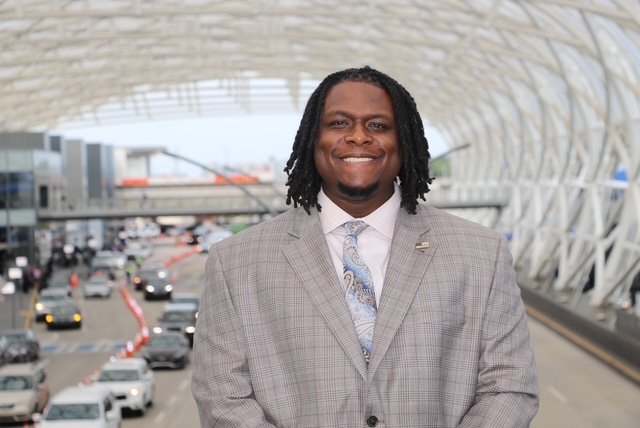
Fire safety in a large international airport is not a problem you solve and then maintain. It is a problem you solve continuously, in an environment that never pauses, never empties, and never reduces its complexity to make the work easier. Dr. DeAnjelo Bradley has spent more than two decades inside exactly these kinds of environments: from early years in the fire service where decisions carried immediate life-or-death consequences, to senior leadership roles overseeing fire safety programs for high-traffic critical infrastructure. His practice, built from the ground up through operational experience rather than theoretical distance, is rooted in a conviction that has never changed: strong relationships built before an incident are what determine success during one. Everything else is preparation for that moment.
A VOCATION THAT BEGAN WITH SERVICE AND EXPANDED INTO STRATEGY
Bradley entered the fire service shortly after high school, motivated by a desire to serve and protect that proved, over time, to be more durable than most professional impulses. What the fire service taught him quickly was that physical courage, however important, was the minimum requirement. The profession demanded discipline, adaptability, and an unwavering commitment to others that held even when the situation was chaotic, the information was incomplete, and the stakes were unambiguously high. Those early years shaped his character as a professional in ways that subsequent academic and leadership experience could only build upon, not replace.
The transition from fire service into emergency management broadened his professional lens considerably. Where the fire service focused primarily on response, emergency management demanded a more strategic orientation: preparedness, mitigation, resilience, and continuity of operations across complex organisational ecosystems. That broadening did not diminish his operational instincts. It gave them a larger stage. Today, Bradley approaches every safety challenge with the integrated perspective of someone who has both responded to emergencies and designed the systems intended to prevent them.
THE AIRPORT CHALLENGE: SAFETY IN AN ENVIRONMENT THAT CANNOT PAUSE
Managing fire safety at a major international airport presents a risk profile unlike almost any other operating environment. The facility functions continuously, twenty-four hours a day, with fluctuating population density, complex and interdependent infrastructure systems, and a diverse mix of stakeholders whose operational needs and accountability structures vary significantly. The challenge at its core is maintaining safety assurance without the ability to pause operations even briefly. Safety systems must be so thoroughly integrated into the daily operational fabric that they function invisibly and reliably without ever requiring the facility to reduce its activity.
Bradley identifies the specific variables that make this environment particularly demanding: multi-agency coordination across emergency responders, security teams, airlines, and regulatory bodies; evolving threat landscapes that require continuous situational awareness updates; and ongoing infrastructure expansion that introduces new risk profiles while existing systems remain live. Managing all of this requires strong systems and disciplined leadership working in concert. Neither alone is sufficient. The systems provide structure and continuity; the leadership provides judgment and responsiveness in the moments when the systems alone cannot determine the right course of action.
RISK-BASED DESIGN: HOW FIRE PROTECTION SYSTEMS ARE ACTUALLY BUILT
Bradley’s approach to designing fire safety systems for critical infrastructure begins with risk, not code. Every decision is grounded in hazard identification, vulnerability analysis, and consequence modelling. Meeting regulatory requirements is a floor, not a ceiling. The systems he designs must reflect the operational realities of the specific environment they protect, which means understanding not just what could go wrong but what the consequences of failure look like in each particular context and what redundancies are necessary to ensure continuity when a primary system is impaired.
Integration is the principle he returns to most insistently. Detection, suppression, alarm systems, and emergency communication platforms must function as a unified ecosystem rather than a collection of independent components that happen to share a building. In an airport context, a detection system that triggers without simultaneously alerting the right people in the right sequence is not merely incomplete; it creates its own risk through false confidence or delayed response. System design must account for human performance under stress as well as technical specification, which means that the design process never truly ends at installation. Continuous inspection, testing, maintenance, and training are the ongoing commitments through which the paper specification becomes a living, reliable capability.
FROM REACTIVE TO PREDICTIVE: TWO DECADES OF FIELD EVOLUTION
Over Bradley’s twenty-plus years in the field, emergency management has undergone a fundamental reorientation. The discipline that once focused primarily on response and recovery has become proactive and increasingly predictive. The shift is both conceptual and technological. Conceptually, the field now emphasises risk reduction, resilience, and operational continuity as the primary objectives, with response capabilities understood as the backstop for the mitigation and preparedness work that should precede any incident. Technologically, data analytics, real-time monitoring systems, and integrated communication platforms have made it possible to identify risks earlier, model potential outcomes, and deploy resources with a precision that was not achievable in the previous generation of practice.
At the same time, he is direct about what this evolution has not resolved. The risk landscape has become more complex rather than simpler. Natural hazards, technological disruptions, and human factors intersect in combinations that resist clean categorisation or simple planning responses. Modern emergency management must be multidisciplinary in the deepest sense: capable of holding technical, behavioural, and policy dimensions simultaneously while moving quickly enough to be useful. That demand for integrated competence, across systems, people, and institutional frameworks, is what makes leadership the differentiating variable in emergency management outcomes.
LEADERSHIP UNDER PRESSURE: WHAT CLARITY AND COMPOSURE ACTUALLY REQUIRE
The defining leadership lesson Bradley draws from his years in high-risk environments is simple to state and difficult to develop: leadership under pressure is not about authority. It is about clarity, composure, and accountability when the stakes are highest and the information is most imperfect. In those moments, teams look to their leaders not for certainty, which is usually unavailable, but for steadiness, which is a choice.
That understanding shapes how he approaches team development. He builds for capability rather than dependence, empowering decision-making at all levels so that the organisation can function with judgment and confidence even when senior leadership is not immediately present. He invests heavily in preparation and trust-building before incidents occur, knowing that the relationships and shared mental models established in training determine the quality of coordination when it matters most. Compliance, in his framework, is not the opposite of operational efficiency. Properly embedded into daily operations, it enhances both safety and reliability. It is a structural argument for treating preparation not as a cost but as the primary investment in performance.
BUILDING RESILIENCE THAT IS NOT STATIC
Bradley’s framework for resilient emergency management begins with a comprehensive understanding of risk through thorough hazard vulnerability analysis, and proceeds through scalable response frameworks with clear activation thresholds, defined roles, and robust communication systems. But the element he emphasises most strongly is the one that is most easily neglected: continuous improvement. Resilience is not static. It is built and maintained through regular training, realistic exercises, and honest after-action reviews that generate the organisational learning needed to keep plans aligned with evolving risks.
His advice to aspiring professionals entering the field reflects the same integration of technical and human competence that defines his own practice. Commit to continuous learning. Develop both technical skills and the leadership capacity to make sound decisions under pressure. And remain grounded in purpose. Public safety is about service. Approached with integrity, discipline, and a genuine commitment to others, it is a profession in which the work matters in ways that are rarely ambiguous and never temporary.