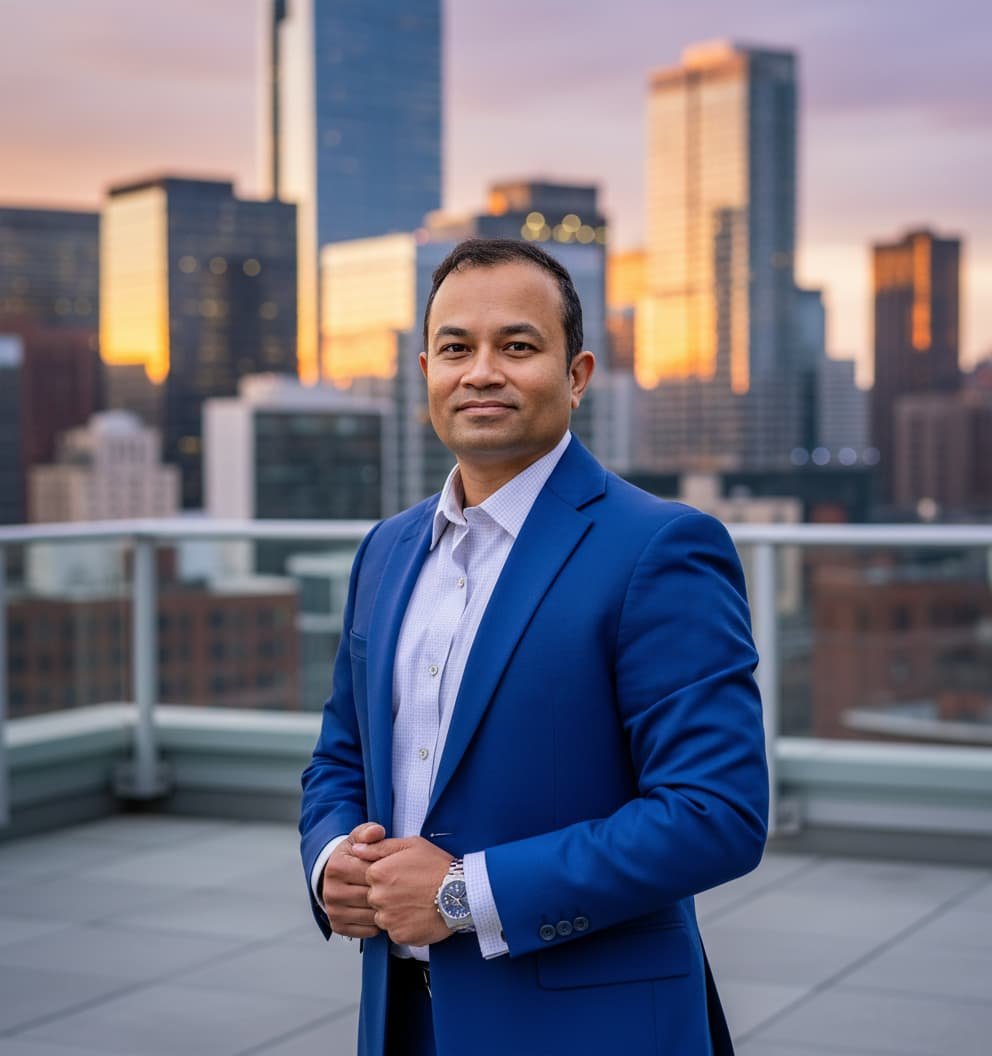
FROM SERVICE TO STRATEGIC BANKING LEADERSHIP
Masrur Hossain’s career has been shaped by a simple belief: banking is ultimately about people, trust, and responsible growth. His journey across commercial banking, retail banking, community organizations, and military service has given him a multidimensional understanding of leadership, one that combines financial discipline with service, relationship-building, and accountability.
Today, as Senior Vice President and Commercial Banking Executive for the Virginia Market at Burke & Herbert Bank, Masrur works closely with small and middle-market businesses navigating growth, investment, changing economic conditions, and evolving financial needs.
His leadership perspective was shaped by each stage of his career. Commercial banking taught him to understand businesses strategically and look beyond individual transactions. Retail banking strengthened his focus on people, customer experience, and team development. Community involvement deepened his understanding of the relationship between business success and local economic strength, while military service reinforced discipline, resilience, teamwork, and responsibility.
Together, these experiences created a leadership philosophy centered on purpose, clarity, empowerment, and service.
For Masrur, effective banking leadership is not simply about managing financial performance. It is about helping employees grow, earning the confidence of clients, and bringing people together around a shared objective.
BANKING BEYOND THE BALANCE SHEET
For today’s business owners, financial challenges rarely exist in isolation. Higher operating costs, labor pressures, changing interest rates, cash-flow requirements, and economic uncertainty can all influence decisions around growth and investment.
Masrur believes the strongest commercial banking relationships begin by understanding the business before discussing the product.
His approach involves understanding a client’s goals, industry, cash-flow cycles, management capabilities, risk appetite, and long-term plans before determining the appropriate financial strategy.
This philosophy reflects his broader view of commercial banking. A banker should not only appear when financing is required. The strongest relationships are built when bankers become trusted advisors during expansion, acquisitions, succession planning, challenging periods, and important strategic decisions.
“Our role is to help business owners make informed financial decisions, anticipate challenges, and capitalize on opportunities.”
DISCIPLINED GROWTH, RESPONSIBLE CREDIT
Commercial banking requires the ability to balance opportunity with discipline.
Masrur approaches credit decisions through both analytical assessment and relationship understanding. Cash flow, leverage, liquidity, collateral, repayment capacity, management strength, and financial performance provide the quantitative foundation. Understanding the people behind those numbers provides the context.
Who is leading the business?
How have they responded to previous challenges?
What are their growth ambitions?
How resilient is the business under pressure?
These questions can be as important as the financial statements themselves.
Masrur believes responsible banking sometimes means telling a client that a particular financing structure is too aggressive. Saying no when necessary, restructuring a request, or recommending a more sustainable approach is part of being a trusted advisor.
The objective is not simply to approve transactions. It is to create relationships capable of surviving different economic cycles.
“The best credit decisions balance opportunity with discipline.”
LEADING THROUGH PEOPLE
Before assuming his current commercial banking leadership role, Masrur served as Head of Community Business Banking at Capital Bank and previously led the performance and operations of 12 retail branches across Central Virginia at M&T Bank.
That experience reinforced one of his strongest leadership convictions: great performance begins with great people.
Managing multiple locations taught him to establish clear expectations, measure performance, coach individuals according to their strengths, and maintain accountability while giving leaders enough flexibility to operate effectively.
It also taught him the importance of visibility.
Reports and performance metrics can reveal what is happening, but conversations with employees and customers often reveal why it is happening.
Masrur therefore emphasizes being accessible to his teams, understanding their challenges, recognizing their achievements, and ensuring they have the resources and confidence required to serve clients effectively.
His approach is neither purely performance-driven nor purely relationship-driven. It is the combination of both that creates sustainable results.
DATA WITH JUDGMENT
Masrur’s academic foundation in Decision Sciences, Management Information Systems, and Economics from George Mason University has strengthened his analytical approach to banking.
He views data as a powerful decision-making tool but not as a substitute for judgment.
Commercial banking generates enormous amounts of information. The real value comes from translating that information into insight: identifying trends, evaluating risk, understanding portfolio performance, assessing market conditions, and determining what the numbers may not reveal.
Technology is similarly changing how banking operates. Digital tools, automation, analytics, faster payments, and evolving financial technologies are reducing friction across everyday banking activities.
But Masrur believes technology should strengthen relationships rather than replace them.
The banker of the future should be more informed, more proactive, and more accessible because of technology not less connected to clients.
“I don’t see technology replacing the relationship. I see it making the relationship more valuable.”
THE HUMAN ADVANTAGE IN DIGITAL BANKING
Business clients increasingly expect speed, convenience, real-time information, seamless treasury management, and easier access to financial solutions.
Automation can manage routine processes. Data analytics can reveal cash-flow patterns and anticipate potential financing requirements. Digital platforms can simplify interactions.
Yet Masrur believes the differentiator for relationship-focused banks will remain expertise, responsiveness, and trust.
As alternative financial providers expand their presence, traditional banking institutions must demonstrate why their relationships matter.
For community-focused banking, that creates an opportunity rather than a threat: combine the efficiency of modern technology with the personal accessibility business owners value.
That balance can make banking more proactive without making it impersonal.
LEADERSHIP THROUGH SERVICE
Masrur’s commitment to leadership extends beyond banking.
His involvement with organizations including the Central Fairfax Chamber of Commerce, Rotary Club of Fairfax, Civil Air Patrol, and Virginia Defense Force has reinforced his belief that leadership is fundamentally an act of service.
Each organization has offered a different perspective from community development and volunteerism to technology, national security, preparedness, teamwork, and mission-focused leadership.
These experiences have shaped his understanding that organizations have responsibilities beyond financial performance.
Businesses influence employees, customers, families, communities, and local economies. In banking particularly, financing a business, supporting an expansion, or helping an entrepreneur achieve a long-term goal can contribute directly to the economic health of a community.
For Masrur, responsible leadership therefore requires humility, accountability, and an awareness of the broader consequences of business decisions.
GLOBAL PERSPECTIVE, LOCAL IMPACT
As part of his Master of Business Administration (MBA) at George Mason University, Masrur participated in executive management sessions at institutions including the University of Oxford and Wuhan University of Technology, broadening his perspective on leadership, global business, and strategic management.
Exposure to different professional, cultural, and economic perspectives reinforced an important lesson: while markets differ, fundamental leadership principles remain remarkably consistent.
People want clarity, trust, purpose, and opportunities to contribute.
These international experiences also strengthened his belief in lifelong learning. Leaders cannot rely solely on accumulated experience; they must remain curious enough to challenge assumptions and learn from perspectives different from their own.
That mindset continues to influence how Masrur leads his teams encouraging them to ask better questions, consider different viewpoints, and remain adaptable as the banking environment evolves.
COMMERCIAL BANKING AS AN ENGINE OF GROWTH
Looking toward the remainder of 2026 and beyond, Masrur sees significant opportunity for commercial banks to become even stronger partners in entrepreneurship, business expansion, investment, and economic development.
Businesses will continue to require capital, but the greater opportunity lies in helping owners determine how, when, and where that capital should be deployed.
At the community level, banks can also help direct capital toward projects that create jobs, strengthen local businesses, expand the tax base, and support long-term economic development.
The commercial banking leader of the future will therefore need to combine several capabilities: strategic thinking, disciplined risk management, technological understanding, adaptability, and relationship-building.
A LEGACY BUILT ON TRUST
Masrur’s career recognitions including the Pinnacle Award, President’s Council, Chairman’s Club, President’s Award, Rotary International’s “Rising Star” Award, and numerous awards and decorations from the Virginia Defense Force reflect a career grounded in performance and service. His recognition as an honored listee in Marquis Who’s Who further acknowledges his professional and community contributions.
Yet the larger legacy he seeks is not defined by titles or awards.
It is reflected in the businesses he helps grow, the employees he develops, the communities he serves, and the relationships that endure beyond individual transactions.
His philosophy is straightforward: modern banking may become increasingly digital, but successful commercial banking will remain deeply human.
The strongest leaders will know how to combine data with judgment, technology with relationships, and growth with responsibility.
For Masrur Hossain, that is the future of commercial banking and the standard by which meaningful leadership should be measured.