WHERE LEADERSHIP BEGINS: THE CLASSROOM
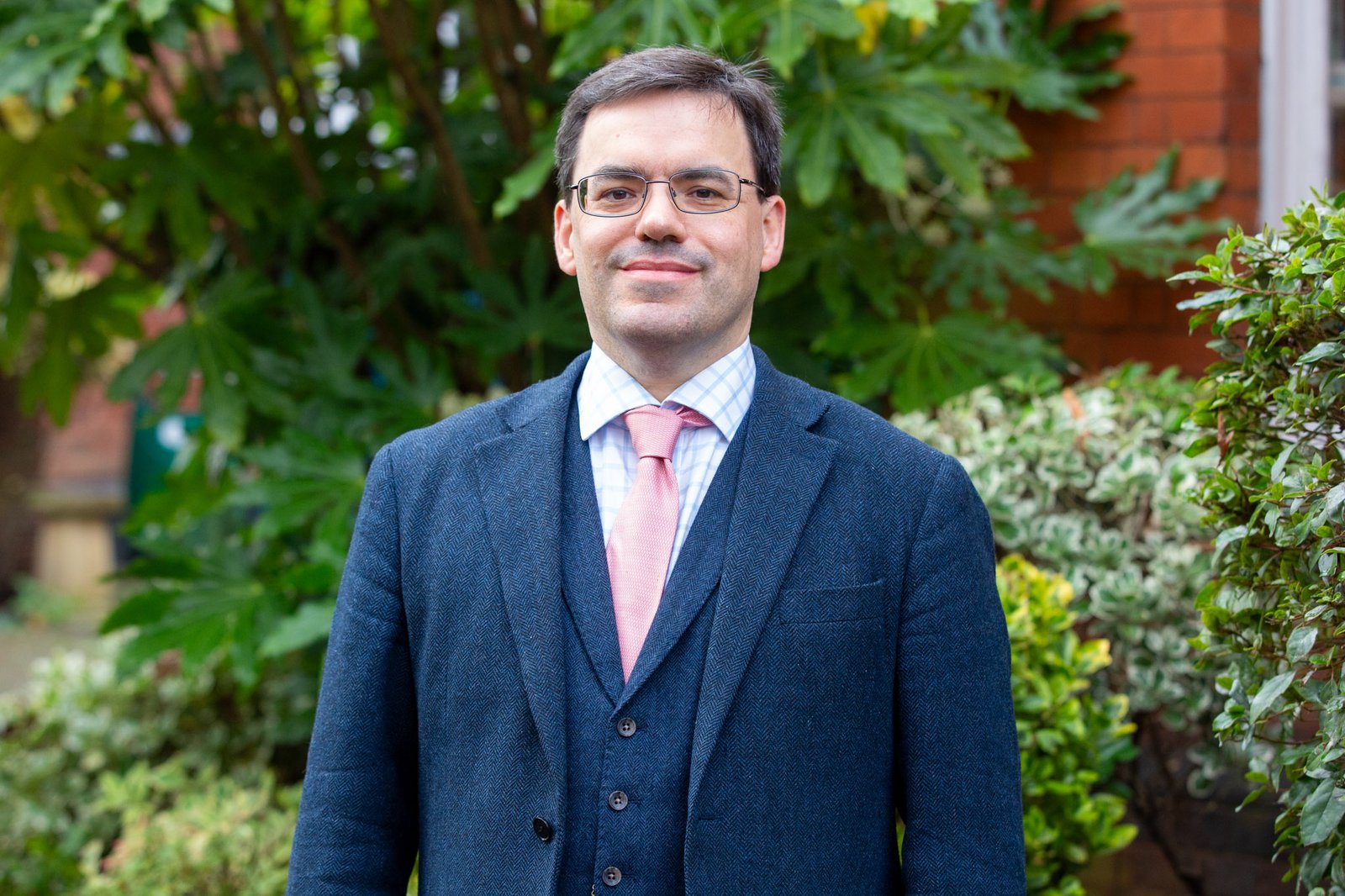
Luke Ramsden will tell you that teaching has never left him. Even now, as incoming Head of St John’s College Cardiff and one of the most recognized voices in educational leadership and responsible AI integration, the instincts of the classroom remain central to how he thinks about schools and the people within them.
He began as a history teacher, first at Ampleforth and later as Head of History at Tonbridge. Those years shaped a foundational conviction that has never wavered: that high expectations, excellent teaching, and strong relationships can enable young people to achieve far more than they initially believe possible. The move into leadership grew organically from that belief, from a desire to influence the wider experience of students beyond the boundaries of a single subject.
His responsibilities broadened during ten years at St Benedict’s as Senior Deputy Head, encompassing safeguarding, pastoral care, strategy, and innovation. Throughout, a particular question began to occupy more of his thinking: how should schools respond intelligently to change, especially the kind of change that arrives uninvited and reshapes everything?
The answer he has developed over a distinguished career is both principled and practical, and it begins with a refusal to treat any of education’s core tensions as genuine contradictions.
ACADEMIC EXCELLENCE AND WELLBEING ARE NOT IN COMPETITION
One of the most persistent false choices in education is the idea that academic ambition and student wellbeing pull in opposite directions. Luke rejects this framing entirely, and his career has been shaped in large part by proving the alternative.
“I have never seen academic excellence and student wellbeing as competing priorities,” he says. “The best schools understand that pupils are most likely to achieve highly when they feel safe, known, supported and genuinely happy to be at school.”
This does not mean removing challenge. Luke is clear that high expectations, intellectual risk-taking, and the experience of perseverance through difficulty are not enemies of wellbeing but essential components of it. The critical ingredient is culture: an environment in which those expectations sit alongside strong relationships and pastoral care that treats students as whole people rather than examination results.
At St John’s over the coming years he is looking to distil this balance into three qualities he wants every student to embody: kind, happy, and hard working. Simple in their framing, they represent a sophisticated understanding of what education is actually for. Academic ambition and human flourishing are not separate goals. Pursued well, they are the same goal.
AI AS A TOOL FOR THINKING, NOT A SUBSTITUTE FOR IT
Luke’s engagement with artificial intelligence in education has earned him national recognition, but it began from a straightforward premise: AI was going to change the world students were entering whether schools embraced it or not. The only real question was whether educators would understand it well enough to navigate it responsibly.
At St Benedict’s, he developed an approach to AI across three distinct areas: supporting teachers by reducing unnecessary workload, improving pastoral and school systems through better data and pattern recognition, and developing students’ AI literacy so they could understand and critically evaluate the technology they would encounter throughout their lives.
His framework for responsible use is precise and worth examining in full. Students need to understand bias, hallucinations, privacy, intellectual property, and what he identifies as the most significant risk of all: cognitive surrender, the point at which technology becomes a substitute for thinking rather than a tool that extends it.
“AI should enhance rather than replace human relationships and professional judgement,” he says. “Schools should neither be frightened of it nor uncritical about it.”
That balance, between open engagement and principled scrutiny, is increasingly rare in a landscape where institutional responses to AI tend toward either blanket restriction or uncritical adoption. Luke occupies a more demanding middle ground, one that requires genuine understanding of both the technology’s capabilities and its limitations.
SAFEGUARDING AS A CULTURE, NOT A POLICY
Luke’s work as Director of Safeguarding has reinforced a belief that runs through everything he builds: the best pastoral care begins long before a young person reaches a point of crisis. Systems matter, but systems alone are never sufficient. Effective safeguarding depends on relationships, professional curiosity, and staff trained to notice when something does not feel right.
He is equally committed to what he calls flexibility in responding to individual students. Young people develop at different rates and face pressures that cannot be standardized, so pastoral support cannot be entirely uniform. Early intervention, sensible adjustments, and genuine partnership with families can prevent difficulties from compounding into crises.
His roles as Chair of Trustees for The Schools Consent Project and advisor to the Global Equality Collective have deepened this perspective considerably. Through the Schools Consent Project, he has seen the transformative importance of giving young people clear, accurate information about consent, boundaries, and healthy relationships. Having conversations that feel difficult, he has come to understand, is precisely the work that builds the knowledge and language students need to recognize both respectful and harmful behavior.
His work with the Global Equality Collective and its CEO, Dr Nicole Ponsford, has reinforced a complementary lesson: schools can have excellent policies on paper while the lived experience of students and staff tells an entirely different story. “We need to be curious about those experiences and prepared to respond to what they tell us,” he says.
INCLUSION THAT RAISES THE BAR
On the question of inclusion and scholarship, Luke holds a position that challenges the assumptions built into both terms. Inclusion, as he practices it, does not mean lowering expectations. It means raising the bar and then working to give every student the support, confidence, and opportunity to reach it.
He wants students to encounter difficult ideas, ask challenging questions, read beyond the curriculum, and develop the confidence to form and defend their own views. Excellent teaching, in his framework, makes intellectual ambition accessible without making learning less demanding. There is an important distinction he draws consistently: making something accessible is not the same as making it easier.
This philosophy reflects a wider conviction about what education should ultimately produce: not simply students who achieve high grades, but young people who leave school believing that ambitious opportunities are genuinely open to them, equipped with the curiosity, resilience, and independence to pursue them.
TRADITION AND INNOVATION AS PARTNERS
At St John’s, which carries a strong history, Catholic character, and established traditions, Luke’s approach to innovation is shaped by a question he applies to every new idea: does this help us do the most important things better?
He is an enthusiastic advocate for thoughtful AI integration, but he would never argue for adopting something simply because it is new. Innovation needs a clear educational purpose. Traditional approaches should be retained when they remain the most effective. And successful change, he is clear, depends on bringing people with you.
“Innovation builds upon a school’s identity rather than replacing it,” he says. Catholic education, in particular, provides what he describes as a strong foundation for leadership: beginning with the dignity and value of every individual and understanding education as the formation of the whole person, academically, morally, socially, and spiritually.
That framework, rooted in service and community rather than hierarchy, shapes how he understands leadership itself. It is not something done from the top. It is something rooted in recognizing the contribution and worth of everyone within an institution.
LEADERSHIP THAT OUTLASTS THE LEADER
When Luke offers advice to aspiring educators and school leaders, it comes from a place that resists the metrics by which leadership is most commonly measured.
He recently encountered a phrase that has stayed with him: that we should be willing to plant trees knowing we may never sit in their shade. For someone whose career has been shaped by long-term investment in people and institutions, the image resonates deeply.
“We do not always see the eventual consequences of what we do,” he reflects. “A conversation with a pupil, an opportunity we create, a teacher we encourage, or a change in a school’s culture may bear fruit many years later.”
His advice to aspiring leaders is consistent with everything his career embodies: remain curious, keep learning, never become so absorbed in leadership that you lose sight of what school feels like from the inside. Listen carefully. Be ambitious for what students can achieve. And have the courage to begin things that may outlast you.
The best legacy, he believes, is not a personal mark left on an institution. It is stronger people, better opportunities, and a culture that continues to develop long after you have gone. That is the standard Luke Ramsden has set for himself. And by every measure, it is one he is meeting