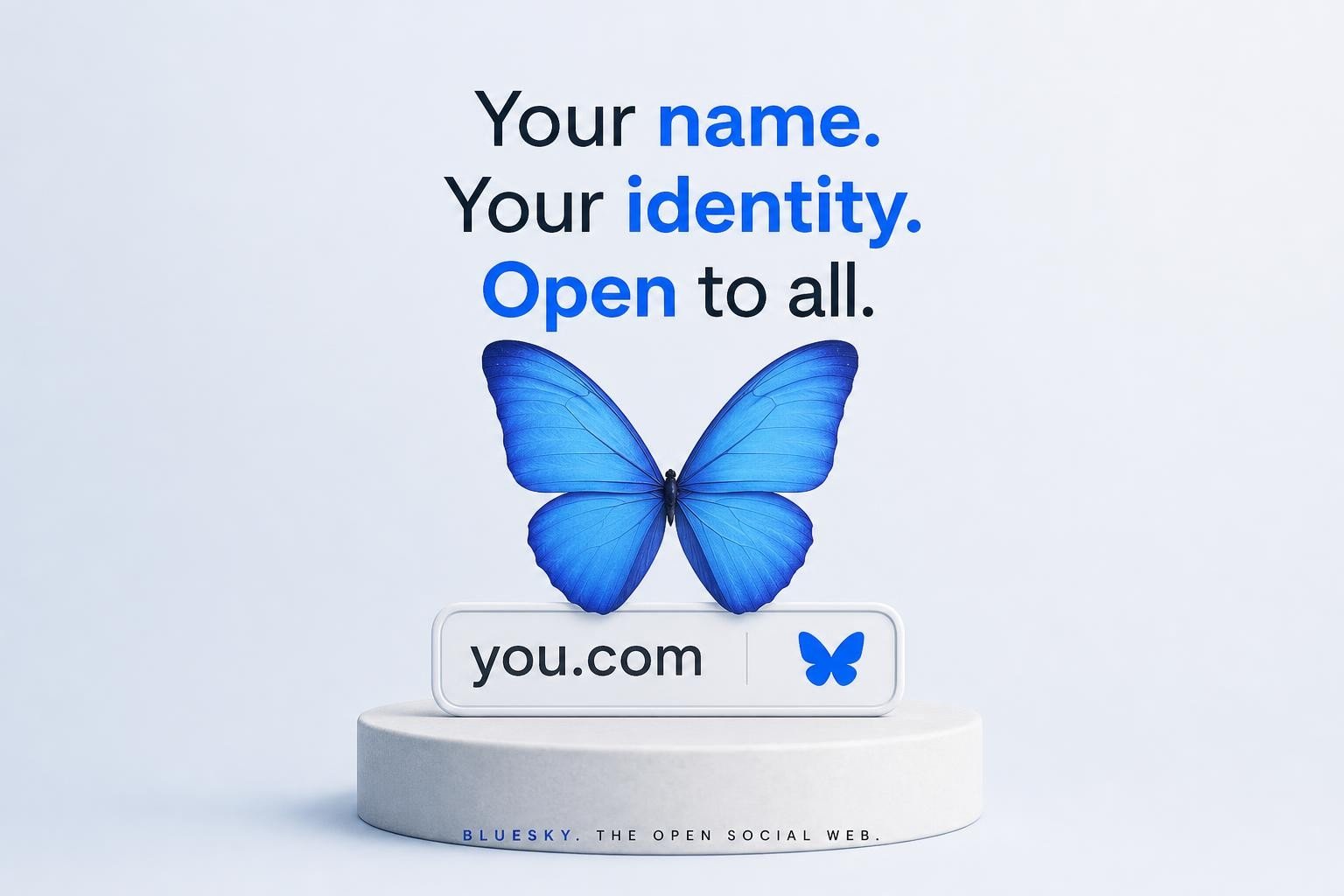
Bluesky is pushing one of the web’s oldest ideas back into the center of social media: your identity should be tied to a domain you control.
The company allows users to replace a standard Bluesky handle with a domain-based identifier, such as name.example.com or example.com. The change is more than a cosmetic profile setting. It connects a person’s social identity to the broader web, rather than leaving that identity entirely inside a platform’s namespace.
A social identity that can travel
Most social networks assign users a handle under a company-owned domain. That makes an account easy to find, but it also places the platform at the center of the relationship between a user and their audience.
Bluesky takes a different route. A user can configure a domain they control as their handle, then verify ownership through a DNS record. The handle becomes a readable form of identification within Bluesky while remaining linked to a domain outside the service.
That distinction matters if a user changes platforms, builds a website, or wants a consistent identity across online services. The domain does not turn Bluesky into a web host, and it does not guarantee that an account or its followers will move elsewhere. It does, however, give the user a stronger claim over the name associated with their account.
Bluesky explains the setup in its official domain handle guide. The process requires access to the domain’s DNS settings, which may make the feature more attractive to businesses, publishers, developers and experienced internet users than to casual social-media users.
Why domains are becoming relevant again
Domain names have long served as portable digital addresses. A company can change its hosting provider without changing its web address. An individual can move between email services while retaining the same domain. Bluesky’s model applies a similar principle to social identity.
For organizations, that could make employee, brand or publication accounts easier to authenticate. A handle connected to a company domain offers a visible relationship between the account and the organization, although users should still verify ownership and context before treating a profile as official.
For individuals, the value is more personal. A custom domain can connect a Bluesky presence with a portfolio, newsletter, independent publication or personal site. It also reduces dependence on a platform-generated username that may be difficult to preserve if the service changes its policies.
The idea fits Bluesky’s broader technical direction. The platform is built on the AT Protocol, an open network protocol intended to support portable identities and interactions across independently operated services. Bluesky describes the protocol in its developer documentation, though the practical experience for most users still depends on the apps and services they choose to use.
Control comes with responsibility
A domain-based handle is not a substitute for verification in the traditional sense. Someone who controls a domain can configure it, but domain ownership alone does not establish that every account using the name represents a well-known person or company. Users still need to check profile details, linked websites and other signals of authenticity.
There are practical risks, too. Domains expire, ownership can change, and DNS settings can be misconfigured. A user who loses control of a domain may also lose control of the handle associated with it, or have to update the account to a different identifier.
Those trade-offs are familiar to anyone who manages a website or business email address. They also underline the central promise of the feature: a domain-based identity gives users more direct control, but it asks them to take on some of the maintenance that platforms normally handle for them.
A modest change with wider implications
Bluesky’s domain handles will not eliminate platform dependence. The service still provides the interface, moderation systems and network where the account is used. But the feature changes the balance slightly by allowing the user’s name to point beyond the platform.
That could prove useful as businesses and individuals reassess how much of their digital identity should sit inside closed social networks. The web’s domain system was designed to let people and organizations maintain a stable address across changing technologies. Bluesky is applying that logic to a new generation of social services.
For more reporting on platforms, digital infrastructure and the business of technology, visit our technology coverage.