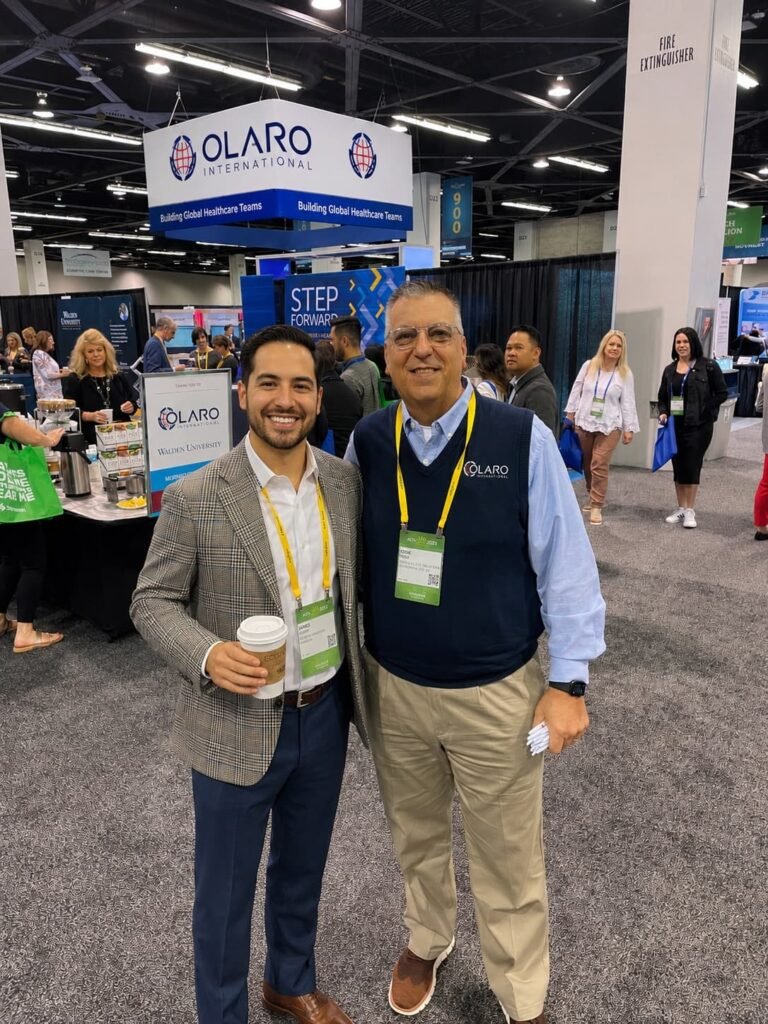
With more than two decades of experience in healthcare staffing, Eddie Money has built a career on a conviction that goes far beyond recruitment: that every placement changes a life, and that the future of patient care depends on the courage to think differently about where talent comes from.
– Eddie Money
In healthcare, the stakes of getting staffing wrong are measured not in missed targets or lost contracts but in patient outcomes and human lives. Eddie Money, Executive Vice President of Client Solutions at Olaro International, has spent more than twenty years understanding that reality from the inside. His journey into healthcare staffing began with a straightforward professional purpose: connecting exceptional healthcare professionals with organizations that needed their skills. What it became was something considerably larger.
The turning point arrived when he began to see the scope of the nursing shortage not as a market condition but as a human challenge with a human solution. On one side were talented nurses around the world who dreamed of building careers in the United States and creating better lives for their families. On the other were hospitals struggling to maintain safe staffing levels and protect the quality of care they existed to deliver. The opportunity to bring those two realities together became, in his own words, a mission.

“International nurse recruitment became more than a business opportunity. It became a mission. Bringing those two needs together has been one of the most rewarding aspects of my career.”

That mission has shaped everything about how Eddie approaches his work, his client relationships, his leadership philosophy, and his vision for where the global healthcare workforce is heading.
Twenty Years of a Changing Industry
Two decades in any industry produces perspective. In healthcare staffing, it has produced a ringside view of a sector in the middle of a profound structural transformation. When Eddie began his career, staffing was primarily understood as a mechanism for filling temporary vacancies. The mindset was reactive, short-term, and largely transactional.
The industry that exists today looks fundamentally different. Workforce planning has become a strategic priority for healthcare organizations rather than an afterthought triggered by shortage. The demand for permanent staffing solutions has grown significantly. Technology has reshaped how candidates are identified, assessed, and onboarded. And perhaps most importantly, healthcare leaders have come to understand something that was not always recognized: staffing decisions are not administrative choices. They are clinical ones. They directly shape patient outcomes, financial performance, and organizational culture.
“Healthcare leaders now recognize that staffing directly impacts patient outcomes, financial performance, and organizational culture,” Eddie reflects. This recognition has elevated the conversation around workforce planning to the executive level, and it has positioned organizations like Olaro International as strategic partners rather than vendors.
Leadership Built on People First
Eddie’s leadership philosophy was not formed in a classroom or through a management framework. It was shaped through years of working alongside both healthcare executives navigating complex operational pressures and international clinicians building new lives in a new country. From that dual vantage point, a clear principle emerged: success in this industry is built on relationships, integrity, and trust, and it is built nowhere else.
The lesson that has stayed with him most persistently is one about meaning. Every placement his team makes represents more than a filled position on an organisational chart. It represents a nurse who has crossed an ocean to build a career and support a family. It represents a hospital unit that can now function safely. It represents a patient who will receive care from a committed, experienced professional.
“I’ve learned that servant leadership, transparency, and always putting people first create long-term partnerships that benefit hospitals, healthcare professionals, and ultimately patients,” he says. This is not a philosophy Eddie applies selectively. It is the foundation upon which every client relationship and every candidate interaction at Olaro International is built.
International Recruitment as a Long-Term Strategy
The nursing shortage facing healthcare systems across the United States is not a temporary disruption. It is a structural challenge driven by an aging nursing workforce, rising patient demand, persistent burnout, escalating labour costs, and fierce competition for experienced clinicians. Organizations that treat it as a short-term problem requiring short-term solutions consistently find themselves in the same position twelve months later.
Eddie’s approach begins from a different premise entirely. International nurses do not represent an emergency stopgap. They represent a sustainable talent pipeline for organizations willing to approach recruitment with the patience and strategic discipline the challenge requires. Unlike agency or travel staffing arrangements, internationally recruited nurses typically commit to multi-year tenures, providing the kind of workforce continuity that fundamentally changes how a unit operates and how patients experience care.
He points to one initiative that captures this philosophy in practice. Rather than responding to a client’s immediate vacancy list, his team worked with healthcare leadership to develop a long-term international recruitment strategy built around planned cohorts of internationally educated nurses arriving in a structured, supported sequence. The results spoke clearly: reduced turnover, lower dependence on agency staffing, improved workforce stability, and stronger continuity of patient care sustained over several years.


“Sustainable staffing requires long-term workforce planning rather than relying solely on temporary solutions.”
What Successful Collaboration Actually Looks Like
The difference between an international recruitment placement that thrives and one that struggles rarely comes down to the clinical qualifications of the nurse. It comes down to preparation, on both sides of the relationship.
At Olaro International, preparation begins long before a nurse arrives in the United States. It includes rigorous candidate selection, clinical competency verification, cultural orientation, immigration and licensure support, and sustained communication throughout the transition process. Eddie believes Olaro leads the industry in each of these areas, and the conviction is grounded in the understanding that the work does not end when a nurse lands. It continues through structured onboarding, mentorship, and the kind of genuine inclusion that determines whether an international professional becomes a long-term contributor or an early departure.
Equally important is how healthcare organisations prepare to receive international nurses. Welcoming a professional who has relocated their entire life requires more than a desk and a badge. It requires intention, structure, and a cultural readiness to integrate someone whose experience and perspective may differ meaningfully from domestic colleagues but whose value to the team is precisely that difference.
Technology as a Tool, Human Connection as the Standard
Eddie is clear-eyed about what technology can and cannot do in healthcare staffing. Artificial intelligence, predictive analytics, credential management platforms, and virtual interviewing have genuinely transformed the efficiency and accuracy of recruitment. They have made it faster to identify qualified candidates, easier to forecast staffing needs, and more reliable to manage compliance across complex international processes.
But technology does not build trust. It does not reassure a nurse navigating an immigration system in an unfamiliar language. It does not help a hospital unit absorb a group of new international colleagues in a way that strengthens rather than disrupts team culture. Those outcomes require human judgment, human presence, and the kind of relationship-centred service that no algorithm can replicate.
“Technology will improve efficiency,” he notes, “but the human connection will remain central to successful healthcare staffing. Organizations that combine innovation with personalized service will lead the future.”
Ethics as the Non-Negotiable Foundation
International recruitment at scale carries responsibilities that extend well beyond any individual placement. When nurses are recruited from countries that are themselves experiencing healthcare shortages, the ethical stakes of how that recruitment is conducted become a matter of genuine consequence for the source communities involved.
Eddie understands this dimension of the work with clarity. Leadership at Olaro International, he explains, establishes the standards that guide every recruitment decision. Ethical recruitment means transparency in every relationship, fair employment practices, strict compliance with international recruitment guidelines, and consistent respect for the rights and wellbeing of internationally educated healthcare professionals at every stage of their journey.
Sustainable recruitment, properly conducted, creates opportunities that benefit everyone: the nurses whose careers and family lives it transforms, the healthcare organizations whose workforce it stabilises, and the communities whose patients receive better care as a result. Conducted irresponsibly, it can cause harm that ripples outward in ways that are difficult to reverse. This is why ethics, for Eddie, is not a value statement. It is an operational standard.
“Ethical leaders prioritize transparency, fair employment practices, compliance with international recruitment guidelines, and respect for both healthcare professionals and source countries.”
The Future of Global Healthcare Staffing
Looking ahead, Eddie sees the forces shaping healthcare staffing converging around several clear trends. The global mobility of healthcare professionals will continue to increase as more countries develop the infrastructure to train nurses who aspire to international careers. Artificial intelligence will become more deeply integrated into every stage of the recruitment process. Workforce analytics will give healthcare organizations a far more sophisticated ability to forecast needs, model scenarios, and make proactive decisions rather than reactive ones.
Most significantly, he sees a fundamental shift in how healthcare organizations conceptualize international recruitment. The era of treating it as an emergency measure is ending. The organizations that will be best positioned five and ten years from now are those investing today in international recruitment as a core, permanent component of their workforce strategy, not a fallback when domestic pipelines run dry.
His advice to those organizations is straightforward: think long-term. Build strategic workforce plans. Invest in retention, leadership development, and sustainable recruitment partnerships. Combine domestic recruitment with ethical international recruitment. The future of patient care depends not on finding nurses when you need them urgently, but on building the relationships and pipelines that ensure they are there before the urgency arrives.
A Mission That Continues
For Eddie Money, the work of transforming healthcare staffing is ultimately about something that resists easy quantification. It is about the nurse in the Philippines or Nigeria or India who dreamed of practicing in the United States and found a pathway through a recruitment process conducted with honesty and care. It is about the hospital in a rural community that can now maintain safe staffing ratios because someone invested in building a pipeline rather than just filling a vacancy. It is about the patient who received excellent care from a professional who was supported, integrated, and valued from the moment they arrived.
“Healthcare staffing is about improving lives,” Eddie reflects, “supporting healthcare professionals in achieving their dreams while helping healthcare organizations provide exceptional patient care. If you lead with integrity, compassion, and excellence, success will naturally follow.”
At Olaro International, that mission does not sit on a wall as an inspirational statement. It shows up every day in how placements are made, how clients are served, and how internationally educated nurses are supported from their first conversation to their first year on the floor and beyond. It is the standard Eddie Money has spent more than two decades building, and it is the standard he intends to keep raising.