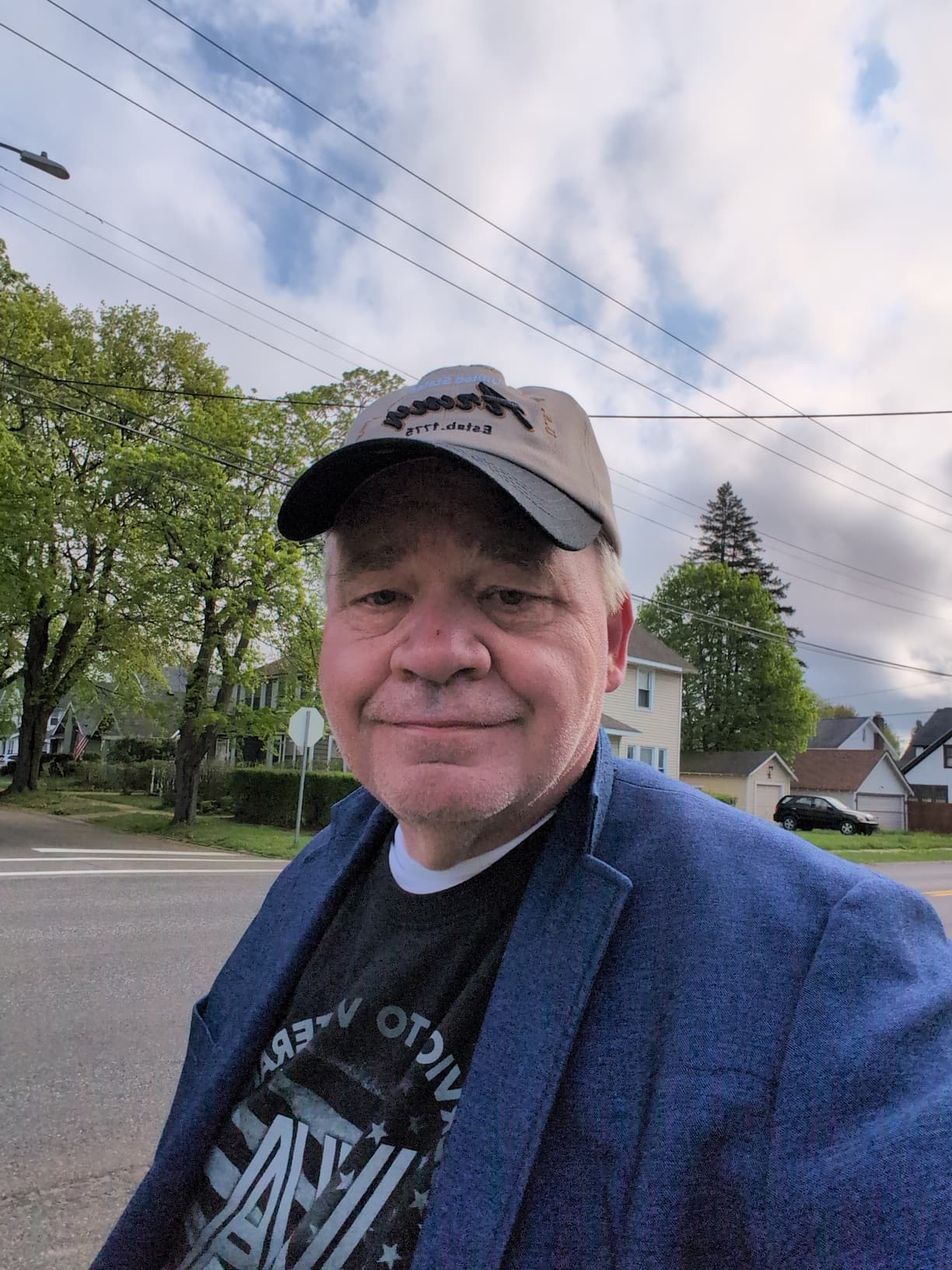
“That was gut wrenching and I thought I let my comrades down. However, because someone tried suicide while I was in the hospital waiting to be sent home, I set my mind on not letting that happen again. Service to others meant everything to me.”
-Gregory Matthew Hitchcock
THE SOLDIER WHO REFUSED TO SURRENDER
Ask any veteran and they will say service never ends with the ending of military service. For Gregory Matthew Hitchcock, this truth became the foundation of an extraordinary second act, one that would transform personal tragedy into a lifelong mission of advocacy, storytelling, and healing.
The U.S. Army gave Greg purpose in serving something larger than himself. But in the sterile corridors of Walter Reed Army Medical Center, that purpose seemed to shatter. The onset of schizophrenia while serving forced his separation under honorable conditions in 1987. The diagnosis felt like betrayal. The discharge felt like failure.
“That was gut wrenching and I thought I let my comrades down,” Greg recalls, the weight of that moment still palpable decades later.
Yet in the darkest hour, purpose found him again. While waiting to be sent home from the hospital, someone attempted suicide. In that moment of witnessing another person’s desperation, Greg made a covenant with himself. He would not let that happen again. Service to others meant everything to him, and if he could not serve in uniform, he would find another way to serve.
This decision, forged in a military hospital room, would become the north star guiding four decades of journalism, advocacy, and creative expression. Greg’s story is not one of overcoming obstacles. It is a story of transformation, of channeling pain into purpose, of turning survival into service.
WHEN THE NATION BLED, A MOTHER BECAME THE HEALER
After his Army discharge in 1987, Greg entered a wilderness few understood. There were not many organizations to help veterans, especially those grappling with mental illness. The infrastructure of support that would emerge post-9/11, when PTSD and anxiety disorders became household terms, did not yet exist. The nation had not yet learned to bleed for its wounded warriors in quite the same way.
In this void stood one person: his mother.
She was a business professor at the local community college, a woman who understood the transformative power of education and the sacred importance of independence. Where the systems failed, maternal wisdom prevailed. She became Greg’s surrogate healer, his advocate, his bridge back to the world.
She influenced his decision to attend college. She encouraged him to seek help from the veteran’s hospital. She supported him as he took the monumental step of securing his own apartment. Each milestone was a small victory against an illness that told him he could not, should not, would not succeed.
“She knew the value of an education,” Greg reflects. “More importantly, she knew the value of independence.”
Her faith became his foundation. Her belief became his possibility.
EDUCATION AS LIBERATION: FINDING VOICE THROUGH WORDS
Greg’s education at Schenectady County Community College from 1987 to 1990 was more than academic achievement. It was reclamation. Each class attended was a declaration: I am more than my diagnosis. Each assignment completed was proof: I can still contribute.
When he transferred to the State University of New York at Albany, the world of literature opened before him like a revelation. He read the world classics, the texts that have shaped human consciousness across centuries. He wrote essays that dissected meaning, that grappled with ideas, that proved his mind was still sharp, still hungry, still capable of profound thought.
In 1992, he received his bachelor of arts degree in English. The diploma represented far more than educational credentials. It was validation. It was vindication. It was the physical evidence that schizophrenia had not stolen his future, only redirected it.
Those essays he wrote at Albany would later serve him well as a journalist. But more than that, they shaped his voice as a writer. They taught him that words could heal, could advocate, could illuminate the shadows where suffering hides.
THE GRAVITATIONAL PULL OF STORIES THAT MATTER
Greg found himself drawn to stories with social impact and resilience. This was not coincidence. This was recognition. In the struggles of others, he saw his own reflection. In their resilience, he found kinship.
“Reporting on these stories impactfully, interviewing those in need, makes me feel that I am not alone with suffering,” Greg explains. “This has healed me and made me a stronger more empathetic writer.”
This is the alchemy of journalism when practiced with purpose. The act of bearing witness to another person’s pain transforms both the storyteller and the subject. Empathy becomes a two-way street. The interviewer seeking to understand finds himself understood.
Greg’s approach to journalism is deeply personal because his mental illness made him intimately acquainted with suffering. But rather than viewing this as limitation, he recognized it as superpower. His lived experience granted him access to emotional territories others could only visit as tourists. He was a native guide through the landscape of struggle.
When he entered the journalism field in the late 1990s, he mostly served as a reporter for newspapers. This was a great time to learn the craft, to master AP style, the guidebook that would shape his professional voice. But Greg was never content to simply report facts. He wanted to create impact, to tell stories that changed minds and moved hearts.
THE EVOLUTION OF A MULTIMEDIA STORYTELLER
As major newspapers began using videos to disseminate news, Greg recognized an opportunity for expansion. He took it upon himself to produce short news stories first for The Ballston Journal’s social media. The medium was new, the format was evolving, but the core mission remained unchanged: tell stories that matter.
Soon it became apparent that he could produce longer documentaries to highlight social problems and solutions. This was storytelling at scale, journalism with depth, advocacy through art.
In 2012, Greg received a $1,000 grant from the Social Justice Center in Albany to highlight the plight of minorities in the Capital Region of New York State. He decided to explore the Haudenosaunee, or Iroquois tribes of upstate New York, examining their history and racism from their perspective. The project pushed him into unfamiliar territory, both literally and creatively. He brought in professional narrators and additional camera operators. He traveled to the reservation at St. Regis near the Canadian border, discovering places and perspectives he had never encountered before.
The documentary became more than journalism. It became cultural preservation, historical correction, a platform for voices too often silenced.
Two years later, in 2014, Greg managed a documentary project for a United Nations Climate Change initiative under the guidance of France and Full Sail University. The project, entitled Climate Change: The Adirondacks, presented environmental issues and potential solutions with the kind of depth and nuance that only documentary filmmaking allows. The work earned an honorable mention from the embassies of France, international recognition that validated his expanding creative vision.
PEGASUS TAKES FLIGHT: BUILDING A LEGACY OF SERVICE
By March 2022, Greg was ready to create something entirely his own. Pegasus Digital Media, operating under Greg Hitchcock Communications, Limited, Inc., became a New York State Service-Disabled Veteran-Owned Business offering editorial services for its clients.
The name carried symbolic weight. In Greek mythology, Pegasus was the winged horse born from adversity, a creature of beauty and power that emerged from tragedy. The metaphor fit perfectly. Greg’s business was born from his own adversity, his own refusal to be grounded by circumstance.
This new entity allowed him to expand his services in ways he had not explored before. More importantly, it gave him the infrastructure to spend more time as a public speaker, author, and advocate for the disabled. The roles fed each other, creating a virtuous cycle of impact.
As a business owner, Greg could choose projects aligned with his values. As an advocate, he could speak truth to power. As a storyteller, he could continue documenting the resilience of the human spirit.
ETHICS AS ANCHORS IN TURBULENT WATERS
Throughout his career covering everything from heroin addiction and poverty to veterans’ issues and mental illness, Greg has maintained unwavering journalism ethics. In an era where boundaries between subject and journalist often blur, where exploitation masquerades as exposure, Greg’s approach stands apart.
“I ask permission before writing anything personally sensitive,” he explains. “If there is anything the subject doesn’t want me to photograph or videotape, I respect their privacy.”
This ethical framework is not mere professional courtesy. It is rooted in his own experience of vulnerability, his understanding of what it means to have your most difficult moments exposed to public scrutiny. He knows what it feels like to be reduced to a diagnosis, to have your complexity flattened into a label.
So he approaches each subject with the dignity he wishes he had always received. He understands that trust is earned, not assumed. He recognizes that the act of sharing one’s story is an act of courage that deserves protection, not exploitation.
STORYTELLING AS THERAPY: THE HEALING POWER OF BEARING WITNESS
For Greg, storytelling is therapy. Like someone writing a personal journal, his journal is the stories of others. By confronting fears, talking with interview subjects, and finally understanding the issues, he maintains his own perspective on his mental illness.
This is the paradox of advocacy journalism. In seeking to heal others through their stories, the journalist himself is healed. In bearing witness to suffering, the witness finds his own suffering contextualized, understood, made meaningful.
Greg’s writing process is not detached observation. It is empathetic immersion. Each interview becomes an opportunity for connection. Each story told is a thread in the larger tapestry of human resilience.
THE AUTHOR AS ARCHITECT OF EMOTIONAL IMPACT
Greg’s books contain emotional impact designed to help others in their struggles. His memoir, Schizophrenia in the Army, tells the story of a soldier who spirals down into madness only to rise above his challenges later in life. It is unflinching autobiography, raw and real, refusing to sanitize the descent or simplify the recovery.
Stories of Stigma: How to Overcome Shame to Live a Healthy Life reflects narratives of others managing social stigma like Greg does. The book becomes a chorus of voices, each adding their testimony to the larger truth: stigma thrives in silence and dies in the light of shared experience.
Even his comic book trilogy, a graphic novella entitled The Spirit, carries autobiographical resonance. The story follows a zombified superhero resurrected as a vengeful spirit, only to return to forgiveness and redemption. It is mythology built from memory, allegory constructed from experience, fantasy that tells deeper truth than realism ever could.
In every medium Greg explores, whether memoir, anthology, or graphic novel, the core themes remain consistent: struggle, stigma, resilience, redemption. These are not abstract concepts for Greg. They are the stations of his own journey, the landmarks he has passed on his path from breakdown to breakthrough.
WISDOM FROM THE MARGINS: THE MENTOR WHO CHANGED EVERYTHING
“Keep on punching until you punch a winner.”
This advice came from an older friend and mentor while both men lived in Catholic Charities housing. Greg was nearing homelessness. The future looked bleak. Hope felt like luxury he could not afford.
But this friendship and mantra had a profound life changing effect. The mentor had schizophrenia too, but his illness had taken him through even darker territories. He had been in and out of mental hospitals, had endured shock treatments, had survived what many would not.
His advice carried the authority of someone who had punched through countless losses before finally landing a winning blow. Never give up until you gain some wins, no matter how bleak it may seem at first.
Greg took that wisdom and made it his creed. He punched through rejection. He punched through setbacks. He punched through the voices that told him he was not enough, would never be enough, could never contribute.
And slowly, punch by punch, the wins started coming.
THE ARTIST’S EYE: DEPICTING A BETTER WORLD
Greg possesses a special talent for drawing, art, and singing, abilities exhibited at an early age and encouraged by his family. His art has been displayed in galleries. His voice rises with the church choir. These creative expressions are not hobbies separate from his journalism and advocacy. They are integral to his vision.
“This talent supports my writing, filmmaking, and advocacy because it lends a medium to develop my vision of what the world should be,” Greg explains. “What I phrase ‘depicting a better world.’”
This concept of depicting a better world is central to understanding Greg’s life work. He is not content to document what is. He insists on illustrating what could be. His journalism exposes problems, but always with an eye toward solutions. His advocacy confronts stigma, but always with the goal of liberation.
The artist’s eye sees beyond current reality to possible futures. The journalist’s discipline documents the path from here to there. Combined, they make Greg a unique force in advocacy media.
BUILDING TOMORROW: LEGACY IN MOTION
Greg’s next book is entitled Learning from Stress: Tips from the Red Line, scheduled for publication in 2026. The title alone reveals his philosophy. Stress is not something to be avoided but something to learn from. The red line is not a boundary to fear but a territory to explore.
In March 2026, Greg will serve as a keynote speaker in Paris for the Euro Global Women’s Leadership Power Conclave Week. He will talk about believing in yourself, a theme that has threaded through his entire history. From that hospital room at Walter Reed to the stages of international conferences, the message remains consistent: belief in self is the foundation of all achievement.
“I hope to build a legacy of helping depict a better world,” Greg reflects, “through believing in yourself and dispelling negativity so we can live better lives.”
This is the vision that drives him forward. Not fame. Not fortune. But the hope that his work might light the path for someone else struggling in darkness, that his story might give permission for someone else to keep fighting, that his example might prove what is possible when service becomes calling.
THE UNENDING MISSION
Service never ends with the ending of military service. Greg Hitchcock proves this truth with every story he tells, every documentary he produces, every speech he delivers, every book he writes.
The young soldier separated from Walter Reed in 1987 could not have imagined the reach his influence would eventually achieve. But the seeds were there even then: the commitment to service, the refusal to give up, the conviction that suffering should lead to purpose rather than despair.
Four decades later, Greg stands as living proof that mental illness does not disqualify you from meaningful contribution. It may redirect your path, but it need not diminish your impact. In fact, when channeled through creativity, advocacy, and storytelling, lived experience with mental illness can become your greatest asset.
Greg’s journey from Army medic to multimedia journalist and advocate demonstrates that resilience is not about bouncing back to who you were before trauma. Resilience is about becoming someone new, someone shaped by adversity but not defined by it, someone who transforms wounds into wisdom and pain into purpose.
The mission continues. Stories still need telling. Stigma still needs confronting. Better worlds still need depicting. And Greg Hitchcock, armed with camera, pen, and unshakeable conviction, marches forward to meet them.
His legacy will not be measured in awards accumulated or positions held. It will be measured in lives touched, perspectives shifted, voices amplified, and hope restored. It will be measured in every person who reads his work or hears his story and thinks: if he can do it, maybe I can too.
That is the ultimate act of service. That is how a soldier continues to serve long after the uniform comes off. That is how one man’s refusal to surrender becomes an entire community’s permission to keep fighting.
Service never ends. For Gregory Matthew Hitchcock, it only transforms.