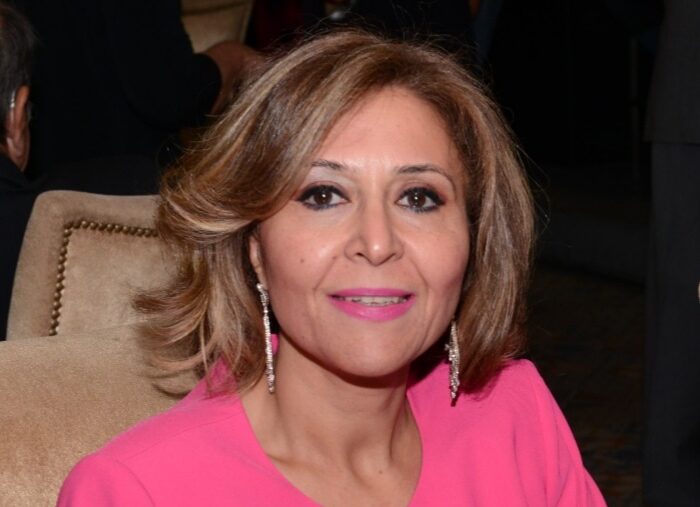
“Education is ultimately about shaping thoughtful, responsible, and interculturally competent individuals who can lead with integrity in an AI-enhanced world.”
–Najwa Saba ‘Ayon Fares
Before she stood in front of university students in Lebanon, before she earned her Doctorate in Education from the University of Sussex, before she became a professor, curriculum reformer, UNESCO Story Circle trainer, and advocate for ethical AI integration in higher education, Najwa Saba ‘Ayon Fares was lining up her dolls and teaching them English. She would explain vocabulary, correct imaginary errors, and picture herself in front of a classroom. What looked like childhood play was, in retrospect, the earliest expression of a vocation she has spent her entire career living out with rigour, warmth, and an ever-deepening conviction about what education is truly for.
A CALLING CONFIRMED BY EXPERIENCE: THE MAKING OF AN EDUCATOR
Najwa’s choice to specialise in English as a Foreign Language was both strategic and sincere. In her context, English was a language of access: to knowledge, to higher education, to global professional opportunity. Graduating from the American University of Beirut gave that choice additional weight and direction. But even as a practical decision, it was one aligned with genuine enjoyment. From the beginning, she was not simply studying the language. She was drawn to what language makes possible.
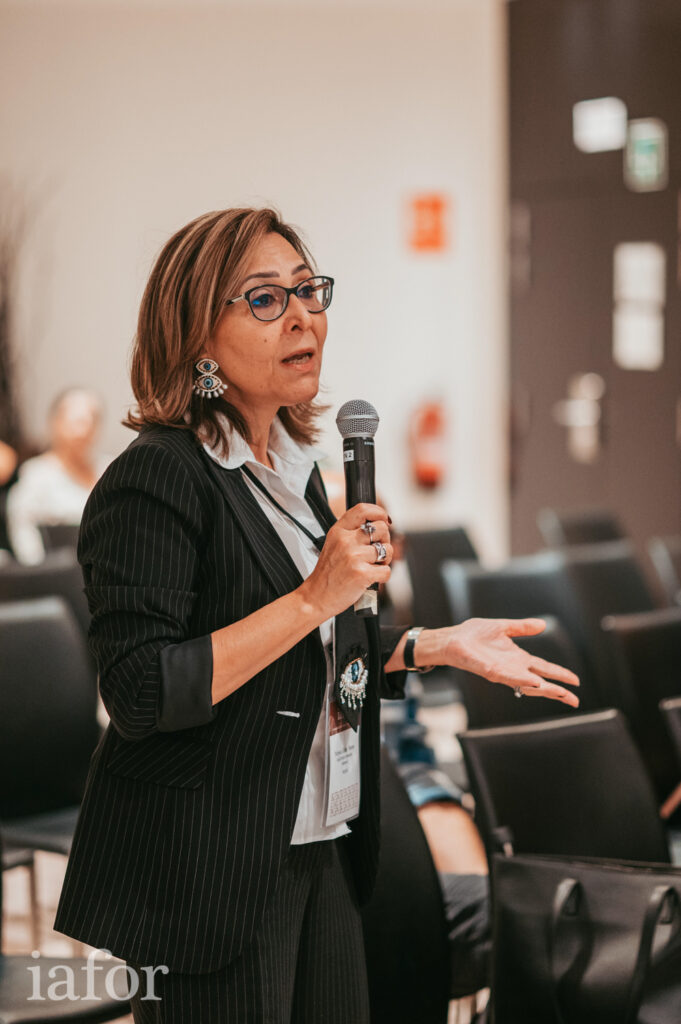
“AI systems reflect the data on which they are trained. Therefore, intercultural awareness becomes even more crucial in AI-mediated learning environments.”
As her career progressed, her understanding of what EFL teaching actually meant expanded significantly. Teaching English, she came to see, was not about delivering grammar rules or building vocabulary in isolation. The language was a medium: for critical thinking, for academic development, for professional preparation, and most compellingly, for intercultural dialogue. That realisation became the intellectual foundation on which everything that followed was built.
THE SUSSEX DOCTORATE: WHERE INTUITION BECAME INQUIRY
Najwa’s Doctorate in Education from the University of Sussex was not simply an academic milestone. It was a transformation in how she understands the nature of knowledge itself. The program shaped her research stance at a fundamental level, moving her toward a socio-constructivist orientation that resonates deeply with how she has always approached the classroom: knowledge is not a fixed entity waiting to be delivered. It is constructed through interaction, context, and interpretation.
Doctoral training gave her the tools to pursue this belief with rigour. She learned research design, thematic analysis, triangulation, and ethical inquiry. She learned how to move from classroom intuition to structured investigation, from noticing a pattern to studying it carefully and grounding a response in evidence. That shift, from reacting to challenges to researching them, was transformative. It did not change who she was as an educator. It gave her the language, the framework, and the methodological confidence to articulate and investigate her beliefs with depth and credibility.
Since completing her doctorate, almost all of Najwa’s research has grown directly from live questions in her teaching practice: motivation, collaborative learning, telecollaboration, plagiarism, intercultural competence, and more recently, the integration of AI. The connection between theory and practice is not aspirational for her. It is structural.
INTERCULTURAL EDUCATION IN A DIGITALLY CONNECTED WORLD
For Najwa, intercultural education is one of the most urgent priorities in contemporary higher education, and its scope has grown considerably in the digital age. Students no longer encounter global perspectives only through travel or physical exchange. They encounter them daily through digital platforms, social media, and AI systems trained on vast and culturally complex datasets. The intercultural dimension of learning has become inescapable, which means the preparation educators provide must be equally comprehensive.
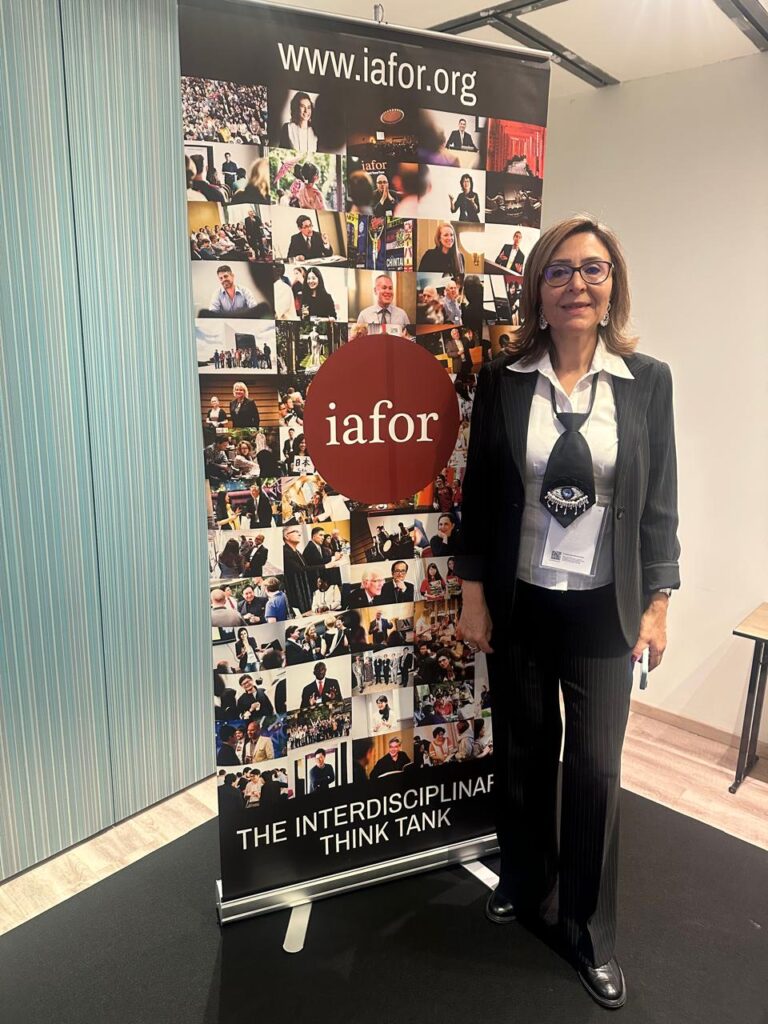
Besides aiming to develop intercultural communicative competence in English communication courses, her Intercultural Communication course at Rafik Hariri University further deepens this understanding through its thoughtful design. Students do not simply study definitions; they develop the knowledge, attitudes, skills, and critical cultural awareness needed to engage meaningfully across cultural boundaries. Through team projects, media analysis, intercultural conflict case studies, and comparative cultural presentations, theoretical concepts are applied to real-life situations. Students learn to critically analyse cultural representations, recognise stereotypes, suspend premature judgement, and propose culturally sensitive responses to complex intercultural contexts.
As a UNESCO Story Circle trainer, Najwa extends this work into a practice of deep listening. Structured storytelling, in her hands, becomes a method for developing empathy, tolerance for difference, and the capacity to engage respectfully with perspectives that challenge one’s own. Her goal is not that students understand intercultural communication as a concept. It is that they embody it.
LEADERSHIP FORGED IN CURRICULUM REFORM
Between 2019 and 2023, Najwa served as Chair and led a comprehensive curriculum reform process that reshaped her understanding of academic leadership. The initiative involved redesigning existing programs, launching a Minor in English Language, and digitalising the institution’s in-house TOEFL assessment. It was complex, multi-stakeholder work, and it reinforced a conviction she carries into every innovation she pursues: meaningful change must be collaborative and evidence-based.
That experience became the template for how she now approaches AI integration. Technology, in her view, is never the point. The point is what technology makes possible when it is introduced thoughtfully, aligned with clear learning outcomes, and evaluated continuously for its actual pedagogical impact. Innovation adopted for its own sake is theatre. Innovation anchored in evidence and purpose is transformation.
AI IN THE CLASSROOM: SCAFFOLD, NOT SUBSTITUTE
Najwa’s approach to AI integration in language learning is one of the most carefully designed in her field, and it reflects her broader philosophy entirely. In her classroom, AI functions as a scaffold rather than a substitute. When students write research proposals, they work through a structured, multi-step process in which AI tools serve as a research assistant, offering feedback that students then evaluate, discuss with peers, and use to make informed decisions. The result is a human-AI-peer-feedback cycle that develops critical thinking, intellectual autonomy, and collaborative discernment.
The question she asks of her students is not whether AI wrote their assignment. She asks how they evaluated the AI output, what they accepted, what they rejected, and why. That shift, from detection to discernment, redefines academic integrity for an era in which AI is a persistent presence. Students do not passively receive AI output. They interrogate it, which is precisely the habit of mind that education at its best has always tried to cultivate.
She has also integrated tools like Careeflow to help students optimise their professional profiles. Students analyse job descriptions, compare AI suggestions with instructor and peer feedback, and refine their materials accordingly. The process prepares them not only for applicant tracking systems but for the broader reality of navigating a professional world in which human judgement and digital tools must work together intelligently.
THE CHALLENGES THAT CANNOT BE AUTOMATED AWAY
Najwa does not approach AI with uncritical enthusiasm, and she is precise about where the risks lie. Overreliance is one concern. Academic integrity is another, one her earlier research on plagiarism explored in depth. Her conclusion from that research, that technology alone cannot ensure ethical behaviour, applies with equal force to AI. Clear policies, consistent expectations, and thoughtful pedagogical redesign are not optional responses to AI in education. They are prerequisites.
She also identifies a deeper challenge: shifting faculty mindset from fear toward informed engagement. Educators need structured frameworks for human-AI collaboration, not uncritical adoption of whatever tools arrive. In her mentorship of colleagues, she focuses not only on methods but on epistemology. What does it mean to co-construct knowledge with an AI system? How does that reshape assessment and feedback? These questions do not have easy answers, but they are the right questions to be asking, and they require sustained, serious conversation.
AI, CULTURE, AND THE RISKS OF UNEXAMINED BIAS
One of Najwa’s most important contributions to the emerging conversation about AI in education is her insistence on the cultural dimension of algorithmic systems. AI reflects the data on which it is trained, and that data carries cultural assumptions, values, and biases, often invisible to users who do not approach it with intercultural awareness. In an educational environment where students are learning to navigate cultural complexity, using AI tools without developing critical AI literacy is not neutral. It is a pedagogical risk.
Her response is to embed ethical AI use directly into curriculum design: teaching students to evaluate AI output for bias, to cite AI contributions transparently, and to apply the same critical cultural awareness they bring to human communication to the digital systems they increasingly work alongside. Intercultural competence, in her vision, is not a complement to AI literacy. The two are inseparable.
LOOKING TO 2030: THE HUMAN DIMENSION MUST REMAIN CENTRAL
When Najwa looks toward 2030, she envisions classrooms where human-AI collaboration is normalised, ethical literacy is embedded across disciplines, and intercultural competence remains foundational to every programme. Technology will continue to evolve at a pace that outstrips most institutions’ capacity to respond deliberately. The educators and leaders who shape that evolution well will be those who hold their ground on what matters most: the relational, reflective, and transformative essence of learning.
Future global learners, she argues, will need intercultural competence, digital literacy, critical AI literacy, ethical reasoning, and the capacity to coordinate human and technological intelligence responsibly. These are not skills that emerge from exposure to tools. They emerge from education designed with deliberate intention, delivered by educators who understand the difference between teaching students to use technology and teaching students to think.
A VOCATION THAT BEGAN WITH DOLLS AND NEVER STOPPED GROWING
There is a thread that runs from a child arranging dolls in a classroom to a professor designing AI-supported research proposal frameworks for university students in Lebanon. That thread is the conviction that education is fundamentally about connection: connecting people to ideas, to each other, and to their own capacity for growth, reflection, and responsible contribution in a complex world.
Najwa Fares has built her career on that conviction, refining it through doctoral research, curriculum leadership, UNESCO training, and the daily work of a classroom that takes both language and culture seriously. As AI reshapes the landscape of higher education, her voice carries a particular kind of authority: not the authority of someone who has simply adapted to change, but of someone who has spent decades thinking carefully about what education is for, and who brings that clarity to every new challenge the profession faces.