
“The challenge was not simply making businesses readable to machines. It was helping machines understand them.”
– Monica Tomasso
With more than twenty years working at the intersection of digital transformation, product, data, and customer strategy, Monica Tomasso is helping businesses solve a problem most do not yet realize they have: the difference between being readable to AI systems and being understood by them.
The insight that became the foundation of Monic AI Systems did not arrive in a strategy session or a research paper. It arrived at the end of a school year, in a quiet observation about Monica Tomasso’s son. He was a strong reader. He could move through text fluently and confidently. But when she asked him what he had just read, he sometimes could not tell her. He could decode the words. He was not always retaining or understanding them.
Monica began building a reading experience where her son could read aloud to an AI agent. When he finished, the agent would talk with him about what he had read: what happened, why a character made a choice, what mattered, and what might happen next. The goal was not to test pronunciation. It was to help him slow down, make connections, recall what he had read, and genuinely understand it.
Somewhere in the middle of building that experience, she saw the same problem in business. There was considerable conversation in the industry about whether AI systems could crawl a company’s website and read the information correctly. But being able to read something is not the same as understanding it. An AI system could crawl an entire website and still not understand what makes that company different, who it is best for, what expertise it holds, or why someone should trust it.
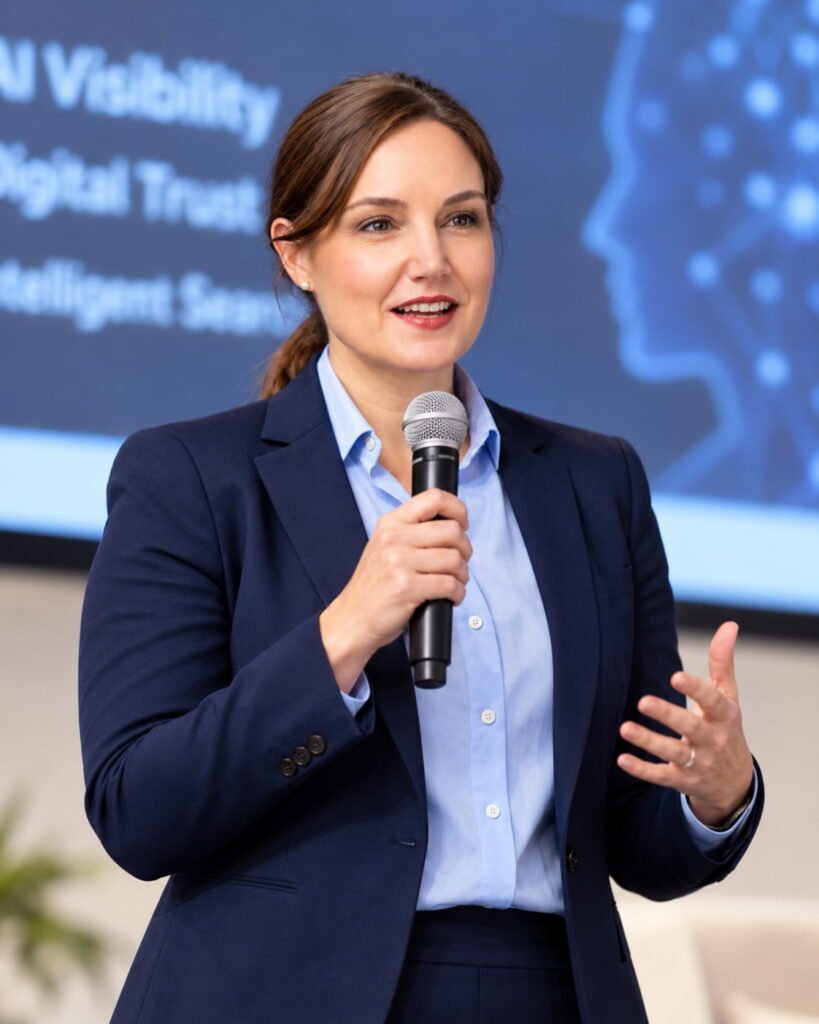
“Many businesses already have their greatest AI visibility asset. They simply have not put enough of it onto the web.”
“The challenge was not simply making businesses readable to machines,” Monica explains. “It was helping machines understand them.” That realization became the founding insight of Monic AI Systems. It took a third grader to surface it.
From Ranking to Recommendation: A Fundamental Shift
Monica describes what is happening in digital discovery as a shift from search as a ranking system to search as a recommendation system. This is not a subtle evolution. It changes the strategic question every business needs to be asking about its digital presence.
Traditional search trained businesses to think in positions: where do I rank? AI discovery introduces a different question: am I part of the answer? In traditional search, a company could appear on page one and allow the buyer to evaluate options. In AI discovery, the system often performs part of that evaluation itself, synthesizing information from websites, reviews, articles, directories, and communities before presenting a response to the user.
The implications are significant. Businesses can no longer focus exclusively on rankings and traffic. They need to ask whether their expertise is clearly represented, whether independent sources corroborate what they say about themselves, and whether AI systems consistently associate the business with the problems it actually solves. The goal shifts from visibility to what Monica calls recommendation readiness.
“In traditional search, a company could rank and let the buyer evaluate. In AI discovery, the system often performs part of that evaluation. The goal is no longer simply visibility. It is recommendation readiness.”
The Four Stages of AI Visibility
Monica thinks about AI visibility as a progression through four stages, each building on the previous. The framework is deceptively simple and practically demanding.
First, a business must be understandable. AI should be able to determine who the company is, what it does, who it serves, and what expertise differentiates it. This sounds basic, but many organizations fail here because their expertise lives inside the company rather than on the web in a form machines can interpret.
Second, the business needs to be verifiable. Claims made on a company’s own website become meaningfully stronger when they are supported by independent sources: media coverage, reviews, professional associations, research, expert mentions, and community conversations. If everything about a company’s expertise comes from its own site, AI systems have fewer independent signals to draw on.
Third comes citability: having useful, accessible information that AI systems can retrieve when answering real buyer questions. And finally, there is recommendability. Being mentioned and being recommended are not the same thing, and the distinction is what separates AI visibility as a metric from AI visibility as a commercial outcome.
“I look at AI visibility as an ecosystem rather than a single metric,” Monica explains. That ecosystem orientation shapes everything about how she approaches strategy with clients.
The Problem of Invisible Expertise
One of the patterns Monica encounters most consistently is the gap between genuine expertise and its digital representation. Organizations with strong reputations and deep knowledge can still have limited AI visibility, and the reason is almost always the same: the expertise exists inside the company, but not in a form the web can easily understand.
A founder may carry twenty years of knowledge in conversations, proposals, presentations, and client relationships. The company website may contain a handful of generic service pages that sound indistinguishable from every competitor. The knowledge is real. Its digital representation is thin. And AI systems can only work with what is actually accessible and legible to them.
There can also be technical barriers, inconsistent information across platforms, weak structural signals, and limited third party corroboration. Monica’s response to this challenge is a phrase she returns to frequently with clients: you need to train the web. Your website matters, but so does the information surrounding your business across the broader digital ecosystem. Helping businesses put their genuine expertise onto the web, in forms that are accessible, structured, and independently corroborated, is central to the work of Monic AI Systems.
“Many businesses already have their greatest AI visibility asset. They simply have not put enough of it onto the web.”
AI Recommendable: Measurement With a Path to Action
Monica’s development of AI Recommendable grew directly from her consulting work and the gap she kept observing between measurement and action. There were increasingly sophisticated tools telling businesses what was happening in their AI visibility. There were very few helping them understand what to do next.
A company could access dashboards measuring AI mentions, citation tracking, traffic monitoring, and technical diagnostics, and still look at all of it and ask what they were actually supposed to do on Monday morning. That was the gap she wanted to close.
AI Recommendable brings together key signals that influence whether a business is likely to be discovered and considered by AI systems: buyer questions, competitive visibility, citations, content gaps, crawler accessibility, third party authority, community signals, and reputation. Critically, it connects those signals to an action plan rather than stopping at a score. Monica did not want to build another dashboard that reported a three point movement in a visibility metric. She wanted a system that could explain why the movement happened, what was holding the business back, and what it should do next. Measurement matters. Measurement without a path to action is just reporting.
The Lessons That Twenty Years of Digital Transformation Taught Her
Monica’s career across digital transformation, product strategy, and technology adoption with organizations including BP, ExxonMobil, and NTT DATA has given her a perspective on AI visibility that goes considerably deeper than tactical optimization. One lesson has persisted across every major technology shift she has navigated: new technology rarely creates value simply because an organization adopts it. The real value comes when people understand what has changed around the technology, including customer behavior, workflows, decision making processes, and measurement frameworks.
AI visibility follows the same pattern. Companies sometimes approach it as though they need a few new pages or another SEO tactic. Monica sees it as a broader transformation in digital discovery, comparable in its implications to the major technology shifts she has observed throughout her career. The organizations that navigate those shifts effectively establish a baseline, understand the changing environment, experiment, measure outcomes, and build repeatable processes around what works.
The Unified Visibility KPI and the Future of Discovery
Looking ahead, Monica is thinking carefully about what she sees as one of the most significant mistakes businesses could make: treating AI visibility as another isolated marketing channel. The buyer journey is becoming increasingly fragmented. Someone might discover a category through social media, ask ChatGPT which companies to consider, validate through Google, read a community discussion, use a different AI model to compare vendors, and then visit a company website. Which channel gets credit for that conversion?
This is the measurement problem businesses are increasingly facing, and it is not a small one. For years, companies have managed digital visibility in separate boxes: SEO, social, PR, paid media, and now AI visibility. Buyers do not experience those channels separately. The next generation of measurement, Monica argues, needs to move toward what she calls a Unified Visibility KPI: a way of understanding how visible, authoritative, and discoverable a business is across the entire modern discovery ecosystem.
AI recommendation visibility would be one component. Traditional search would still matter. So would third party authority, community visibility, branded demand, and citations. The strategic objective shifts from ranking first in one interface to being present wherever the decision is actually being formed.
Her practical guidance to businesses is clear: understand where buyers are actually discovering you, test the questions buyers ask AI systems, identify which competitors appear in those answers, examine which sources influence the responses, make your expertise explicit on the web, build independent corroboration, and then measure the whole system rather than celebrating one isolated metric.
It is a framework that reflects everything Monica Tomasso has built across two decades of working at the intersection of technology, customer behavior, and organizational change. The AI discovery economy is not a new channel to optimize. It is a new way of being found, understood, and trusted. And the businesses that grasp that distinction early, and begin working now to become genuinely understandable to the systems that are increasingly shaping buyer decisions, will be far better positioned for what comes next.