“Build systems that do more than identify problems build systems that prevent them from returning.”
– Urvashi Sinha
FROM FAMILY BUSINESS TO A CAREER BUILT AROUND DATA
For Urvashi Sinha, business strategy was not something she discovered in a classroom; it was something she grew up observing. Raised in a family where business was the primary source of income, she initially assumed that entrepreneurship was simply how everyone made a living. The concept of working for an employer was unfamiliar to her during much of her childhood, but that early environment gave her an instinctive understanding of how businesses operate. Inventory, vendors, sales, contracts, expenses, and customer relationships were not abstract business concepts; they were part of the world she encountered naturally. More importantly, she learned early that data was one of the most reliable tools for making sense of a business. She began looking at information across different areas of the family business, analysing what it meant, identifying patterns, and using it to think about both immediate decisions and longer-term goals. What began organically would eventually become the foundation of her professional identity at the intersection of business analytics, strategy, and operations.

“I want to be someone who can walk into a messy, ambiguous business problem and build the structure underneath it that lets it actually scale.”
That early exposure also shaped the way Urvashi approaches problems today. Rather than viewing departments as isolated functions, she instinctively looks at the business as a connected system. Her career has consequently developed around a simple but powerful principle: understand how the pieces fit together before attempting to optimize one of them. Her work across finance, information systems, analytics, project management, and operations reflects that philosophy. Data, for her, is not simply a collection of numbers; it is a way of understanding how an organization behaves and where its potential is being constrained.
BUILDING A BIRD’S-EYE VIEW OF BUSINESS
Urvashi’s academic journey further strengthened this multidisciplinary perspective. After completing her undergraduate studies in Finance & Accounting and building her own startup, she recognized that operating in an increasingly global business environment required a broader understanding of technology and analytics. Her interactions with professionals across the UAE, UK, USA, and South Africa made her increasingly aware that business practices, communication styles, and operating environments could differ significantly across countries. She understood the financial side of a business through income and expenses, but wanted to go deeper into the analytical and technological systems that determine what data is collected, how it is extracted, and how it can ultimately support strategic decisions. This led her to the United States, where she pursued an MBA in Finance & Information Systems from California State University, Los Angeles.
Her pursuit of knowledge continued as her professional ambitions evolved. In 2025, she began an M.S. in Business Analytics to deepen her understanding of technical analysis. A year later, recognizing that her interests were increasingly aligned with the broader relationship between technology, information systems, and corporate strategy, she transferred into a Doctorate in Information Technology program in Fall 2026. This combination of business, finance, analytics, information systems, and technology has given Urvashi what she describes as both a bird’s-eye and focused view of organizations. It enables her to understand not only the specific function she has been assigned to, but also how that function affects the broader business. That perspective has helped her engage with strategic conversations early in her professional career.
MAKING SENSE OF 40,000+ CASES
Her role as Project Manager at The Law Offices of Jacob Emrani has placed that analytical philosophy into an exceptionally complex operational environment. Working with data associated with more than 40,000 cases, Urvashi encountered a challenge that is common in large organizations but rarely visible from the outside: having enormous quantities of information does not necessarily mean having usable data. When she began a focused analysis of the firm’s cases approximately two years ago, she was dealing with nearly 41,000 unique projects within the CRM, much of which contained missing, inconsistent, or incorrect information. Instead of treating the scale of the problem as a reason to step back, she approached it as the kind of operational challenge she enjoys most finding the hiccups, understanding why they exist, and working toward making them right.

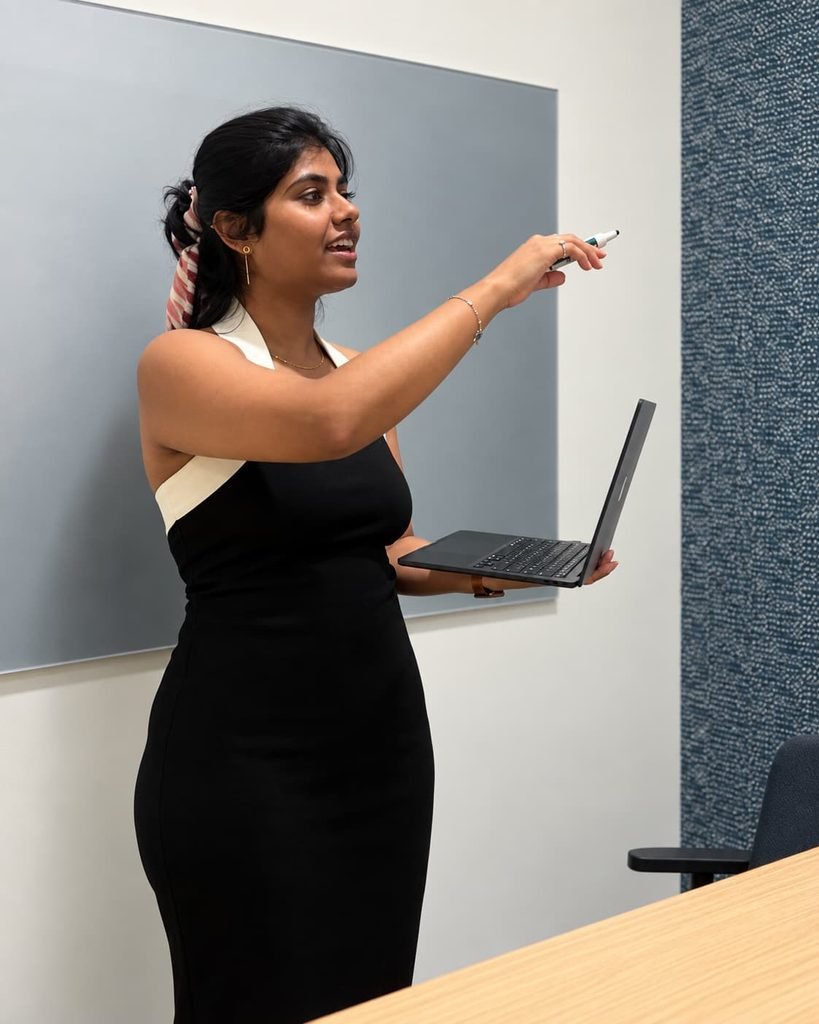
The experience fundamentally reinforced her belief that data and operations are only as effective as the people and standard operating procedures supporting them. A sophisticated system cannot compensate for inconsistent processes, unclear ownership, or poor data practices. Just as importantly, Urvashi learned that analytical expertise must be accompanied by communication discipline. When presenting insights to leadership, technical complexity can easily become a barrier rather than an advantage. Her approach is therefore to simplify the message, focus on what matters, and translate complex analysis into information that decision-makers can immediately understand and act upon. In her world, the value of data is ultimately measured by what it enables people to do.
BUILDING KPIs THAT ACTUALLY MATTER
Urvashi considers KPIs fundamental to effective leadership because they provide organizations with visibility into performance and reveal where attention is required. At her current firm, she built the organization’s first KPI dashboard, fundamentally changing how management could view and work with operational data. Yet the experience also taught her that dashboard development can quickly become overwhelming. Organizations have enormous amounts of information, while only a fraction of that information is genuinely useful. Different departments naturally have different priorities, and every stakeholder can believe that their preferred metric deserves a place on the final dashboard.
Her solution is deceptively simple: keep asking why. Why is this metric important? What decision will it support? Does it identify a real problem? Will monitoring it help remove a bottleneck, improve performance, or support scalability? Or is it present simply because someone wants to see it? This willingness to question assumptions has become an important part of Urvashi’s approach to analytics. She does not see a KPI dashboard as a display of impressive numbers. Its purpose is to reveal what requires attention and provide leadership with a clearer path toward action. For her, the dashboard is successful only when it helps the organization find problems and solve them.
“Keep asking why.”
AUTOMATING THE WORK BEHIND THE INSIGHT
One of Urvashi’s strongest operational principles is that organizations should not spend valuable analytical time performing work that technology can reliably automate. She recalls a recurring reporting process that consumed hours every week because information had to be collected from different systems, reconciled manually, and prepared before the actual analysis could even begin. By mapping the process from beginning to end, she discovered that the real bottleneck was not analytical interpretation but the manual groundwork preceding it. Automating that foundation changed the nature of the conversation. Instead of spending time asking whether the numbers were accurate, teams could begin asking what the numbers actually meant and what should be done next.
This philosophy has extended into her work on CRM migration, Power BI dashboards, and automation pipelines. For Urvashi, these are not separate technology projects. A dashboard is only as useful as the data pipeline feeding it, while the pipeline is only effective if the underlying operational process has been properly understood. Her focus is therefore not simply on identifying inefficiencies but on creating systems capable of preventing the same inefficiencies from returning. This distinction captures an important aspect of her strategy-and-operations mindset: optimization is not about fixing a problem once; it is about designing a stronger system around it.
DATA MUST SERVE THE BUSINESS
Despite her technical background, Urvashi does not believe that sophisticated analytics should ever become an objective in itself. Before building a dashboard, analysis, or automated workflow, she begins by asking what decision the work is supposed to support and who ultimately needs the answer. This keeps her work connected to the business rather than allowing technical capability to drive unnecessary complexity. A technically impressive solution has little value if the people responsible for acting on it do not need it or cannot use it.
Maintaining that alignment requires continuous engagement with the people closest to the business objectives. Leadership, department heads, and in her current environment—the attorneys managing cases each have different priorities and operational realities. Those priorities can change, meaning analytical systems must evolve alongside them. Urvashi therefore treats alignment as an ongoing process rather than a one-time discussion. Data remains useful only when it continues answering the questions the organization actually needs answered.
THE HUMAN SIDE OF PROCESS OPTIMIZATION
Technology can identify where a process is failing, but Urvashi believes it cannot always explain why the problem exists. A bottleneck may appear clearly in the data, yet the reason employees have developed workarounds or avoided a particular process may only become apparent through conversation. This is why she approaches operational improvement by combining analytical evidence with human understanding. Data provides the map; the people working within the process provide the context required to understand the terrain.
Her experience has taught her that even a technically perfect process can fail if the people expected to use it do not understand or trust it. Sometimes the answer is a new system or automation; sometimes the underlying issue is simply that an SOP no longer reflects how work is actually performed. The most effective operational improvements therefore require both technical discipline and empathy. Urvashi’s role sits precisely at that intersection, translating information into process improvements while ensuring that those improvements remain practical for the people responsible for executing them.
AI AND THE NEXT GENERATION OF DECISION SUPPORT
For Urvashi, one of the greatest opportunities presented by Generative AI and automation is not replacing analytical thinking but eliminating the manual work that prevents analysts from reaching meaningful insight quickly. Data cleaning, reconciliation, reporting preparation, and other repetitive activities can consume enormous amounts of professional time. Automating those stages creates space for the work that matters more: interpretation, strategic thinking, forecasting, and decision support.
She sees the next stage of business intelligence moving beyond retrospective reporting toward proactive intervention. Instead of simply showing that a metric has declined, intelligent systems could identify anomalies worth investigating or forecast where a bottleneck is likely to emerge. Reporting could become less about explaining yesterday and more about preparing leadership for tomorrow. Yet Urvashi also recognizes that technology must be introduced with discipline. Human judgment remains essential because automated systems can identify patterns without necessarily understanding the business context behind them. The future she envisions is therefore not technology replacing people, but technology giving people better information sooner.
LEADERSHIP THROUGH CURIOSITY, COMMUNICATION, AND GRIT
When asked what capabilities modern Strategy & Operations professionals need, Urvashi points first to a quality that is sometimes overlooked in technically focused environments: curiosity. Her instinct is to keep asking why rather than accepting an existing process simply because it has always been done that way. Alongside curiosity, she values the ability to move comfortably between technical systems and human relationships. Professionals need enough technical fluency to understand data and build systems, but enough interpersonal awareness to recognize when the numbers are not telling the entire story.
Communication is equally important. A sophisticated dashboard has little value if its creator cannot explain its significance to someone who does not work with data every day. Urvashi’s approach is to translate complexity into clarity, ensuring that insights remain accessible to decision-makers. Adaptability completes the picture. As technologies, business questions, and operating environments continue to change, professionals must be willing to learn, pivot, and abandon methods that no longer serve the organization. Her own career reflects that mindset, from finance and accounting to information systems, analytics, operations, and technology.
REDEFINING WHAT IT MEANS TO BE A WOMAN IN DATA-DRIVEN LEADERSHIP
Urvashi’s perspective on women’s leadership is rooted less in overcoming a single defining barrier and more in developing an uncompromising sense of capability. She says she has not personally experienced obvious gender bias in her workplaces, but believes that understanding human behavior and recognizing the strengths, knowledge, and temperament of different people has helped her lead effectively. Her confidence has been reinforced by a lifelong expectation that problems should be approached with a solution-oriented mindset. Growing up, she learned that “I don’t know” should not be the end of the conversation; instead, the response should be, “I’ll figure it out.”
Her father, whom she considers her first mentor, is a visionary entrepreneur who emphasized leadership qualities rather than gender. His expectation was clarity, capability, and responsibility, and he regarded her as “a leader in the making.” That philosophy continues to influence how she approaches her career. Her advice to women aspiring to leadership is direct: develop a strong sense of self, understand the business deeply, and become exceptionally good at what you do. For Urvashi, confidence is strengthened when it is supported by competence, preparation, and a willingness to keep learning.
“I’ll figure it out.”
ENTERTAINMENT, ANALYTICS, AND THE BUSINESS OF STORIES
Beyond her current work, Urvashi is increasingly drawn toward media and entertainment, an industry she has long admired and has come to appreciate from a business perspective. Coming from India, she recognizes the extraordinary reach of the entertainment industry and its ability to influence audiences at scale. Her interest is particularly focused on what happens behind the story the strategy, distribution, analytics, operations, and commercial decisions that determine how far a piece of content ultimately travels.
Her interest has already moved beyond observation. She has participated in the production of an independent film, gaining exposure to the process of creating a movie from the ground up. For her, this experience reinforced an important realization: entertainment produces more than a conventional product; it produces stories, and the reach and commercial impact of those stories are influenced heavily by analytics and strategic distribution. This is where she sees an opportunity to apply her expertise in data, operational strategy, and process optimization to an industry she genuinely cares about.
BUILDING THE SYSTEMS THAT ENABLE GROWTH
Looking toward 2026 and beyond, Urvashi sees business strategy and operations moving from retrospective reporting toward proactive decision-making. Instead of waiting for leaders to ask why a metric dropped or why a case remained untouched for months, she envisions systems capable of identifying emerging problems before they require human intervention. Dashboards, automated workflows, predictive analysis, and intelligent decision-support systems can provide leadership with a head start rather than a postmortem. Ultimately, however, Urvashi does not want to be remembered for a single dashboard, automation pipeline, or process improvement. She wants to be known as the person who can enter a complex and ambiguous business environment, understand what is happening beneath the surface, and build the data, systems, processes, and strategy required to help it scale. Her ambition is to operate at the intersection where numbers meet narrative, technology meets people, and strategy becomes execution. With her sights increasingly set on media and entertainment, her journey continues to evolve around a central idea: turn complexity into clarity, and clarity into scalable action.